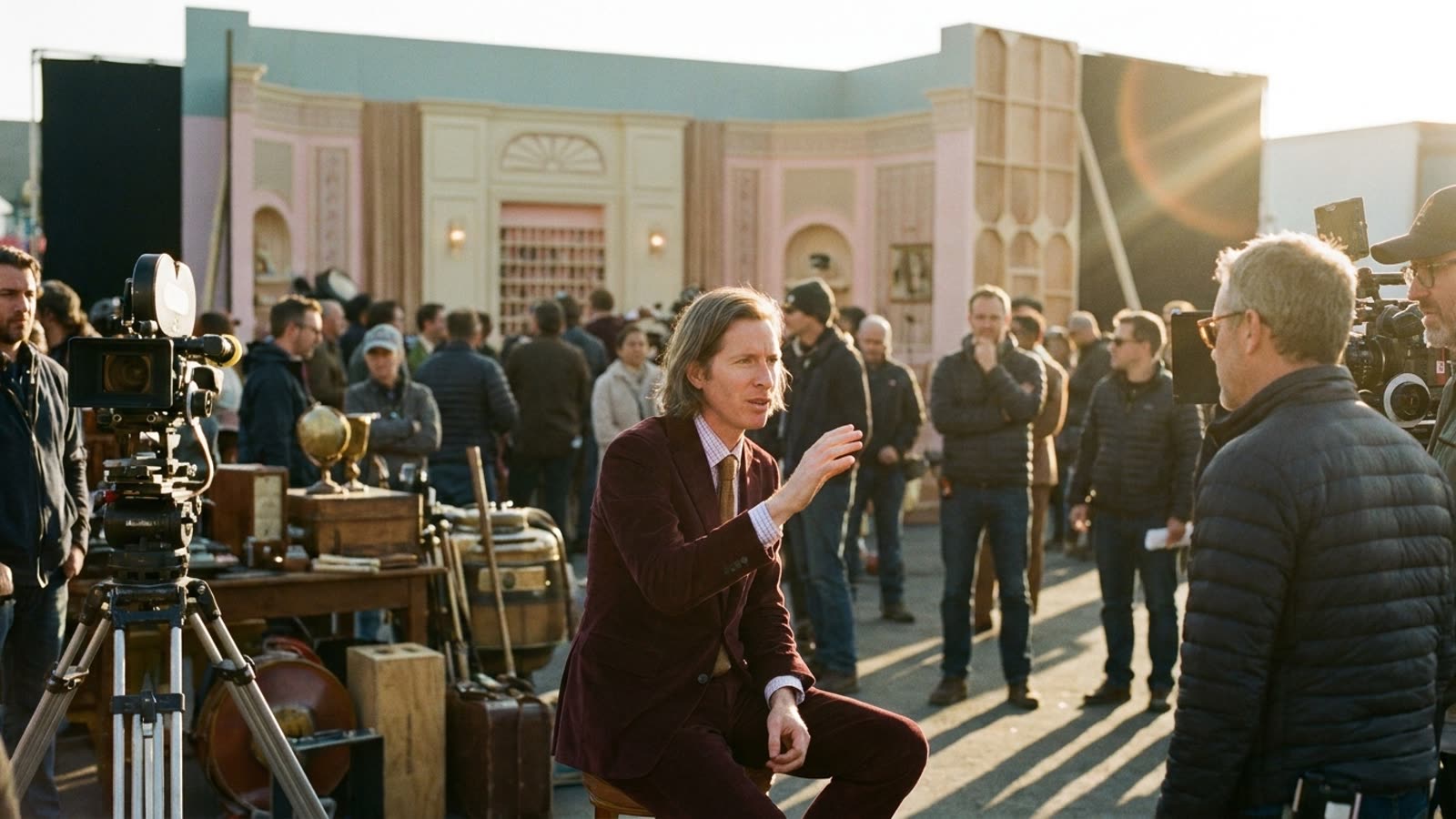
There is a particular shade of pink—dusty, faintly melancholic, suggesting both birthday cake and decay—that now belongs to Wes Anderson. The director did not invent it, of course, but he colonized it so thoroughly that encountering it in the wild triggers immediate recognition: the centered framing, the deadpan delivery, the sense that every object has been placed with the precision of a museum curator suffering from obsessive-compulsive disorder and a subscription to Architectural Digest.
What began as the idiosyncratic vision of a Texan filmmaker obsessed with Salinger and Truffaut has become something far stranger: a global aesthetic movement. Hotels advertise "Anderson-esque" suites. Cafés arrange their pastries in symmetrical grids. TikTok accounts amass millions of followers by filming mundane locations—laundromats, gas stations, suburban kitchens—through the Anderson lens. The man's visual grammar has escaped the cinema entirely.
The architecture of whimsy
Anderson's style crystallized gradually. Bottle Rocket showed flashes; Rushmore established the deadpan; The Royal Tenenbaums introduced the color palette that would define everything after. By The Grand Budapest Hotel, the formula had achieved something like perfection: every frame a diorama, every character a wounded eccentric delivered in flat affect, every tracking shot a lateral glide through meticulously constructed worlds.
The technique is deceptively simple. Center your subject. Flatten the depth. Restrict your palette. Move the camera only on perpendicular axes. Dress your actors like they wandered out of a 1960s children's book. The cumulative effect is of reality rendered as a particularly melancholy dollhouse—life observed through glass, beautiful and unreachable.
From auteur signature to commercial vernacular
The strange second act of Anderson's influence has been its absorption into marketing. Luxury brands discovered that his aesthetic—nostalgic, handcrafted, vaguely European—translated remarkably well to selling expensive things to people who consider themselves discerning. Prada hired him for short films. Hotels from Tokyo to Marrakech redesigned lobbies to photograph well in that particular register.
The democratization came through social media. Suddenly anyone with a smartphone could apply the Anderson treatment to their surroundings. Accounts dedicated to "Accidentally Wes Anderson" locations accumulated followers by the million. The aesthetic became detached from its creator, a free-floating signifier of curated taste and gentle irony.
The criticism and the staying power
Detractors have long accused Anderson of prioritizing style over substance, of building elaborate confections that collapse under scrutiny. The charge has merit and misses the point simultaneously. His films are explicitly about surfaces—about the elaborate performances people construct to survive grief, loneliness, and the indignity of being alive. The artifice is the argument.
What his imitators often miss is the sadness underneath. Strip away the color theory and the centered compositions, and Anderson's films are studies in loss: dead fathers, failed families, the impossibility of returning to childhood. The aesthetic without the melancholy becomes mere decoration—pleasant, shareable, empty.
Our take
Anderson built something genuinely rare: a visual language so coherent it functions as its own adjective. That this language has been commodified, diluted, and reduced to an Instagram filter is neither his fault nor entirely a loss. The best imitations still carry a trace of his sensibility—the understanding that beauty and sadness are not opposites but collaborators. In an era of algorithmic homogeneity, the persistence of his influence suggests a hunger for something handmade, even if the handmade is now mass-produced. The dollhouse endures because we still want to press our faces against its windows.