Stan Wawrinka was never supposed to be a Grand Slam champion, let alone a three-time major winner. He was supposed to be the other Swiss, the talented contemporary who made quarterfinals and collected respectable prize money while Roger Federer accumulated trophies and mythology. Instead, Wawrinka became something rarer and arguably more impressive: a player who beat the best players in history on the biggest stages when they were at their absolute best.
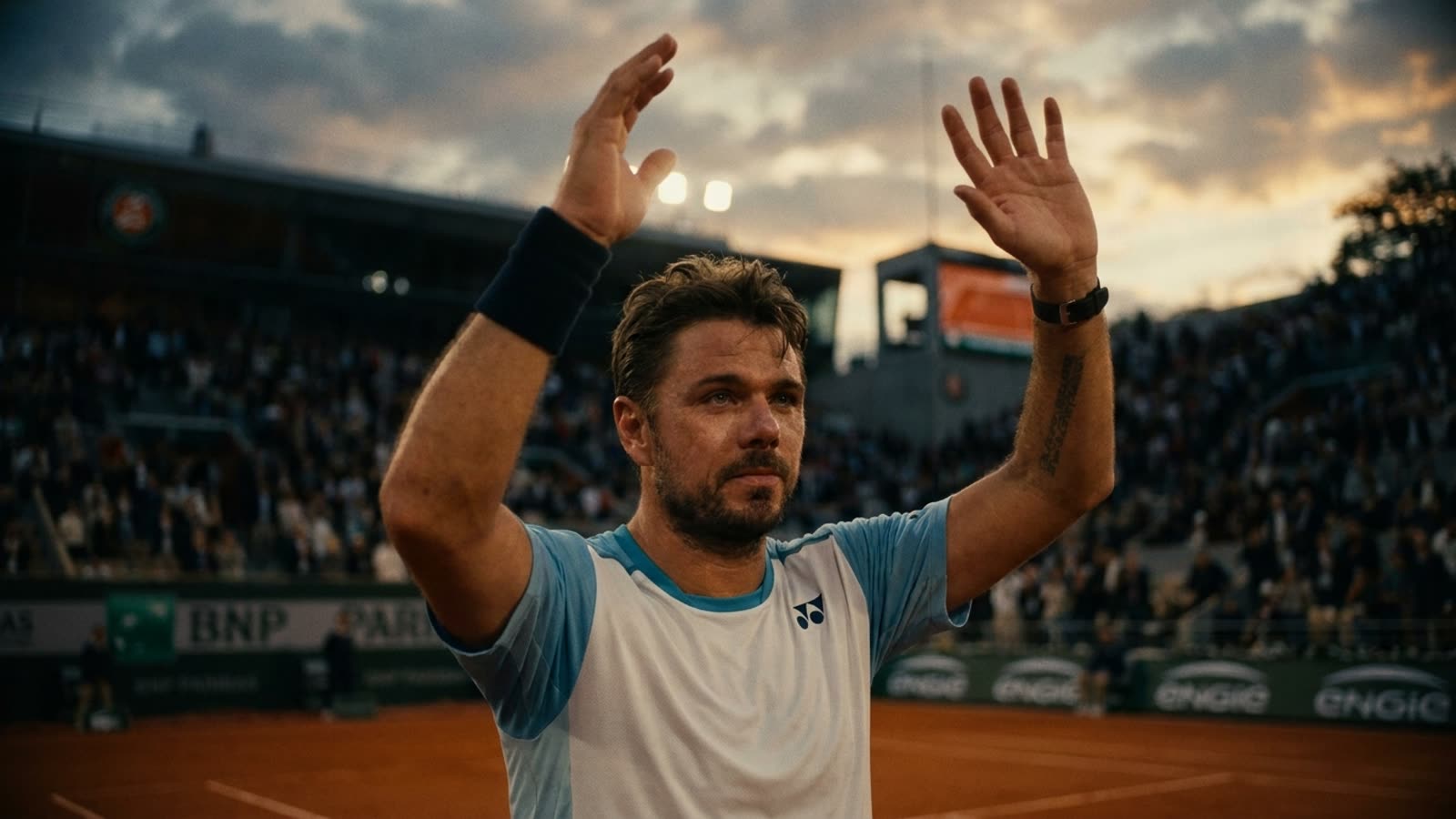
His final walk off Court Philippe-Chatrier on Sunday—a first-round defeat that surprised no one given his ranking and recent form—closes a career that defied every reasonable expectation. At 41, with a surgically repaired knee and a body that long ago stopped cooperating with his ambitions, Wawrinka has earned the right to stop fighting.
The anti-dynasty dynasty
Wawrinka's three major titles—the 2014 Australian Open, 2015 French Open, and 2016 US Open—share a remarkable through-line: he won each by defeating either Novak Djokovic or Rafael Nadal in the final. Not by catching them on off days, but by overwhelming them with the kind of incandescent shotmaking that no defensive strategy could contain.
The 2015 French Open final remains perhaps the most aesthetically violent performance in modern tennis history. Wawrinka's one-handed backhand, struck with a violence that seemed to personally offend the ball, dismantled Djokovic in four sets. The Serb, who would complete his career Grand Slam the following year, had no answer. Nobody did when Wawrinka played like that.
The problem, of course, was that Wawrinka couldn't always play like that. His career record against the Big Three was decidedly negative. He was streaky, inconsistent, prone to inexplicable early-round losses. But when the stakes were highest and his game clicked into that rare gear, he was unplayable.
A body that refused to cooperate
The knee surgery in 2017 effectively ended Wawrinka's time as a genuine contender. He spent years grinding through the lower reaches of the draw, occasionally threatening a deep run before his reconstructed joint reminded him of its limitations. That he continued playing at all spoke to either admirable determination or stubborn denial, depending on your perspective.
Roland-Garros was the appropriate venue for his farewell. The red clay of Paris witnessed his most complete performance, and the French crowd—always appreciative of shotmaking artistry over grinding efficiency—gave him the sendoff the occasion demanded. The result was irrelevant. The ceremony was the point.
Our take
Wawrinka's career is a useful corrective to the narrative that the Big Three era left no room for anyone else. Federer, Nadal, and Djokovic dominated tennis so thoroughly that their contemporaries have been largely forgotten, reduced to historical footnotes who existed primarily to lose in semifinals. Wawrinka refused that role. He proved that you didn't need to be the best player in the world to win the tournaments that mattered most—you just needed to be the best player for two weeks, three times. In an era defined by superhuman consistency, he offered something more human: brilliance that arrived unpredictably and departed just as suddenly, leaving behind three trophies that the sport's immortals would have preferred to keep for themselves.