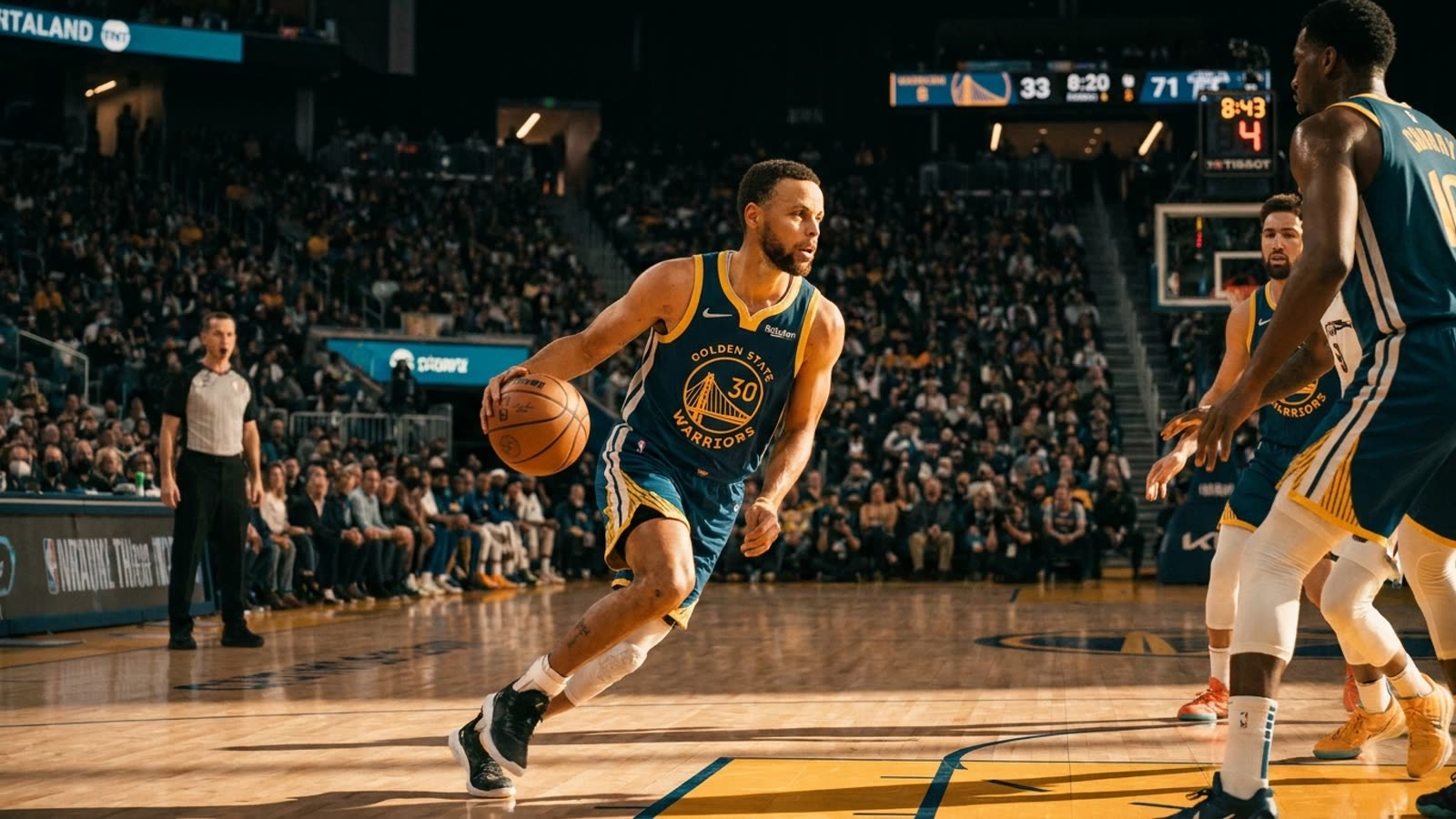
The Lakers led by 25 points in the third quarter on Sunday night, and anyone who has watched Stephen Curry for the past decade knew exactly what that meant: nothing at all.
Curry's 31-point performance in Golden State's 112-95 demolition of Los Angeles wasn't merely statistical excellence — it was a referendum on the durability of basketball genius. The signature moment came midway through the fourth quarter when Curry crossed over Luka Dončić so violently that the Slovenian's ankles seemed to file for divorce from each other. The bucket that followed was almost beside the point. The message had already been delivered.
The architecture of a collapse
Los Angeles's 25-point lead evaporated in roughly 18 minutes of game time, a span during which the Lakers managed just 22 points while the Warriors poured in 47. The defensive intensity that Golden State summoned after halftime would have been impressive from any team; from a squad that many had written off as a nostalgia act, it bordered on the supernatural.
What made the collapse particularly instructive was its familiarity. The Lakers have now blown double-digit leads in three of their last seven games, a pattern that speaks to something deeper than bad luck. Their offense, built around individual brilliance rather than systemic coherence, tends to stagnate precisely when opponents raise their defensive effort. Golden State, by contrast, moves the ball with the muscle memory of a team that has won four championships this decade.
Curry's impossible longevity
At 38, Curry is playing some of the most efficient basketball of his career. His shooting percentages remain elite, his court vision has arguably sharpened with age, and his conditioning — always underrated — allows him to explode in fourth quarters when younger players are gasping. Sunday's performance included 14 points in the final period, each one arriving at maximum psychological damage.
The ankle-breaker on Dončić will circulate on social media for days, but the more telling plays were the subtle ones: the off-ball screens that freed Kuminga, the defensive rotations that disrupted LeBron James's driving lanes, the timeout huddles where Curry's body language radiated absolute certainty. Leadership, it turns out, doesn't require volume.
What it means for both franchises
For Golden State, this victory is less about playoff positioning than identity preservation. The Warriors remain a team that can humiliate anyone on any given night, even as their roster lacks the depth of their championship years. For the Lakers, the questions are more uncomfortable. Their defensive inconsistency and fourth-quarter fragility suggest structural problems that no single trade can solve.
Our take
Stephen Curry has been so good for so long that we've grown numb to his brilliance. Sunday was a useful corrective. Watching him dismantle a 25-point deficit with the calm of a man who has done this dozens of times before was a reminder that some athletes transcend the normal arc of decline. The Warriors may not win another championship, but as long as Curry is crossing over All-Stars and draining contested threes in crunch time, they remain appointment television. The Lakers, meanwhile, should be asking themselves a harder question: if you can't hold a 25-point lead against a 38-year-old, what exactly is the plan?