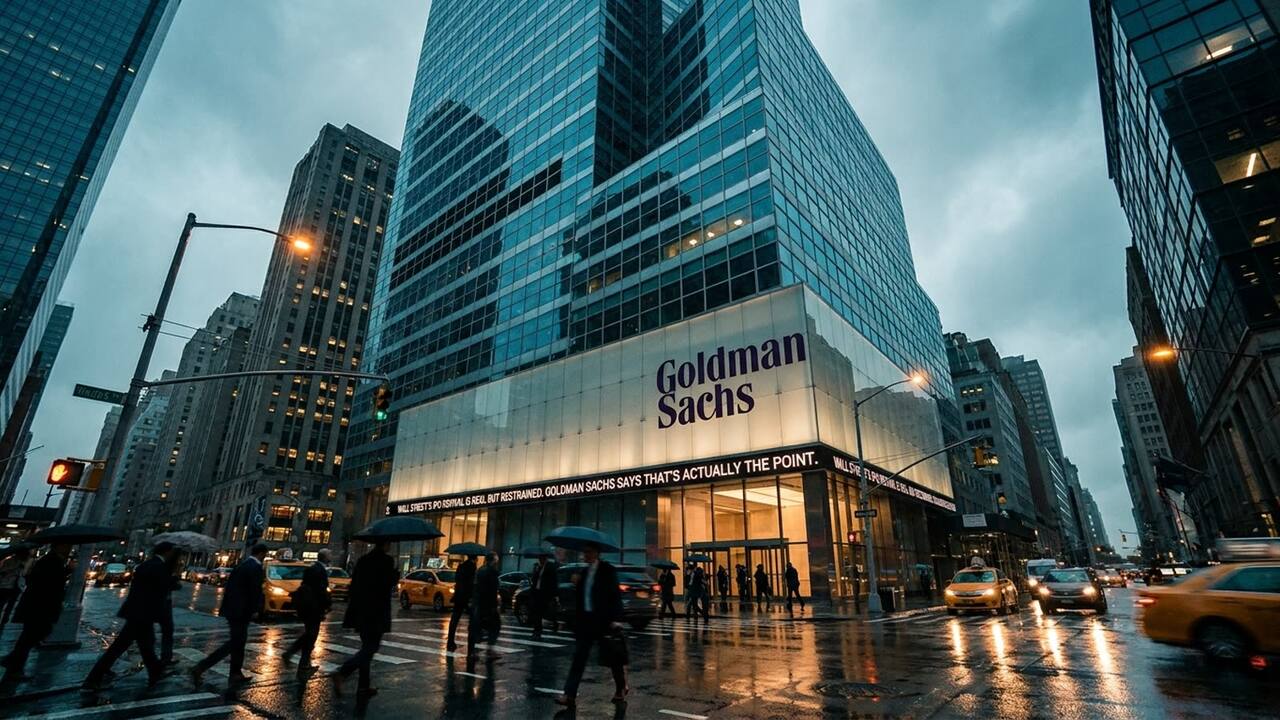
The initial public offering market is unmistakably back. After a brutal 2022-2024 drought that saw annual IPO proceeds crater to levels not seen since the financial crisis, 2025 and early 2026 have delivered a genuine resurgence. Tech unicorns are finally listing, private equity firms are exiting their portfolio companies, and investment banking fees are recovering. But according to Goldman Sachs, anyone expecting a return to the late-1990s carnival atmosphere should temper their enthusiasm—and that's probably a good thing.
Goldman's equity capital markets team has been tracking what they call the "euphoria gap": the distance between current IPO valuations and the frothy multiples that characterized the dot-com peak. By their metrics, today's newly public companies are trading at roughly 60 percent of the revenue multiples that prevailed in 1999-2000. First-day pops, while healthy, average around 15 percent rather than the 65 percent that defined the bubble era. Retail participation, though elevated, remains a fraction of the day-trading mania that once saw dentists quitting their practices to flip IPO allocations.
The quality filter is working
What's changed is the composition of companies reaching public markets. The pandemic-era SPAC boom served as a cautionary tale, flooding exchanges with unprofitable ventures that subsequently collapsed. Underwriters, chastened by the reputational damage and legal exposure, have grown considerably more selective. The median company going public in 2026 shows positive EBITDA, a meaningful departure from the "growth at any cost" cohort that dominated 2020-2021.
This selectivity creates a virtuous cycle. Institutional investors, burned by the SPAC debacle, are more willing to participate in offerings when they trust the gatekeepers. Better-quality offerings attract stronger demand, which in turn encourages more quality companies to list rather than remain private indefinitely. The flywheel, for now, appears to be spinning in the right direction.
Private markets are still the pressure valve
The IPO revival doesn't mean private markets have lost their appeal. Venture-backed companies can still access substantial late-stage capital without the disclosure requirements and quarterly scrutiny of public life. But the calculus is shifting. Private valuations have compressed meaningfully from their 2021 peaks, narrowing the gap with public market multiples. For founders and early investors seeking liquidity, the public markets are no longer the inferior option they seemed two years ago.
Goldman notes that the pipeline of companies confidentially filing for IPOs is the healthiest since 2021, spanning fintech, enterprise software, healthcare, and consumer brands. The question is whether market conditions—particularly interest rates and geopolitical uncertainty—will cooperate long enough for these filings to convert into actual offerings.
Our take
The absence of euphoria is itself the bullish signal. IPO markets function best when they serve their original purpose: connecting companies that need growth capital with investors seeking equity exposure, at prices that reflect reasonable expectations rather than lottery-ticket fantasies. Goldman's analysis suggests we're closer to that equilibrium than we've been in years. The dot-com comparison is inevitable but misleading—that era ended in tears precisely because it was euphoric. A sustainable IPO market should feel slightly boring. By that measure, Wall Street might finally be getting it right.