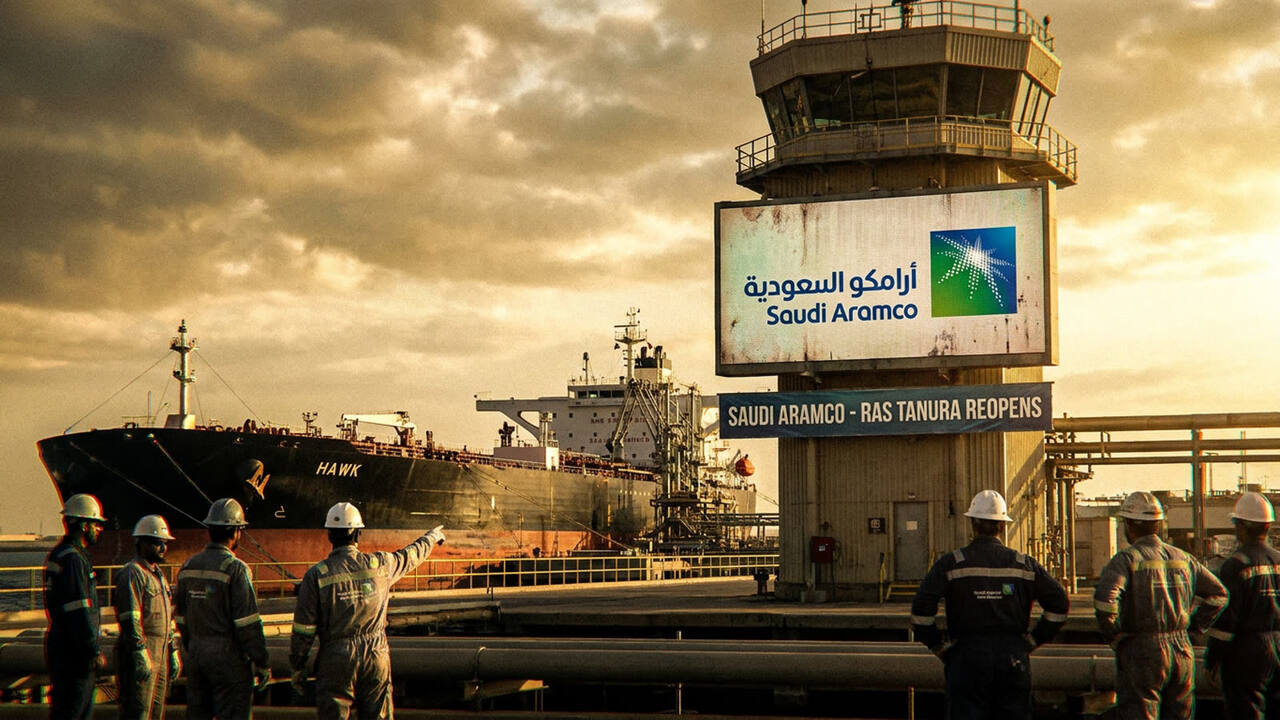
The most consequential oil infrastructure on Earth is pumping again, and crude prices are responding accordingly.
Saudi Aramco has resumed oil loading operations at Ras Tanura, its flagship export terminal on the Persian Gulf coast, following a disruption that had sent energy markets into a brief but intense spasm of anxiety. Brent crude dropped roughly two percent on the news, unwinding gains that had accumulated as traders priced in the possibility of a prolonged supply interruption from the kingdom that still functions as the global oil market's central banker.
Ras Tanura is not merely large; it is singular. The facility can handle more than six million barrels per day, making it the largest crude oil loading terminal in the world. When it goes offline—for any reason—the arithmetic of global supply changes immediately. The past week offered a reminder of just how fragile that arithmetic remains.
The geography of chokepoints
The resumption comes against a backdrop of persistent tension in the Strait of Hormuz, the narrow waterway through which roughly a fifth of the world's oil consumption passes daily. Even as Aramco restarted Ras Tanura, reports emerged of a cargo vessel struck near Oman, a reminder that the region's shipping lanes remain contested territory.
For energy strategists, this is the permanent condition of the oil market: a system of extraordinary efficiency built atop extraordinary vulnerability. The Persian Gulf's export infrastructure represents decades of accumulated investment and engineering prowess, yet it remains hostage to geography. The Strait of Hormuz is barely twenty-one miles wide at its narrowest point. Every tanker that transits it does so within range of multiple state and non-state actors who have demonstrated both the capability and the willingness to disrupt maritime traffic.
What the price action reveals
The two-percent decline in crude prices following the Ras Tanura news tells a particular story about market expectations. Traders had evidently begun to price in a more extended disruption—not a catastrophic one, but enough to tighten an already balanced market. The swift resumption deflated that premium almost instantly.
This is the oil market's version of a stress test, and it revealed both resilience and fragility. Resilience, because Saudi Aramco demonstrated it could restore operations quickly. Fragility, because the initial price spike showed how little slack exists in global supply. The era of comfortable spare capacity is over. When the world's largest exporter sneezes, the market still catches a fever.
Our take
The Ras Tanura episode is a useful corrective for anyone who believed the energy transition had rendered oil geopolitics obsolete. It has not. The world still runs on hydrocarbons, and those hydrocarbons still flow through a remarkably small number of physical chokepoints controlled by a remarkably small number of actors. Saudi Aramco's ability to restart operations quickly is reassuring; the fact that its temporary pause moved global markets is not. The infrastructure of the old energy order remains as strategically significant as ever, even as the new one slowly takes shape.