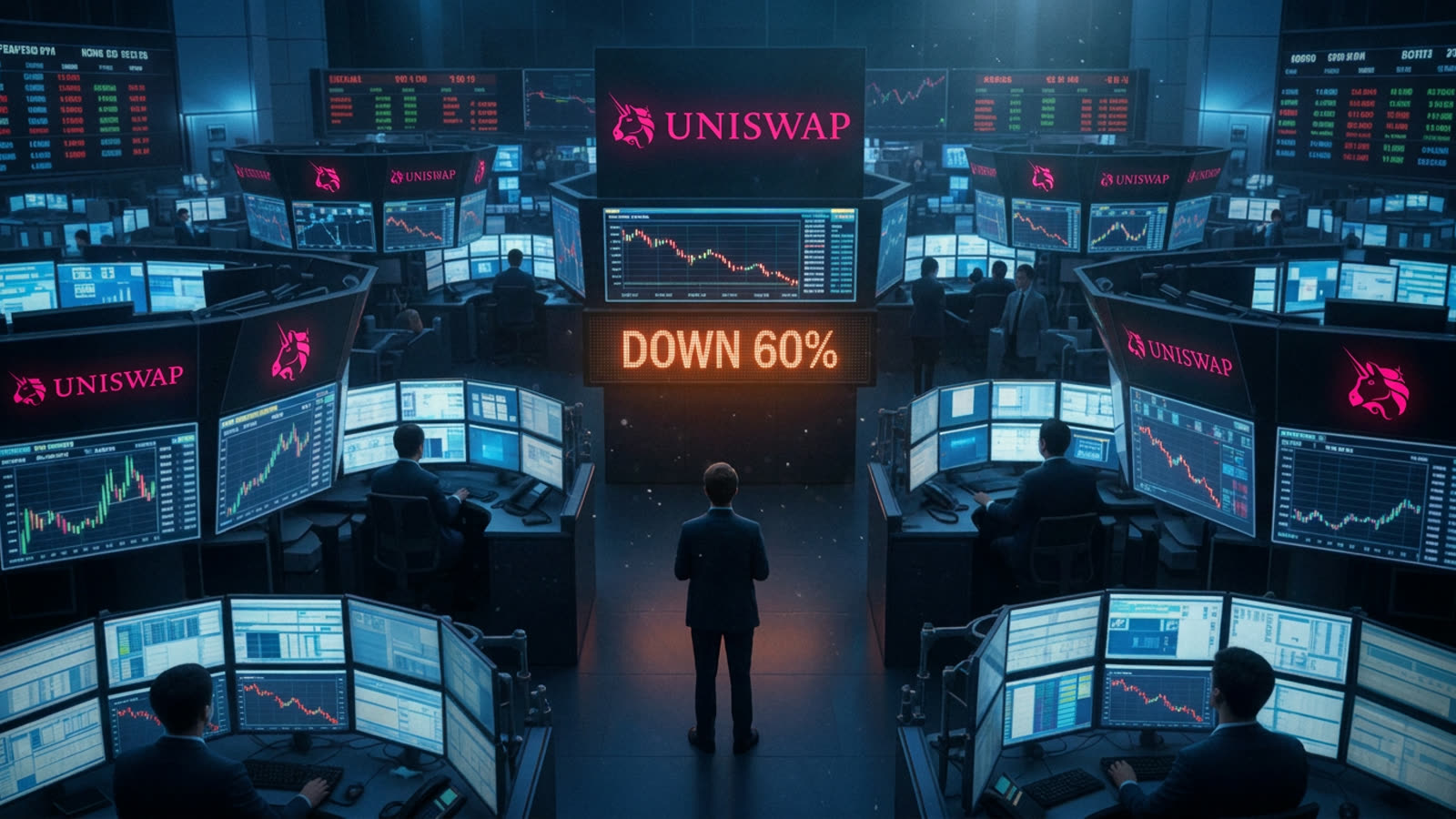
The token that launched a thousand imitators is quietly bleeding out. Uniswap's UNI dropped another 3.4% in the past day, extending a brutal year that has erased more than 60% of its value. The protocol still processes billions in trades. The governance token increasingly looks like a relic.
This is not a story about a hack or a scandal. It is something worse: irrelevance creeping in at the edges.
The original sin of governance tokens
Uniswap invented the automated market maker model that now underpins nearly every decentralized exchange. When it airdropped UNI tokens in September 2020, recipients treated them like lottery winnings. The token briefly touched $45 in 2021. Today it trades below $3.
The problem was always structural. UNI grants voting rights over protocol parameters but no direct claim on revenue. Uniswap Labs, the company that maintains the interface, captures fees through its frontend. Token holders get governance theater. The SEC's ongoing scrutiny of whether UNI constitutes a security has frozen any serious discussion of fee-sharing mechanisms that might give the token actual utility.
Competition from every direction
Uniswap once dominated on-chain trading. Now it fights for market share against specialized competitors on every front. Curve handles stablecoin swaps more efficiently. Trader Joe and Orca own their respective chains. Aggregators like 1inch route around Uniswap when better prices exist elsewhere.
The protocol's expansion to multiple chains—Arbitrum, Polygon, Base, Optimism—has not reversed the slide. It has merely distributed the same problem across more networks. Liquidity fragments. Fees compress. The moat that once seemed impregnable turns out to have been mostly timing.
The infrastructure trap
Uniswap's code remains essential. Forks of its smart contracts power exchanges across dozens of blockchains. Its price oracles feed data to lending protocols. The technology won. The token lost.
This is the infrastructure trap that haunts crypto's first movers. Being foundational does not guarantee capturing value. HTTP powers the internet; nobody owns HTTP. Uniswap built the rails for decentralized trading and is now discovering that rails are commodities.
Our take
Uniswap deserves credit for proving that on-chain trading could work at scale. But the market is delivering a verdict on governance tokens without revenue rights: they are vanity metrics dressed up as ownership. Until the protocol finds a way to share fees with holders—or until regulators clarify that doing so would not trigger securities law—UNI will remain a badge of early participation, not a productive asset. The 60% decline is not a buying opportunity. It is a price discovery process that may have further to run.