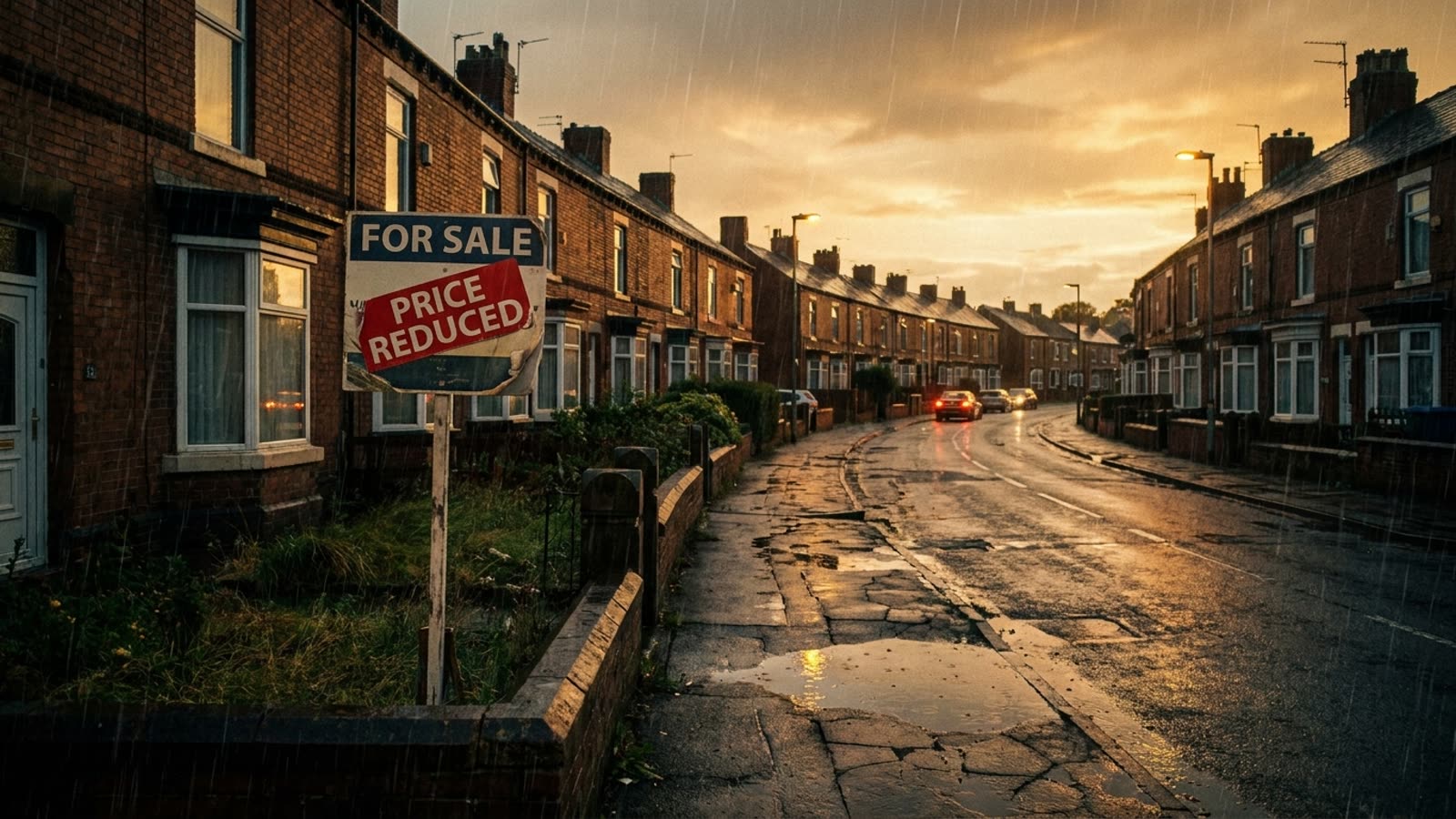
The British housing market has entered a new phase, and it is not a comfortable one for sellers. Data shared with the BBC reveals that asking-price cuts are now occurring at their highest frequency in fifteen years—a striking marker that places the current moment alongside the aftermath of the 2008 financial crisis in terms of seller capitulation.
The numbers are stark: more than 3,000 properties per day are seeing their asking prices reduced, a volume that speaks to a fundamental mismatch between what vendors believe their homes are worth and what buyers are willing—or able—to pay. This is not a localised phenomenon confined to overheated London postcodes or pandemic-era hotspots in the countryside. The reductions are broad-based, touching markets across England and Wales.
The arithmetic of correction
For more than a decade, British homeowners operated under a simple assumption: property values only travel in one direction. That assumption survived Brexit, a pandemic, and the initial shock of higher interest rates. What it could not survive was the sustained reality of mortgage rates that remain elevated by post-2008 standards, combined with a cost-of-living squeeze that has left buyers with less discretionary income for deposits and monthly payments.
The Bank of England's rate-hiking cycle, which began in late 2021 and pushed the base rate to levels not seen since before the financial crisis, has fundamentally altered the calculus. A buyer who could comfortably afford a £400,000 mortgage at 2 percent finds themselves priced out at 5 percent. Sellers who listed at peak-era valuations are discovering that the market has moved on without them.
What the data reveals about sentiment
The frequency of price cuts functions as a real-time sentiment indicator, more immediate than official house-price indices that lag by months. When sellers reduce asking prices en masse, it signals a collective recognition that the market has shifted beneath their feet. Estate agents report that properties which would have attracted multiple offers within days during 2021 and 2022 are now sitting for weeks, prompting the inevitable downward revisions.
This is not yet a crash in the dramatic sense—transaction volumes remain subdued, which paradoxically supports headline prices by keeping distressed sales off the market. But the sheer volume of reductions suggests that the gap between expectation and reality has become too wide to ignore. Sellers who need to move are capitulating; those who can wait are withdrawing listings entirely.
Our take
Britain's housing market has long operated as a one-way bet that defied economic gravity. The current correction is less a crisis than a normalisation—a painful but necessary adjustment to a world where money actually costs something. For first-time buyers who have spent years locked out of the market, this is not bad news. For homeowners who treated their property as a pension substitute, it is a reminder that assets can fall as well as rise. The 3,000 daily price cuts are not a sign of panic; they are a sign of reality finally asserting itself.