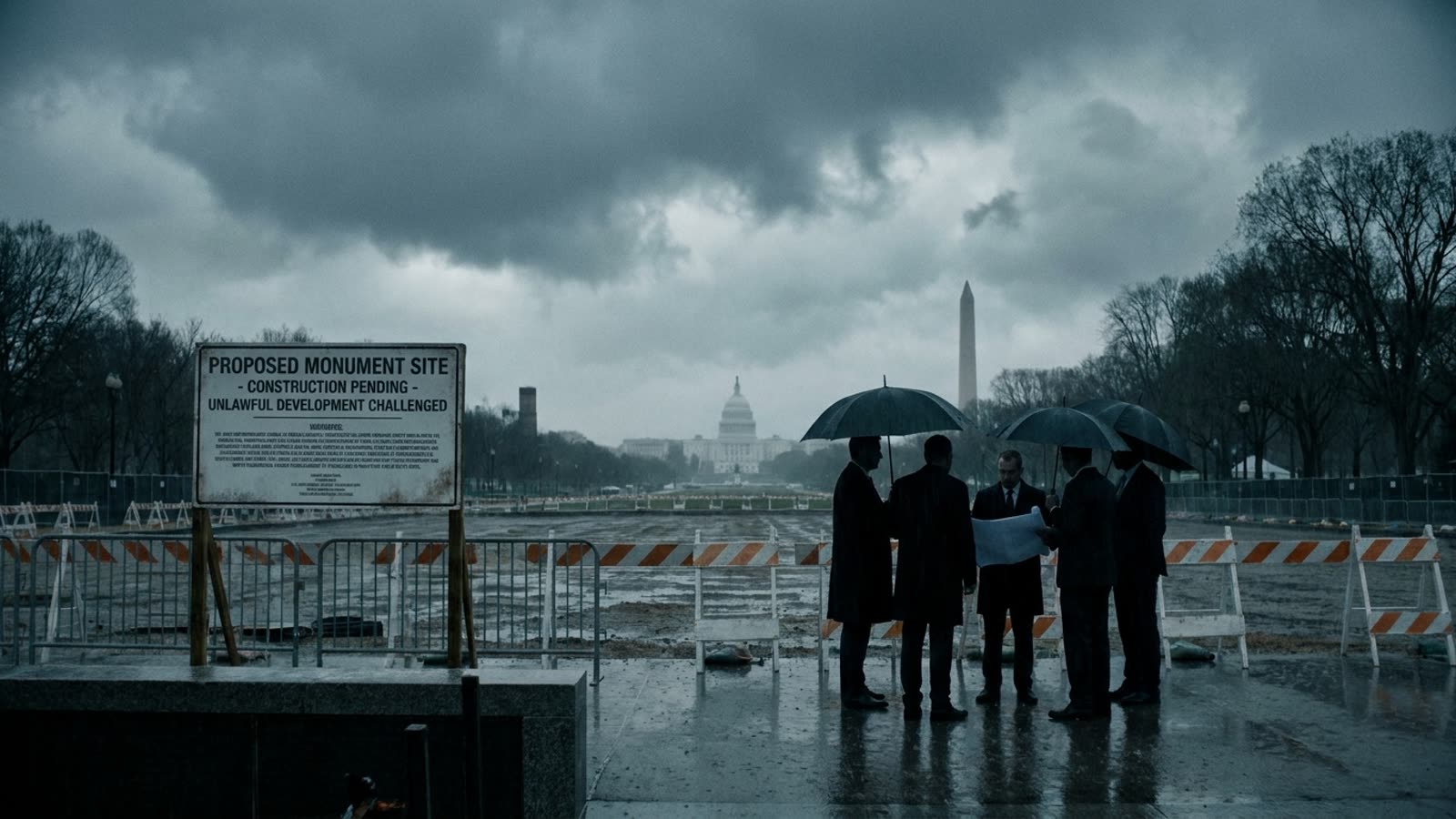
The president's plan to erect a 250-foot triumphal arch on federal land near the National Mall has drawn a joint legal challenge from Virginia and the District of Columbia, marking the first time in decades that two jurisdictions have coordinated litigation against a sitting president's construction project on such grounds.
The lawsuit, filed Friday in federal court, argues that the arch—which the administration has described as a monument to "American greatness"—violates the National Environmental Policy Act, the National Historic Preservation Act, and multiple local zoning ordinances that apply to federal projects in the capital region. Virginia Attorney General Jason Miyares and D.C. Attorney General Brian Schwalb, an unusual bipartisan pairing, called the project "flagrantly unlawful" in a joint statement, citing inadequate environmental review and the monument's proximity to protected viewsheds.
The Traffic and Sight-Line Problem
The proposed site sits near the Theodore Roosevelt Bridge approach, where Virginia officials estimate the arch's construction and eventual tourist draw would add tens of thousands of daily vehicle trips to an already congested corridor. D.C.'s filing emphasizes that the structure would obstruct protected sight lines between the Lincoln Memorial and Arlington National Cemetery—a view explicitly safeguarded under the 1910 Height of Buildings Act and subsequent federal preservation guidelines. The administration has argued that presidential authority over federal land supersedes local concerns, a position legal scholars say has limited precedent.
Historic Preservation as Battleground
The National Trust for Historic Preservation filed an amicus brief supporting the challenge, noting that the site falls within the boundaries of the L'Enfant Plan, Pierre Charles L'Enfant's original 1791 design for the capital. Any major construction requires a lengthy Section 106 review under the National Historic Preservation Act—a process the administration reportedly bypassed by classifying the arch as "emergency infrastructure" related to national security. That designation has drawn bipartisan skepticism on Capitol Hill, with even some Republican senators questioning whether a monument qualifies as emergency construction.
Political Timing
The legal challenge lands three days before midterm elections in which the president's approval rating has become a central issue. Democratic candidates in Virginia's competitive suburban districts have seized on the arch as a symbol of executive overreach, while the administration has framed opposition as coastal elitism hostile to patriotic expression. The arch's design—reportedly inspired by the Arc de Triomphe but scaled to exceed it—has become a culture-war totem, with conservative media defending it as a celebration of American exceptionalism and critics mocking it as a pharaonic vanity project.
Our take
Presidents have always left architectural marks on Washington, from Jefferson's neoclassical vision to Kennedy's push for modernist federal buildings. But those projects moved through established review processes that balanced ambition with accountability. The arch controversy is less about aesthetics than about whether a president can unilaterally reshape the capital's landscape by invoking emergency powers designed for genuine crises. If the courts allow that precedent, every future administration will have a template for monument-by-fiat. Virginia and D.C. are right to force the question now, before the concrete trucks arrive.