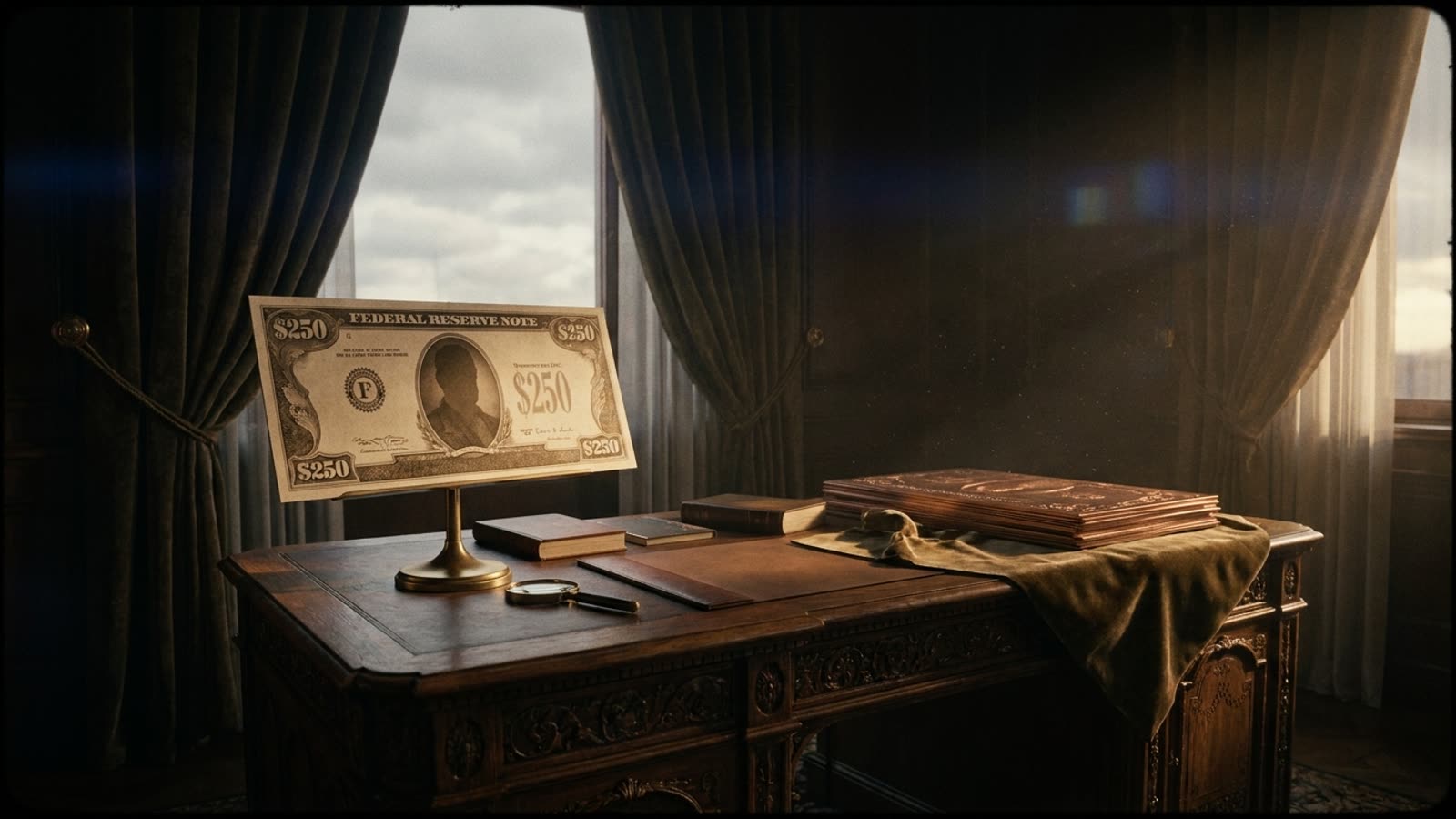
The Trump administration is actively planning to place the president's image on a commemorative $250 bill, according to CNN reporting—a denomination that does not currently exist and would need to be created specifically for this purpose. The initiative represents perhaps the most audacious exercise in presidential self-commemoration since Mount Rushmore, though Gutzon Borglum at least had the courtesy to carve dead men.
The tradition being broken
American currency has, since 1866, followed an unwritten but religiously observed rule: no living person appears on it. The practice emerged after Congress banned the likeness of living officials on coins and notes, a reaction to the unseemly spectacle of Spencer Clark, a Treasury official, placing his own face on fractional currency during the Civil War. The prohibition has held for 160 years across administrations of both parties, surviving even presidents with considerably larger egos than their predecessors.
The commemorative designation offers a technical workaround. Commemorative coins and bills occupy a legal gray zone—they're official U.S. currency but not intended for everyday circulation, typically sold at premiums to collectors. The administration appears to be threading this needle, creating a new denomination that exists primarily as a vehicle for the president's portrait.
The $250 question
The choice of denomination is telling. The highest-value bill currently in circulation is the $100, featuring Benjamin Franklin. Higher denominations—$500, $1,000, $5,000, and $10,000 bills—were discontinued in 1969 over money-laundering concerns and are now collector's items. A $250 bill would slot awkwardly between existing notes, serving no obvious transactional purpose.
Which, of course, is the point. The bill isn't meant to buy groceries; it's meant to be purchased, displayed, and discussed. The administration is essentially creating a federally sanctioned collectible, using the machinery of the U.S. Treasury to produce what amounts to official merchandise.
Historical precedent, or lack thereof
Presidents have appeared on currency before—Washington on the $1, Lincoln on the $5, Jackson on the $20—but always posthumously, and always after extended national deliberation about their historical significance. The process typically takes decades. Hamilton waited until 1928 to grace the $10, more than a century after his death. The idea of a sitting president commissioning his own currency portrait would have struck the founders as monarchical, which is precisely why they didn't do it.
Foreign precedents exist, though they're not flattering. Saddam Hussein put himself on Iraqi dinars. Muammar Gaddafi appeared on Libyan currency. The company one keeps in this particular tradition tends toward the autocratic.
Our take
The $250 bill is performance art disguised as monetary policy. It won't circulate, won't matter economically, and will be forgotten by everyone except the collectors who buy it and the critics who deplore it. But that's beside the point. The point is the announcement, the outrage cycle, the demonstration that norms exist to be broken. Two centuries of tradition against living presidents on currency? That's not a guardrail; it's a dare. The administration has called it.