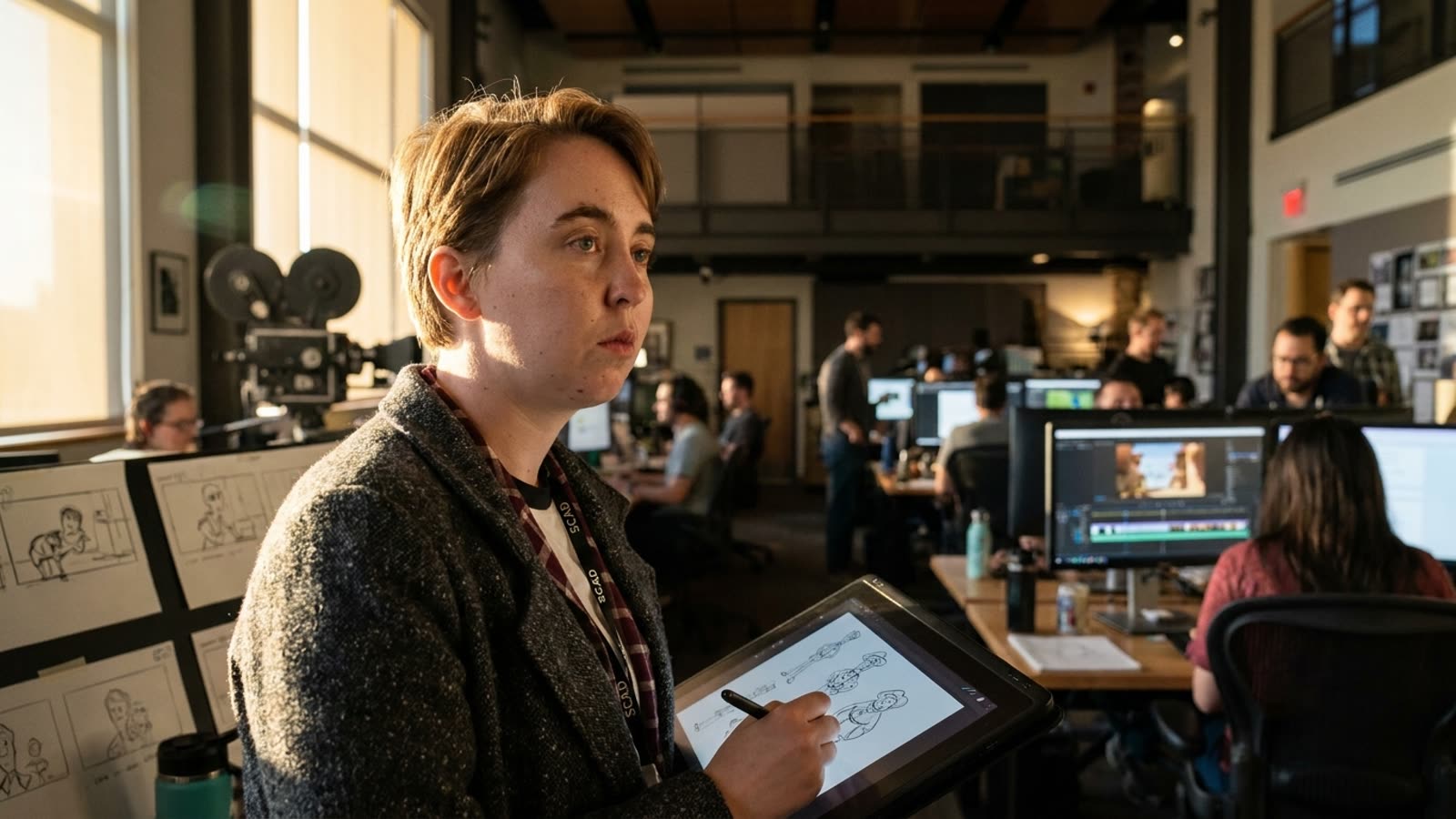
The most reassuring thing about Pixar in 2026 is not that it still makes money—it does—but that it still makes sense. Kenna Harris, who spent her childhood painstakingly reproducing Jessie's yarn braids from reference frames of Toy Story 2, is now co-directing Toy Story 5. The studio that once seemed to promote only from within the Lasseter–Stanton–Bird triumvirate has, quietly and without fanfare, built a pipeline that turns superfans into stewards.
Harris's appointment is the clearest evidence yet that Pixar's post-pandemic identity crisis may be resolving into something coherent. The question was never whether the Emeryville campus could still animate water droplets or fur follicles better than anyone else; it was whether institutional knowledge could survive the departures, the Disney reorganizations, and the streaming-first detours that sent Turning Red and Luca straight to living rooms.
The two-week rewrite
According to Harris, a compressed two-week rewrite fundamentally reshaped the sequel's direction—a detail that would have been unthinkable in the studio's mid-aughts heyday, when development cycles stretched for years and scripts passed through a half-dozen brain trusts. The accelerated timeline suggests either creative confidence or corporate pressure; probably both. Pixar's parent company has made clear that theatrical releases must justify theatrical budgets, and Toy Story 5 carries the weight of a franchise whose previous installment grossed over a billion dollars worldwide.
What Harris brings is not just technical competence but emotional continuity. Her childhood drawings of Jessie were not idle doodles; they were acts of close reading, the kind of obsessive attention that animation demands. When she describes imagining Woody offering Jessie a flower, she is describing the same impulse that drove the original filmmakers: the conviction that plastic toys have interior lives worth dramatizing.
Pixar's quiet meritocracy
The studio has always claimed to promote from within, but the claim often felt like mythology—a story Pixar told about itself while a small circle of men directed the marquee projects. Harris's rise, alongside recent appointments like Domee Shi on Turning Red, suggests the mythology is becoming operational. The question is whether this generation can produce original properties with the same cultural velocity as Finding Nemo or Inside Out, or whether they will be permanently assigned to franchise maintenance.
For now, the franchise work is the test. If Toy Story 5 succeeds, it will validate Pixar's belief that passion and proximity matter more than pedigree—that the kid drawing Jessie in her bedroom was always the target audience and, eventually, the target hire.
Our take
Hollywood loves a full-circle narrative, and Harris's story is almost too neat: the superfan becomes the shepherd. But neatness is not the same as inevitability. Pixar chose to cultivate her, to keep the door open for people whose first qualification was loving the work. In an industry increasingly dominated by IP extraction and algorithmic greenlighting, that choice is worth noticing. The best sequel Toy Story 5 could deliver is proof that the studio still knows how to grow its own.