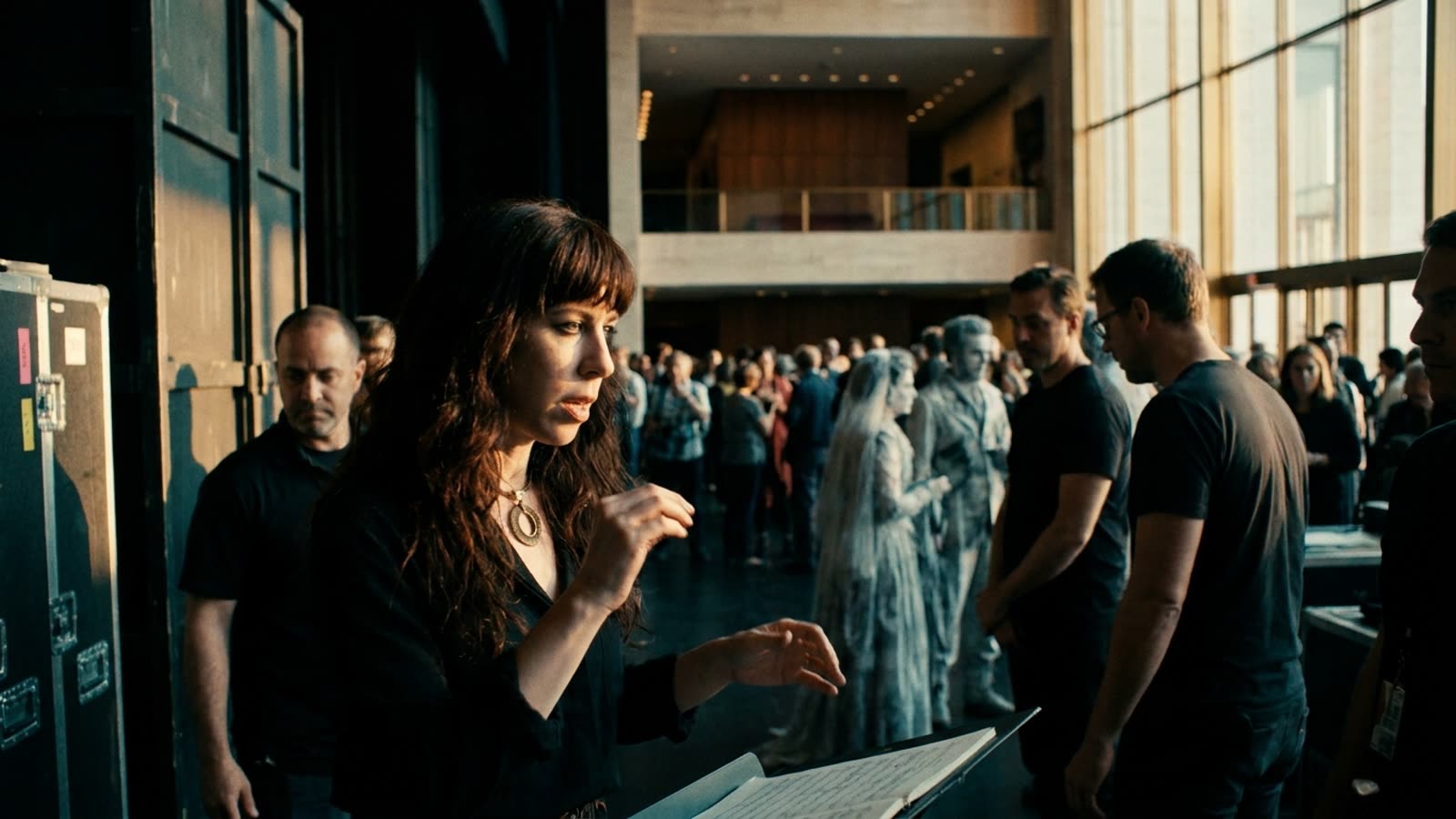
Some books resist adaptation so completely that attempting one feels like an act of vandalism. George Saunders's "Lincoln in the Bardo" — a 2017 Booker Prize winner constructed from a cacophony of ghostly voices hovering in a Georgetown cemetery on the night Abraham Lincoln visits his dead son Willie — seemed permanently consigned to that category. The novel has no protagonist in the conventional sense, no through-line of action, and a cast of spirits who speak in overlapping fragments. It is, by any reasonable measure, unfilmable. Which is precisely why it makes such exquisite sense as an opera.
Missy Mazzoli, the composer who convinced Saunders to hand over the rights, understood something that Hollywood adaptation executives routinely miss: certain stories need music not as ornamentation but as architecture. Opera has always been the art form where the dead get to sing, where grief suspends time, where a single moment of loss can expand to fill an entire evening. Mazzoli's previous work — including "Breaking the Waves" and "The Listeners" — demonstrated her facility for translating interior psychological states into sound. "Lincoln in the Bardo" demanded something more: the sonic equivalent of purgatory itself.
The Problem of Voices
Saunders's novel features dozens of speakers, from historical figures quoted in period documents to fictional ghosts trapped in the bardo — the Tibetan Buddhist concept of an intermediate state between death and rebirth. On the page, this polyphony works because readers can move at their own pace, tracking attributions, building a mental map of who speaks when. In any linear performance medium, the effect threatens to collapse into noise.
Mazzoli's solution, developed with librettist Royce Vavrek, treats the ensemble as a kind of Greek chorus that occasionally crystallizes into individual portraits. The ghosts become a texture, their overlapping testimonies creating harmonic density rather than narrative confusion. Willie Lincoln and his father emerge from this swirl as the opera's emotional anchors, their scenes together stripped to devastating simplicity against the surrounding complexity.
Why Opera, Why Now
The Met's decision to commission this work reflects a broader institutional bet that contemporary American opera can fill seats without relying on the standard repertoire. Recent seasons have seen mixed results — some new commissions greeted with genuine enthusiasm, others politely endured. "Lincoln in the Bardo" arrives with unusual advantages: a source text beloved by the literary establishment, a composer with genuine crossover appeal, and subject matter that resonates with the American moment without being crudely topical.
The opera also benefits from timing. Nine years after the novel's publication, the initial hype has faded enough that the adaptation can be judged on its own terms rather than as a referendum on the book. Saunders himself has been conspicuously supportive, telling interviewers that Mazzoli's approach revealed dimensions of his own story he hadn't consciously intended.
Our take
Most literary adaptations fail because they treat the source as a container to be emptied into a new vessel. Mazzoli has done something rarer: she's found the form the story was always secretly reaching toward. A novel about voices that cannot rest, about a father's impossible grief, about the thin membrane between the living and the dead — of course it should have been an opera all along. The Met, for once, has earned its reputation as the house where American ambition meets European tradition.