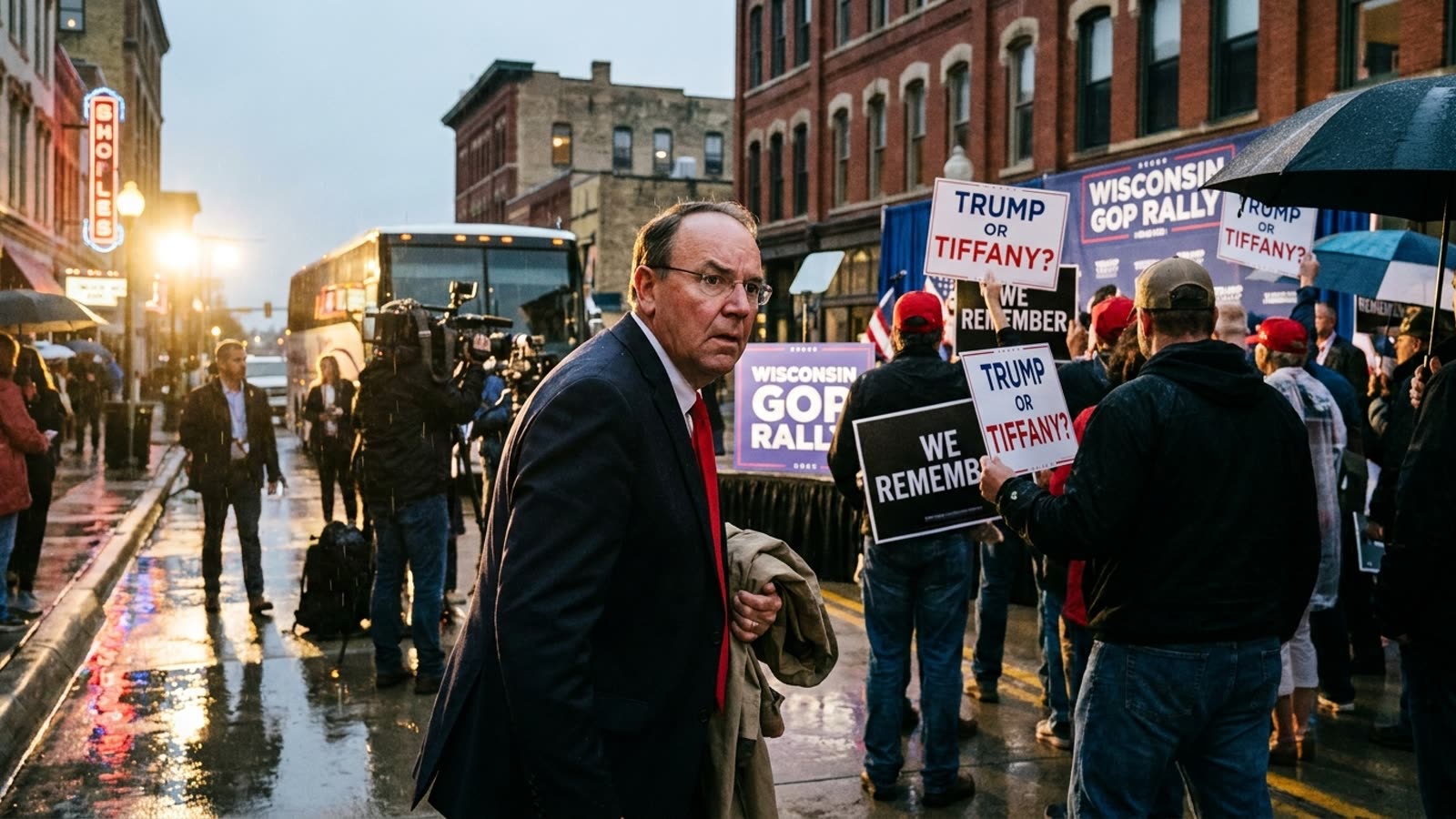
Tom Tiffany built his political career as one of Donald Trump's most reliable surrogates in Congress. The Wisconsin Republican voted to overturn the 2020 election results, defended the president through two impeachments, and rarely missed an opportunity to amplify Trump's grievances on cable news. Now, with three weeks until Election Day and Trump's approval ratings underwater in swing-state Wisconsin, Tiffany is attempting the most transparent pivot in modern gubernatorial politics: pretending none of that ever happened.
The campaign's new ads emphasize Tiffany's record on local issues—dairy subsidies, Great Lakes conservation, broadband expansion—while carefully avoiding any mention of the man whose endorsement he sought and received in the primary. His stump speeches now open with anecdotes about his grandfather's cheese farm rather than red-meat culture-war talking points. When pressed by reporters, Tiffany insists he's "always been an independent voice" and that his focus is "100 percent on Wisconsin families." The problem is that voters have memories, and opposition researchers have hard drives.
The receipts are everywhere
Tiffany's Trump loyalty wasn't quiet or occasional—it was his entire brand. He appeared at Mar-a-Lago fundraisers, co-sponsored articles of impeachment against Biden cabinet officials at Trump's urging, and told Fox News in early 2025 that Trump "saved the Republican Party and saved America." His primary opponents attacked him as a Trump puppet; he leaned into it and won by 18 points. Democratic groups are now running those clips on loop in Milwaukee and Madison media markets, juxtaposed with his current attempts at moderation. The contrast is devastating precisely because it requires no editorializing.
The strategy reflects a broader Republican dilemma in purple states. Trump remains popular with the party base—essential for winning primaries—but remains toxic with independents and college-educated suburbanites who decide general elections. Candidates like Tiffany are trapped: they can't disavow Trump without depressing turnout among his fervent supporters, but they can't embrace him without alienating everyone else. So they split the difference with this awkward pantomime of independence that convinces nobody.
Wisconsin's structural problem
Polls show Tiffany trailing Democratic Attorney General Josh Kaul by 4-7 points, a margin that has held steady even as Tiffany's media spending has increased. The governor's race matters beyond Wisconsin: a Kaul victory would give Democrats control of the redistricting process after the 2030 census and likely end the Republican legislative gerrymander that has dominated state politics for over a decade. National Republican groups have poured money into the race, but they're fighting against fundamentals. Trump lost Wisconsin by 21,000 votes in 2024, and his standing has only deteriorated since. Tiffany's bet is that he can outrun that drag by 5-6 points. History suggests otherwise—in 2022, every Trump-endorsed candidate in a competitive statewide race underperformed the generic ballot.
Our take
Tiffany's reinvention attempt is less a campaign strategy than a Hail Mary born of desperation. Voters tolerate many things from politicians, but they have a keen nose for inauthenticity. You cannot spend years building a public identity as someone's most faithful lieutenant and then expect people to believe you were independent all along simply because the polls shifted. The irony is that Tiffany might have had a better chance if he'd simply owned his record and tried to make the case that Trump's policies—whatever their controversies—produced results for Wisconsin. Instead, he's chosen the path of maximum cynicism: asking voters to ignore what they saw with their own eyes. Wisconsin voters are not that forgetful, and Tiffany is about to learn that the hard way.