The kissaten is not trying to optimize your morning. It does not offer oat milk, does not accept mobile orders, and would never dream of suggesting you take your siphon-brewed Kilimanjaro blend to go. In a culture now synonymous with convenience—the country that perfected the vending machine and the capsule hotel—the kissaten exists as a deliberate anachronism, a space where the transaction is not coffee but time itself.
These establishments, whose name translates roughly to "tea-drinking shop," proliferated across Japan from the 1950s through the 1980s, serving as the de facto living rooms of a cramped, urbanizing nation. At their peak, there were more than 150,000 across the country. Today, estimates suggest fewer than 70,000 remain, with the number declining each year as elderly proprietors retire and real estate economics make such low-turnover businesses increasingly untenable.
The architecture of lingering
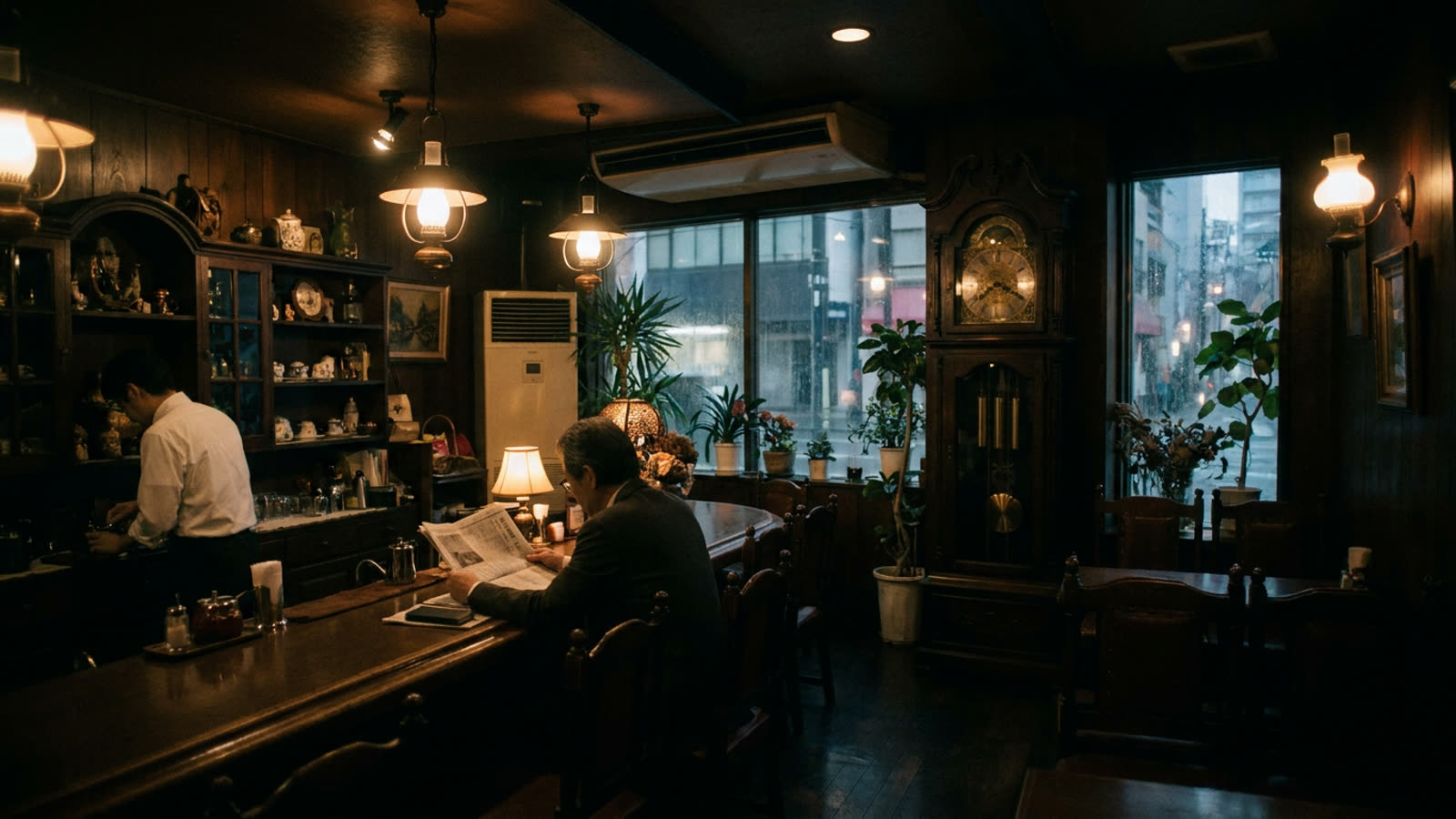
What distinguishes the kissaten from its spiritual descendants—the Starbucks, the Blue Bottles, the specialty pour-over bars—is its fundamental relationship with the customer's time. The lighting is low, often amber. The seats are velvet, sometimes cracked. Ashtrays, though increasingly unused, remain on tables as archaeological artifacts. Classical music or jazz plays at a volume that discourages laptop work. The master behind the counter, often in his seventies or eighties, may take eight minutes to prepare a single cup using a nel drip cloth filter, a method that predates paper filters and requires constant attention.
This is not inefficiency. It is philosophy. The kissaten emerged in an era when Japanese salarymen needed spaces that were neither home nor office—what the sociologist Ray Oldenburg would later term "third places." But unlike the American coffee shop, which evolved toward productivity and wifi, the kissaten calcified around contemplation. You are paying not for caffeine but for the right to sit, to think, to be unproductive.
The pilgrimage economy
The paradox of the kissaten's decline is that it has coincided with a surge in international fascination. Design blogs, travel guides, and social media accounts dedicated to Japanese aesthetics have transformed certain establishments into destinations. Chatei Hatou in Tokyo's Shibuya, which has operated since 1989, now sees visitors from Seoul, Sydney, and Stockholm who have traveled specifically to experience its hand-roasted beans and wood-paneled interior. The coffee costs roughly what you would pay at any specialty roaster; the experience is irreplaceable.
This attention has not saved the kissaten as a category—most closures happen quietly in residential neighborhoods, unmourned by Instagram—but it has created a curious two-tier system. A handful of photogenic survivors become cultural monuments while the majority disappear, their velvet booths replaced by convenience stores or chain cafés.
Our take
The kissaten's persistence, however diminished, suggests something the global hospitality industry has been slow to understand: there is a market for deliberate friction. The third-wave coffee movement fetishized the bean, the origin, the roast profile. The kissaten fetishizes nothing except duration. In an era when every service competes to save you time, the kissaten charges you for the privilege of wasting it—and a growing cohort of exhausted professionals, overstimulated by optimization, will travel across oceans for exactly that. The lesson is not that efficiency is bad. It is that its absence, curated correctly, is a luxury good.