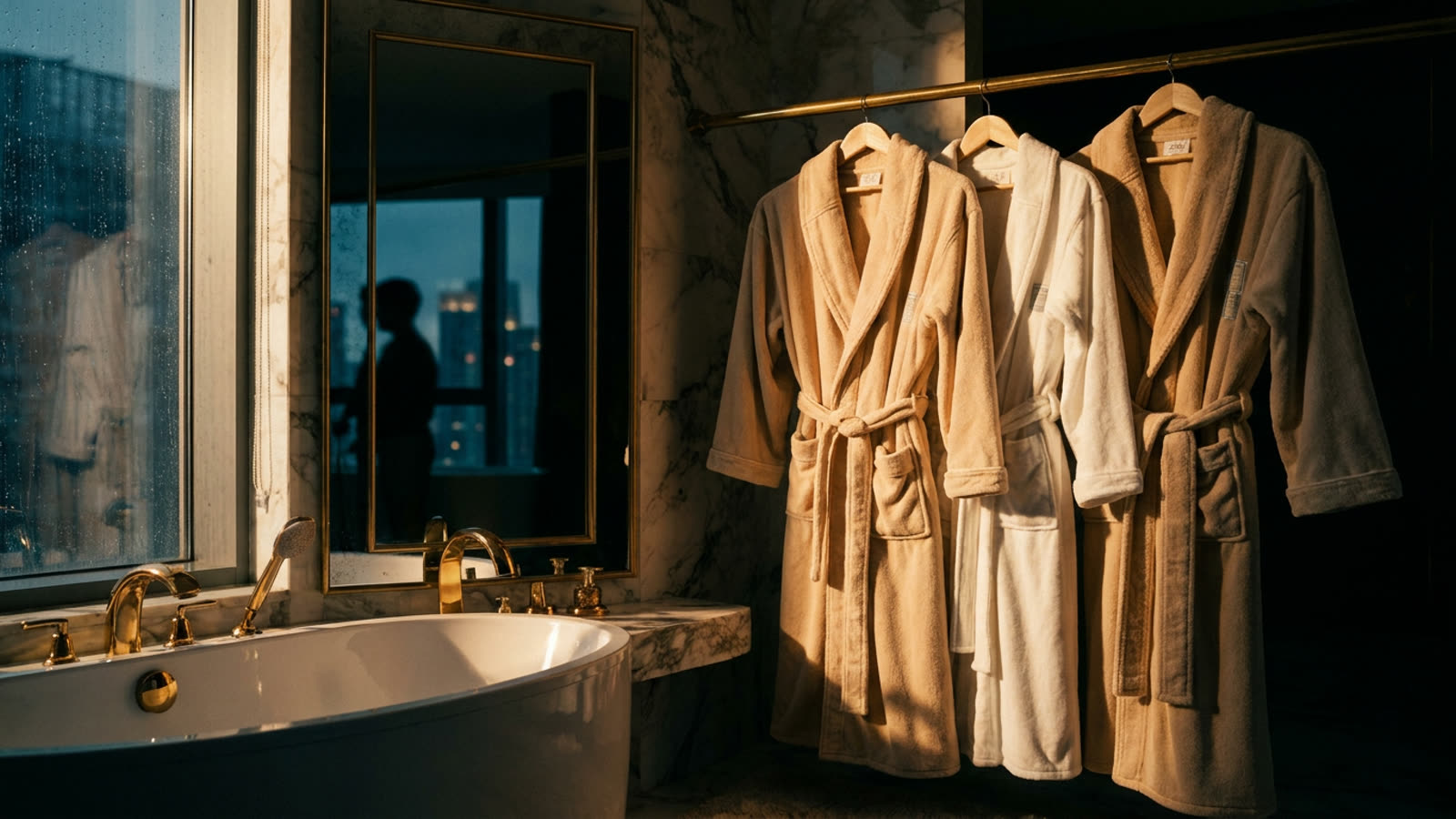
There is a moment, familiar to anyone who has checked into a decent hotel, when you open the closet and find it hanging there: white, thick, absurdly soft, promising nothing except comfort. The bathrobe asks nothing of you. It has no app integration, no loyalty points attached, no QR code linking to a wellness experience. It simply exists to make you feel, for a few hours, like someone who deserves to feel good.
This is increasingly rare. The modern hospitality industry has become extraordinarily sophisticated at extracting value from every guest interaction. The minibar has dynamic pricing. The spa requires advance booking through a third-party platform. The restaurant wants your email address before you've seen a menu. Room service carries fees that would have seemed satirical a generation ago. Even the act of checking in has been transformed into a data-collection exercise dressed up as personalization.
The bathrobe remains stubbornly analog, and this is precisely its power.
The economics of plush
Hotel bathrobes occupy a peculiar position in the hospitality P&L. They cost real money—a quality terry cloth robe from a commercial supplier runs anywhere from forty to several hundred dollars depending on weight and weave. They require laundering after every use, adding to operational costs. They get stolen with sufficient regularity that most hotels simply build replacement into their budgets.
And yet cutting corners on the bathrobe is understood, industry-wide, as a false economy. Guest satisfaction surveys consistently rank robe quality among the most emotionally resonant elements of a stay, outperforming far more expensive amenities. The reason is psychological: the bathrobe is experienced in private, in moments of genuine relaxation, when the guest's defenses are down. It becomes associated with the feeling of the stay itself.
This is why budget hotels rarely bother with robes at all—they know they cannot compete—while luxury properties obsess over thread count, collar construction, and the precise weight that conveys substance without feeling like a burden.
The theater of comfort
The bathrobe's cultural significance extends beyond hospitality. It has become shorthand for a particular kind of aspirational leisure: the life where mornings are unhurried, where one might plausibly spend two hours drinking coffee before getting dressed. This fantasy sells not just hotel rooms but real estate, retirement plans, entire lifestyle categories.
What makes the hotel robe specifically potent is its temporariness. You do not own it. You are borrowing, briefly, a version of life where someone else handles the laundry, where the towels are always fresh, where comfort is simply provided rather than earned. The robe is the most wearable manifestation of this borrowed existence.
There is also something democratizing about it. The same robe wraps the hedge fund manager and the couple celebrating an anniversary they saved months for. For the duration of the stay, the garment makes no distinctions.
Our take
The hotel bathrobe endures because it represents something the hospitality industry has otherwise abandoned: generosity without calculation. It sits in your closet whether you use it or not. It doesn't upsell you. It doesn't require a password. In an era when every amenity has been reimagined as a revenue stream or a data-harvesting opportunity, the robe remains a gift—temporary, freely given, asking only that you enjoy it. This is not nostalgia. It is a reminder that luxury, at its core, is simply the experience of being taken care of without being asked for anything in return.