Tesla's New Roadster Is Finally Here, and It Flies. Here Is Everything We Know.
Nine years after it was first promised, Tesla has unveiled its second-generation Roadster. The show was built around one claim: that a production car can drive upside down, take off on cold-gas thrusters and land again. Musk calls it "the best of the last of the human-driven cars." What follows is what Tesla actually showed, what its engineers said afterward, where their numbers disagree, and what is still unknown.
The show
The reveal took place on the evening of October 15 at SpaceX's test site in McGregor, Texas, just outside Waco. A select crowd of fans, investors and media attended, and the event was streamed live on X. The stunts explain why it was held outdoors.
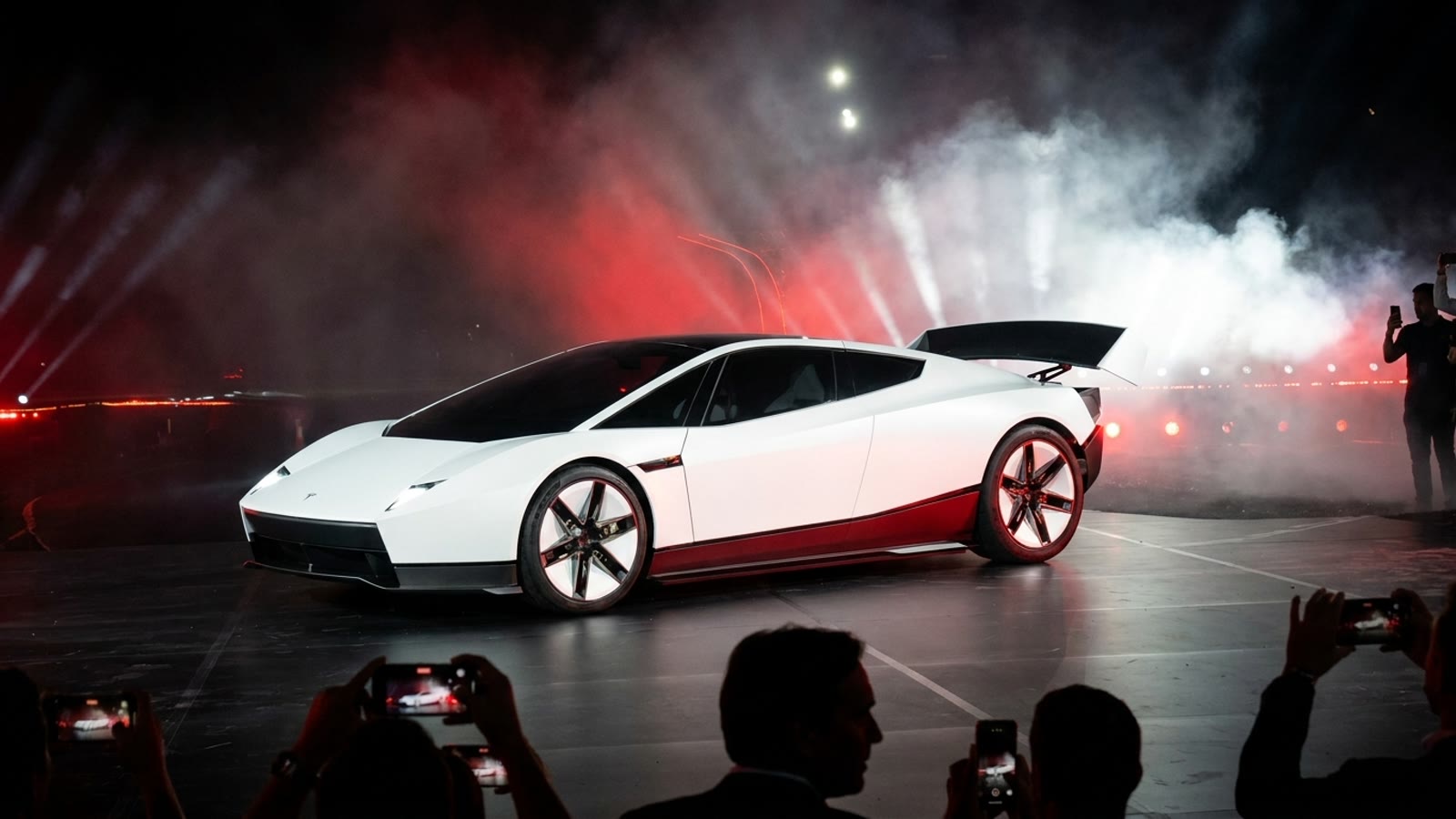
A white, wedge-shaped prototype drove up a looping track shaped like a Hot Wheels set. It stayed on the track because of a fan system under the car, which Tesla says can hold the car to the surface even when it is upside down and standing still. At the top, the car's thrusters lifted it off the track. According to Car and Driver, they produce more than 80 kilonewtons of force. The car flew forward, rolled through the air and set down gently in a cloud of white vapor. In a second run, it used the thrusters to hop over a row of Tesla's other vehicles while moving: a Cybercab, a Cybertruck, a Semi, a Model Y and a Model 3.
"It can basically fly like a rocket," Musk told the crowd. "It can do, like, crazy gymnastics. Whatever you want."
Then came the acceleration runs. The first 0-to-60 mph run was announced at one second flat. Someone reminded Musk that he had promised better than one second, and the second run was announced at 0.8 seconds. He said Tesla expects to beat that too. All of these times are Tesla's own claims. No independent party has measured them.
Car and Driver noticed one detail. The prototype that did the stunts was not the car that was driven onto the stage. The flying car had Cybercab-style hubcaps, and the display car had more elaborate wheels.
Three trims, and how the thrusters work
Tesla is taking reservations for three versions:
- Performance ("road ready"). Two seats, an active rear wing and a "multi-mode suction" fan system. The reservation costs 50,000 dollars.
- Thrust ("race ready"). The same hardware plus rear cold-gas thrusters for the sub-one-second launch. The reservation costs 250,000 dollars.
- Rocket ("air ready"). One seat only, with ten thrusters placed around the car so it can lift, move sideways and rotate. Invitation only.
Tesla has not announced a final price. The New York Times reported the car will cost at least 200,000 dollars.
The thrusters do not burn fuel. They run on very high-pressure stored gas. "Every usable void in the car," Tesla wrote, is filled with Carbon Fiber Overwrapped Pressure Vessels (COPVs). These are the same kind of tank SpaceX uses on its rockets, and COPV failures were behind several SpaceX explosions. Tesla's engineering chief, Lars Moravy, said on stage that the system feeds ten thrusters from 600 liters of compressed air. In a Top Gear video afterward, he described a 200-liter tank that takes up the trunk of the Thrust version. It fills in two to six hours from a high-pressure nitrogen system, and Tesla says it is working on a version that fills in under 30 minutes. A full tank gives about five to six seconds of thrust. In other words, the effect is real, but it lasts seconds and is not meant for everyday driving.
The specifications Tesla didn't put on stage
Tesla gave almost no hard numbers at the event. Most of what is now known comes from the Top Gear interview with Moravy and design chief Franz von Holzhausen, as reported by InsideEVs:
- Chassis. A new chassis built only for the Roadster, made of aluminum and carbon fiber. It has steer-by-wire, brake-by-wire and carbon-ceramic brake discs.
- Drivetrain. Rear-wheel drive only, in every version. Two rear motors split power between the wheels to help in corners.
- Power. More than 800 kilowatts (about 1,073 horsepower) in the base car, and more than 1,000 kilowatts (about 1,341 horsepower) in the faster versions.
- Battery and charging. A pack of 800 to 1,000 volts with nickel-based cells made for this car. It can charge at up to 500 kilowatts on a V4 Supercharger, going from 15% to 85% in about ten minutes. Tesla calls it its fastest-charging battery yet.
- Range. Tesla says 300 miles, and the engineers say about 310 to 320 miles in real driving. That is about half the 620 miles Musk promised in 2017.
- Weight. About 3,700 pounds (1,700 kilograms) for the lightest version.
- Body. It is not actually an open roadster. The glass panels on the butterfly doors lift off, which turns the car into a T-top.
- Cabin. Two seats, a yoke instead of a steering wheel, and a large horizontal screen.
The design is new. The soft lines of the 2017 car are gone. Tesla says the angular shape draws on the SR-71 Blackbird spy plane, the F-35 fighter jet and the white Lotus Esprit from the James Bond film The Spy Who Loved Me. Musk owns that Esprit, and it was on display at the event. The large rear wing switches between low-drag and high-downforce modes. The fans under the car can either press it to the ground at low speed or open up to speed airflow underneath it at high speed.
Where the numbers don't agree
Some of the claims conflict, depending on who is speaking:
- Top speed. Tesla says over 230 mph, and Musk said he wants to reach half the speed of sound (about 380 mph). The engineers told Top Gear the current top speed is 214 mph and the target is 330 mph.
- Tank size. 600 liters on stage, 200 liters in the follow-up video.
- Number of versions. Tesla's reservation page lists three trims, while the engineers spoke of four.
- Weight. About 3,700 pounds according to Tesla's engineers. YouTuber Marques Brownlee, who reserved a Roadster in 2017, called it a "4000+ pound car" and asked: "This is a prank, right?"
Nine years of delays
The second-generation Roadster first appeared in November 2017 as a surprise at the end of the Tesla Semi launch. Deliveries were promised for 2020. Buyers paid 50,000 dollars to reserve one, and some paid 250,000 dollars for one of 1,000 "Founders Series" cars. In 2018, Musk tweeted about a "SpaceX option package" with about ten small rocket thrusters. Then the project stalled while Tesla dealt with the Model 3's "production hell," the Model Y and the Cybertruck. The reveal was delayed in 2020, 2021, 2023 and 2024. It was then set for April 1, 2026, a date Musk said would give him "some deniability." It was moved again to October 1 and finally postponed by bad weather.
Musk now says production will begin in Texas in 2028. "This one, we're going to build," Moravy said.
Safety and legality
Musk was open about both. "This is not necessarily a safety-optimized car," he said on stage. He also admitted he is "not sure it's necessarily legal in all jurisdictions." Earlier this year he had put it more bluntly: "If safety is your number one goal, do not buy the Roadster," adding that Tesla would "aspire not to kill anyone in this car." Business Insider listed three disclaimers Tesla attached to the reveal. Musk also floated a jump over Idaho's Snake River Canyon, where Evel Knievel made his famous rocket attempt. The open question is how regulators will treat a road car that carries rocket-grade pressure tanks and can briefly fly.
How the markets reacted
The reveal came after the stock market had closed, and the first reaction came on crypto exchanges. On Hyperliquid, trading in a contract that tracks Tesla's share price jumped from 2.8 million dollars to 47 million dollars in one hour, and the price rose about 5% to around 378 dollars. Tesla shares had closed at 362.44 dollars and were up about 4.5% in early trading the next morning. Musk himself has said the Roadster may not "move the needle massively" on revenue. It is a showcase car, not a mass-market one. Investors will get a better picture on October 21, when Tesla reports its third-quarter results.
What we still don't know
- Final price. Not yet announced for any trim.
- Thrust in real conditions. No independent tests of the thrust, the flight time, or how the tanks behave over years of use.
- Approval. Whether road-safety regulators in the United States and abroad will approve the Thrust and Rocket versions.
- The 2028 date. Whether production will actually start then. Tesla has missed every previous Roadster deadline.
For now, the Roadster has done something Tesla had not managed in nine years: it was finally shown.