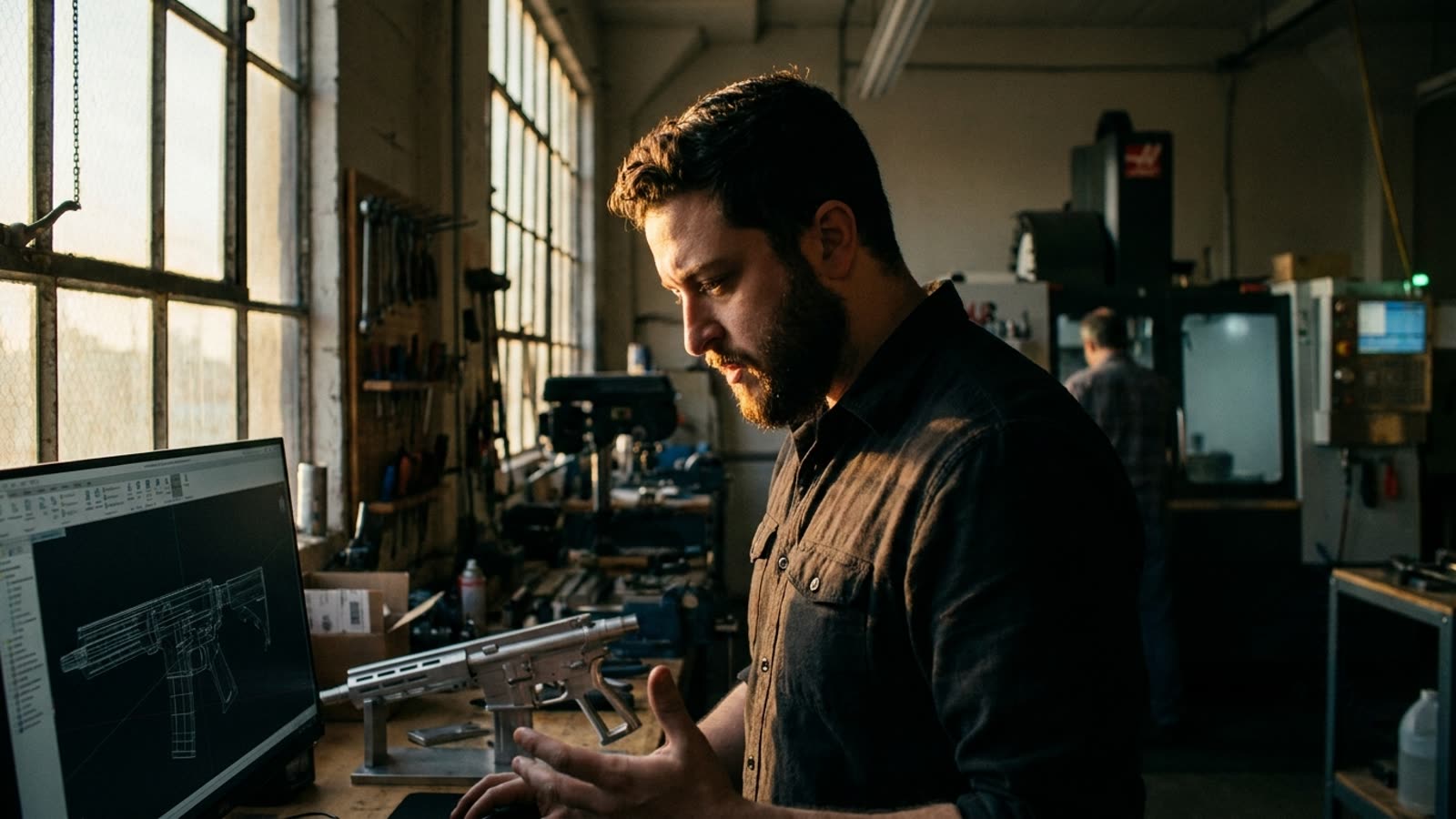
Thirteen years after Cody Wilson demonstrated that anyone with a 3D printer could manufacture an untraceable firearm, the gun-rights provocateur is claiming another dubious milestone: what he calls "the first AI-made gun." The weapon was reportedly designed using generative AI tools in a process Wilson describes as "vibe coding"—the increasingly popular practice of describing what you want to software and letting the machine figure out the technical details. If the claim holds up, it represents a troubling convergence of two technologies that regulators have struggled to contain.
Wilson has spent over a decade at the intersection of libertarian ideology and weapons technology, first with his Defense Distributed organization and its Liberator pistol, then through a series of legal battles with the State Department over the right to publish firearms blueprints online. His latest project suggests he sees generative AI as the next frontier in democratizing—critics would say destabilizing—weapons manufacturing.
The vibe-coding problem
The term "vibe coding" emerged from software development circles to describe using AI assistants like Claude, ChatGPT, or Copilot to generate functional code from natural-language descriptions. A developer might type "build me a login page with OAuth" and receive working code in seconds. The approach has lowered barriers to entry across programming, enabling people with minimal technical training to build functional applications.
Applied to firearms design, the implications shift dramatically. Traditional gun manufacturing requires specialized knowledge of metallurgy, ballistics, and mechanical engineering. If generative AI can translate "design me a reliable semi-automatic pistol" into functional blueprints, the expertise barrier collapses. Wilson's claim—still unverified by independent testing—suggests this collapse may already be underway.
Regulatory vacuum meets technological acceleration
The Bureau of Alcohol, Tobacco, Firearms and Explosives has spent years trying to catch up to 3D-printed weapons, finally issuing rules in 2022 requiring serial numbers on ghost gun kits. Those rules addressed a manufacturing method that was already a decade old. AI-assisted design moves faster than any regulatory apparatus can follow.
Major AI labs have implemented guardrails against weapons-related queries, but these protections remain inconsistent and easily circumvented. A user asking Claude or ChatGPT to "design a gun" will be refused. A user asking for "a spring-loaded mechanical device with a cylindrical chamber" may not be. Wilson has long understood that the battle over weapons access is fundamentally a battle over information, and generative AI represents the most powerful information-synthesis tool ever created.
Our take
Wilson is a provocateur who courts controversy as a business model, and his "first AI gun" claim should be treated with appropriate skepticism until independently verified. But the underlying concern is real regardless of whether this particular weapon works as advertised. The same AI capabilities that let a novice build a website or write functional code can, in principle, help someone design lethal weapons. The major labs know this; their safety teams have surely war-gamed these scenarios. What remains unclear is whether guardrails designed for today's models will hold as capabilities improve. Wilson is betting they won't—and history suggests he's usually a few years ahead of the regulators trying to stop him.