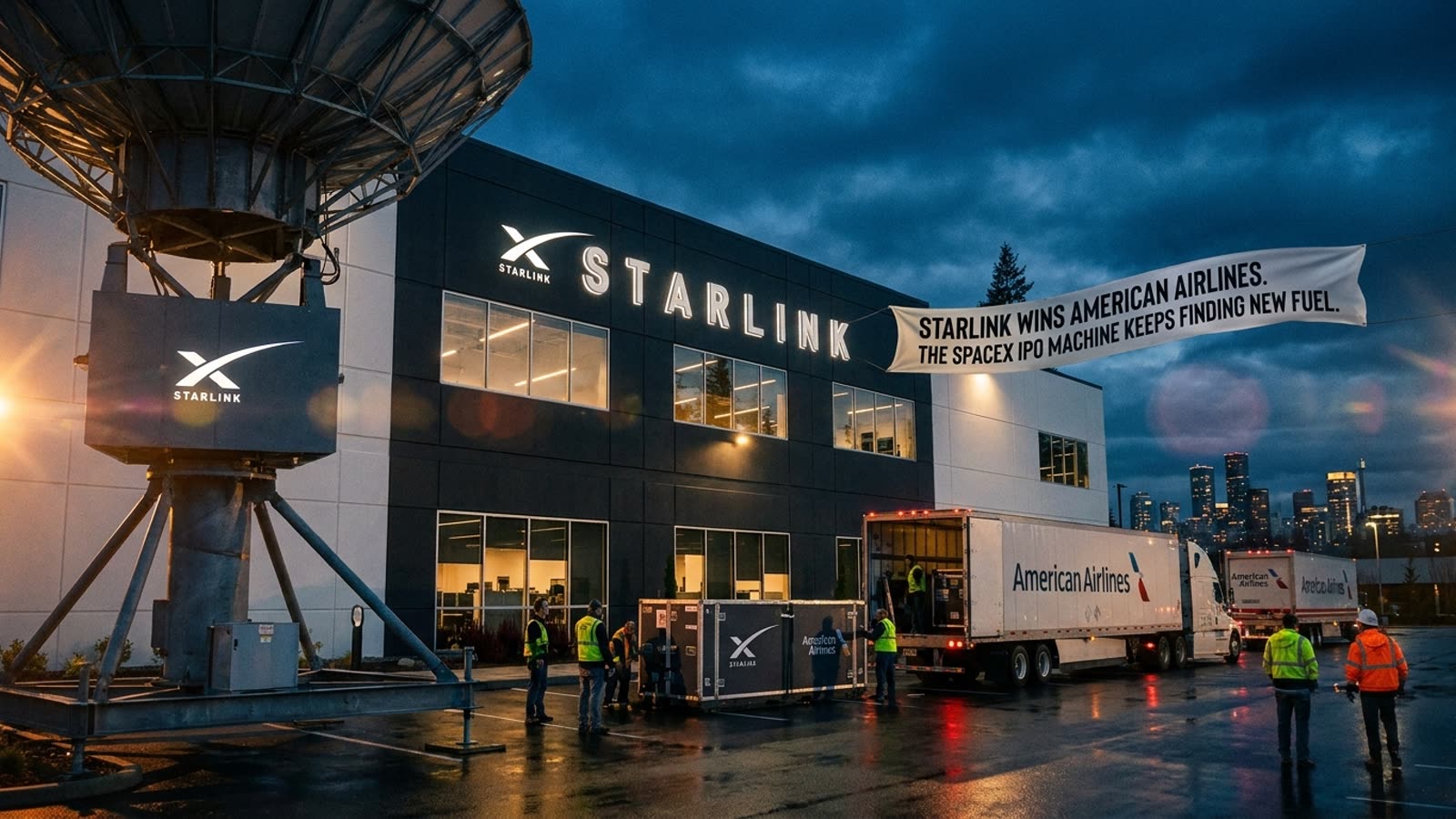
SpaceX's Starlink division has secured a contract to provide inflight Wi-Fi for American Airlines, adding another blue-chip customer to a roster that increasingly resembles a who's-who of global aviation. The deal arrives as SpaceX prepares for what may be the most anticipated initial public offering since Facebook, and it answers a question investors have been asking: can Starlink's commercial momentum justify the stratospheric valuations being whispered in private markets?
The answer, for now, appears to be yes. American joins Delta, United, and a growing list of international carriers that have either signed with Starlink or are in advanced negotiations. The satellite internet service, which began as a side project to fund Elon Musk's Mars ambitions, has quietly become the company's steadiest revenue engine—less glamorous than Starship, but far more predictable.
Why airlines matter more than rural broadband
Starlink's original pitch was connectivity for underserved areas: rural America, developing nations, maritime vessels. That market exists, but it's fragmented and price-sensitive. Aviation is different. Airlines pay premium rates for reliable service, sign multi-year contracts, and have captive customers willing to pay for Wi-Fi at cruising altitude. The American deal reportedly covers the carrier's entire mainline fleet, representing hundreds of aircraft and a recurring revenue stream that could run into the hundreds of millions annually.
For SpaceX, this is exactly the kind of contract that makes an IPO prospectus sing. Institutional investors want predictable cash flows, not just rocket launches that can be delayed by weather or engineering setbacks. Starlink's aviation business provides that ballast.
The IPO calculus
SpaceX's recent S-1 filing revealed a company betting heavily on AI infrastructure, Starship's interplanetary ambitions, and Musk's continued centrality to operations. But buried in the forward-looking statements is a simpler story: Starlink is already profitable on a unit-economics basis, and its total addressable market keeps expanding. Aviation alone could be worth tens of billions over the next decade, and SpaceX is positioning itself as the default provider.
The timing is strategic. With public markets still digesting a wave of AI-adjacent IPOs, SpaceX needs to differentiate itself from the hype cycle. A contract with America's largest airline by fleet size does that work better than any investor presentation could.
Our take
Musk's genius has always been in stacking businesses that feed each other: Tesla's batteries power SpaceX's ground systems, Starlink funds Starship, and now aviation contracts de-risk the IPO. The American Airlines deal isn't just a win for inflight Wi-Fi—it's a signal that SpaceX has learned to play the long game Wall Street rewards. Whether the stock eventually justifies its expected valuation is another question, but the company is doing everything right to ensure the opening bell rings loud.