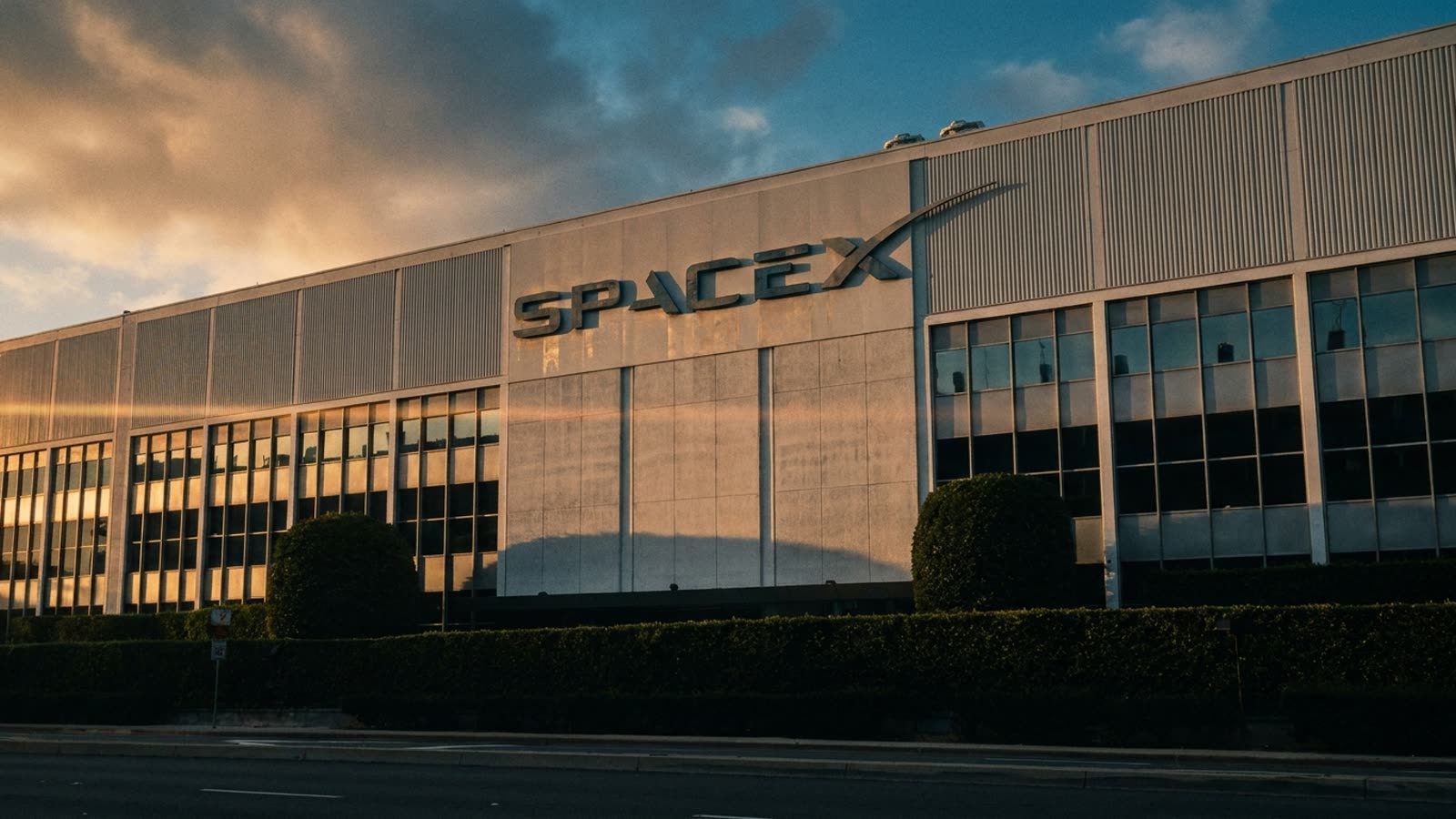
Elon Musk announced Wednesday that SpaceX and Tesla are "exploring" a merger, a transaction that would create a company worth well north of three trillion dollars and consolidate his sprawling interests in electric vehicles, rockets, satellite internet, and — crucially — artificial intelligence into a single corporate entity. The word "exploring" is doing a lot of work; Musk controls both firms and could, in theory, push the deal through with minimal external opposition. The question is not whether he can do it, but why he wants to do it now.
The answer, almost certainly, is AI.
The autonomy thesis
Tesla's valuation has always rested on a bet that its fleet of vehicles would one day become a self-driving robotaxi network, generating software-like margins on hardware already sold. SpaceX, meanwhile, operates Starlink, the satellite constellation that provides low-latency connectivity to remote corners of the planet — and, increasingly, to autonomous systems that cannot rely on terrestrial infrastructure. Merge the two, and you get a company that manufactures the robots, trains the models on billions of miles of real-world driving data, and owns the orbital backbone that keeps them connected. No other firm on Earth possesses all three layers of that stack.
Musk's xAI venture, which built the Grok family of large language models, would presumably slot into this structure as the reasoning engine. Tesla's Optimus humanoid robots, still in pilot production, would gain access to SpaceX's aerospace-grade manufacturing discipline. The synergies are not imaginary; they are, in fact, the entire point.
Governance arbitrage
A merger would also solve a problem Musk has complained about for years: the tyranny of quarterly earnings. Tesla is a public company subject to SEC disclosure rules, activist investors, and the whims of index-fund managers. SpaceX is private, valued on the strength of Starlink's subscriber growth and NASA contracts, and answers to a handpicked board. By folding Tesla into a SpaceX-dominated structure — or vice versa — Musk could engineer a governance regime that insulates his AI ambitions from short-term market pressure.
The precedent is Alphabet's 2015 reorganisation, which created a holding company to house Google's moonshots alongside its advertising cash cow. But Alphabet never controlled the physical infrastructure of autonomy the way a merged Musk entity would. This is less a conglomerate than a vertically integrated state.
Regulatory landmines
Antitrust regulators in Washington and Brussels will scrutinise the deal, though the legal theory is murky. SpaceX and Tesla do not compete directly; their markets overlap only in the speculative future of autonomous transport. The more potent objection may come from national-security hawks worried about a single private actor controlling both America's dominant launch provider and its leading EV-and-AI platform. Musk's erratic public statements — and his entanglements with the Trump administration — will not help.
Our take
Musk is not "exploring" anything. He is signalling. The merger talk is a trial balloon designed to gauge investor appetite and regulatory temperature before committing to a structure that would make him the undisputed sovereign of the autonomy economy. Whether that is good for competition, for safety, or for the democratic accountability of transformative technology is a question the market is not equipped to answer. But the market will price the deal anyway, because that is what markets do.