For two years, the investment thesis was elegant: you don't need to pick the winning AI model if you own the real estate where all the models live. Data centres were the safe bet, the infrastructure play, the gold-rush general store. On Wednesday, that thesis took a 44 percent haircut in a single session.
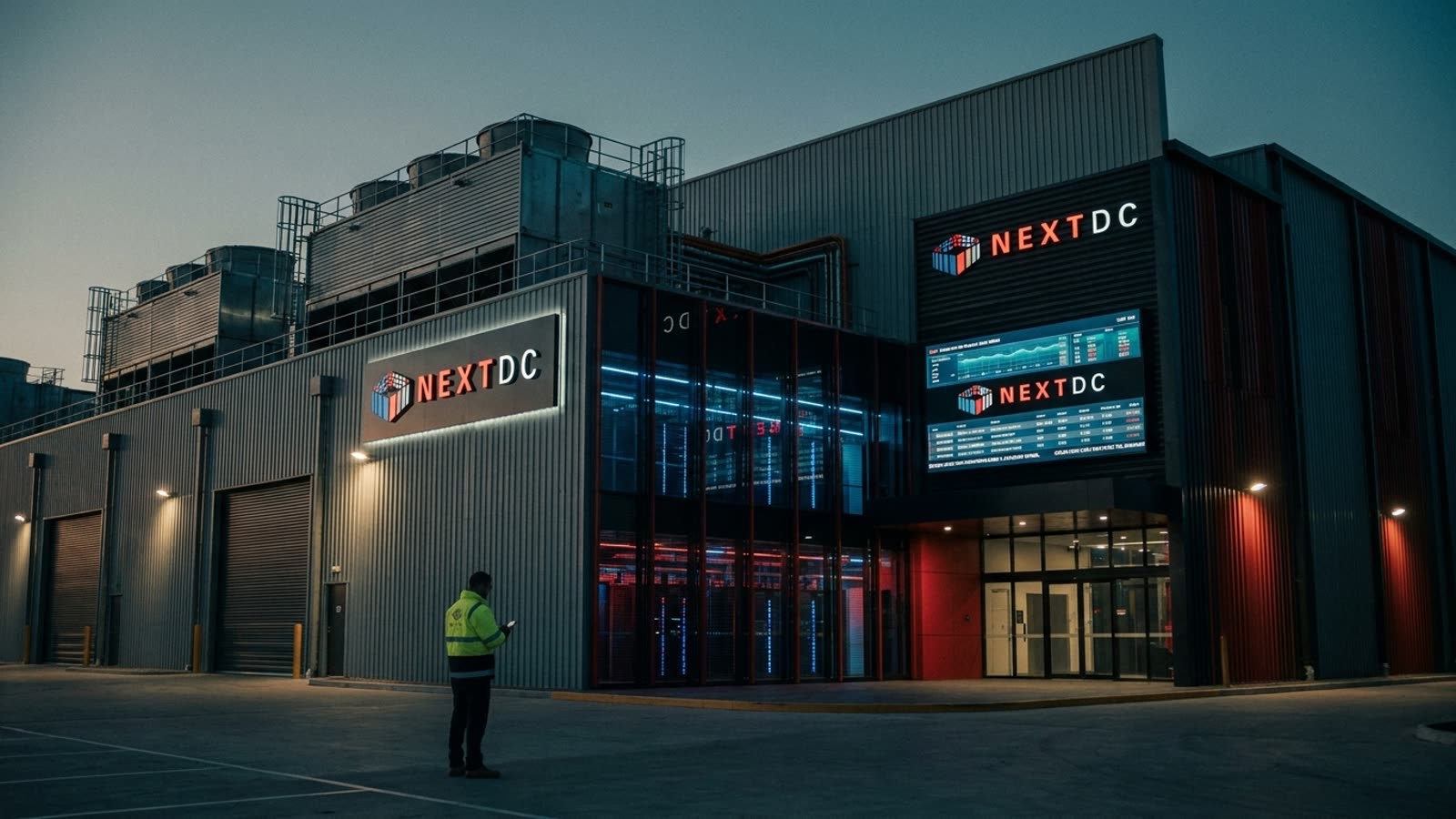
NextDC, Australia's largest independent data centre operator, issued a profit warning that sent its shares into freefall and wiped roughly A$4 billion from its market capitalisation before lunch in Sydney. The company blamed delayed enterprise commitments and softer-than-expected hyperscaler demand—polite corporate language for "the customers we were counting on haven't shown up."
The contagion spreads
NextDC is not an isolated case. The same morning, Nvidia was reportedly in emergency talks to inject capital into Firmus, a smaller data centre group whose IPO collapsed last month. Nscale, another Nvidia-backed infrastructure player, had its founder Josh Payne publicly reassuring staff that demand remains "insatiable"—the kind of statement executives make when they fear employees are updating their CVs.
The pattern is familiar from previous tech cycles: infrastructure spending runs ahead of actual revenue, funded by the assumption that demand will catch up. When it doesn't—or doesn't fast enough—the correction is brutal. Data centres have particularly unforgiving economics: massive upfront capital expenditure, long construction timelines, and customers who can renegotiate or delay commitments with relative ease.
The hyperscaler hesitation
What's changed is the behaviour of the hyperscalers themselves. Microsoft, Google, and Amazon have all quietly extended their AI infrastructure timelines in recent quarters, spooked by the slower-than-expected enterprise adoption of generative AI tools. The killer app that would justify trillion-dollar infrastructure buildouts has not materialised. Copilot is useful; it is not yet indispensable. Claude writes good prose; it does not yet replace departments.
This hesitation cascades downward. When Microsoft delays a data centre expansion in Singapore, NextDC's forward bookings in Sydney evaporate. When Amazon renegotiates power contracts in Virginia, Firmus's London IPO becomes uninvestable. The AI supply chain is globally interconnected, and so is its anxiety.
Our take
The AI revolution is real, but revolutions rarely proceed on the timeline that investors price in. NextDC's collapse is not a verdict on artificial intelligence—it's a verdict on the assumption that infrastructure demand would grow linearly and indefinitely. Some data centre operators will survive and thrive; others were always dependent on a greater fool arriving before the debt came due. The market is now sorting which is which, and the sorting is not gentle.