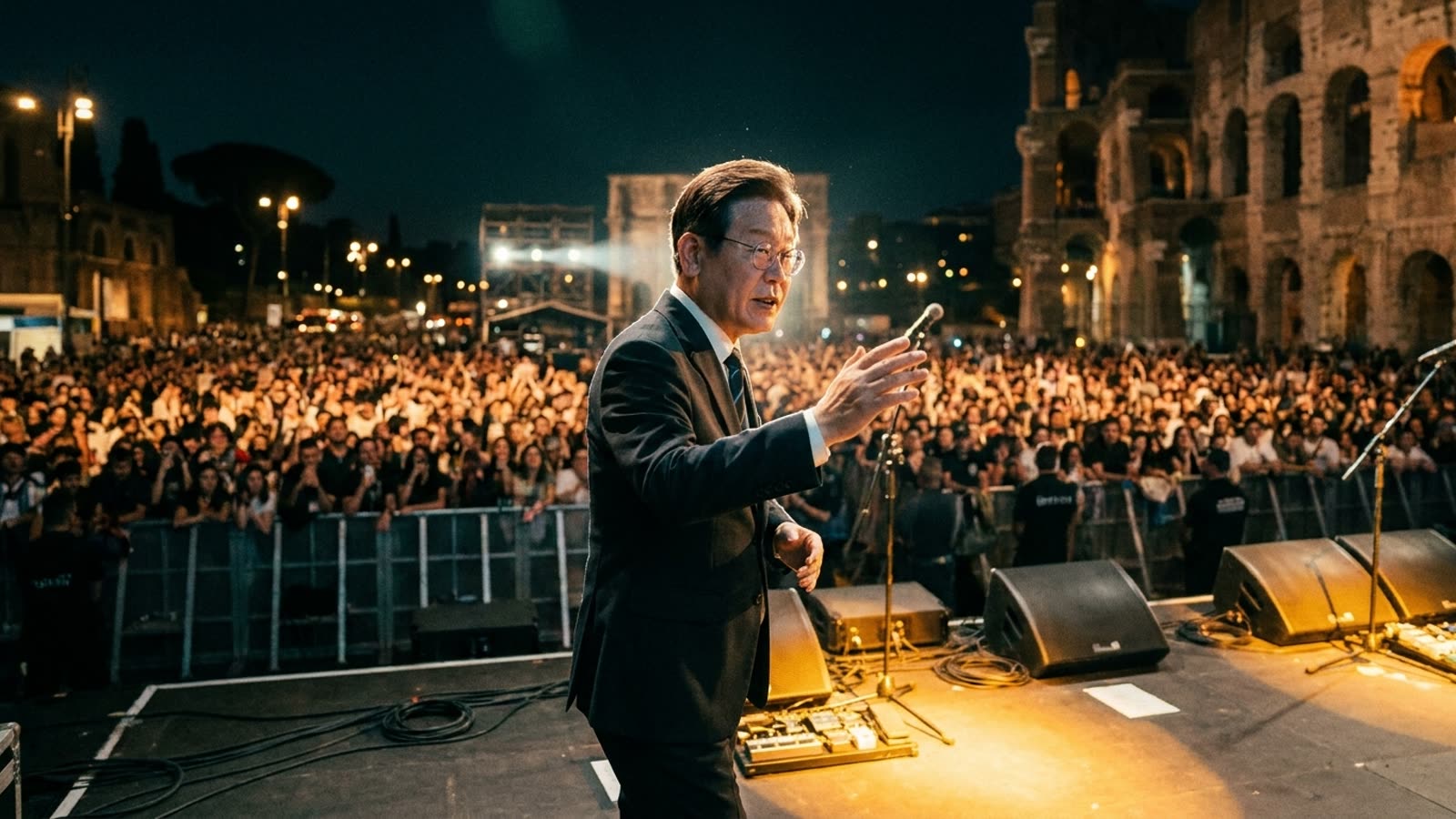
Six months into his presidency, Lee Jae-myung is doing what progressive South Korean leaders have always done when they sense drift in the alliance with Washington: he is cultivating alternatives.
The state visit to Italy this week is Lee's third European stop since taking office in January, following summits in Berlin and Paris. The official agenda covers defense-industrial cooperation, semiconductor supply chains, and cultural exchange. The subtext is rather more pointed. Seoul is hedging.
The Washington question
Lee's election last December marked a sharp pivot from the conservative Yoon Suk-yeol administration, which had leaned hard into the U.S.-Japan-South Korea trilateral framework. Lee, a former Gyeonggi Province governor who survived an assassination attempt during the campaign, has not repudiated that architecture outright — doing so would be politically suicidal given North Korean provocations — but he has quietly signaled skepticism about putting all of Seoul's eggs in the American basket.
The concern is not abstract. Washington's on-again, off-again approach to tariffs, its unpredictable posture toward Pyongyang, and its growing preoccupation with domestic manufacturing have left South Korean policymakers uncertain whether the security umbrella will hold its shape. Lee's team believes that deeper ties with European middle powers offer insurance without the diplomatic cost of appearing to abandon the alliance.
Why Rome matters
Italy is not an obvious partner for South Korea, but that is part of the appeal. Rome sits outside the fraught politics of Northeast Asia. It has a defense industry eager for export markets and a manufacturing base that complements rather than competes with Korean conglomerates. The two countries signed a preliminary agreement on naval shipbuilding cooperation, and discussions on joint ventures in aerospace are reportedly advanced.
For Lee, there is also a domestic audience. His progressive base is skeptical of military spending, but framing defense partnerships as industrial policy — jobs in Busan and Ulsan — makes the medicine easier to swallow.
Our take
Lee is playing a careful game. He cannot afford to alienate Washington, but he also cannot afford to be seen as a supplicant. The European tour is diplomatic theater, yes, but it is theater with a purpose: reminding the Americans that South Korea has options, and reminding his own electorate that sovereignty means more than hosting U.S. troops. Whether Rome and Berlin can actually substitute for the Seventh Fleet is another question entirely — but the symbolism, for now, is the point.