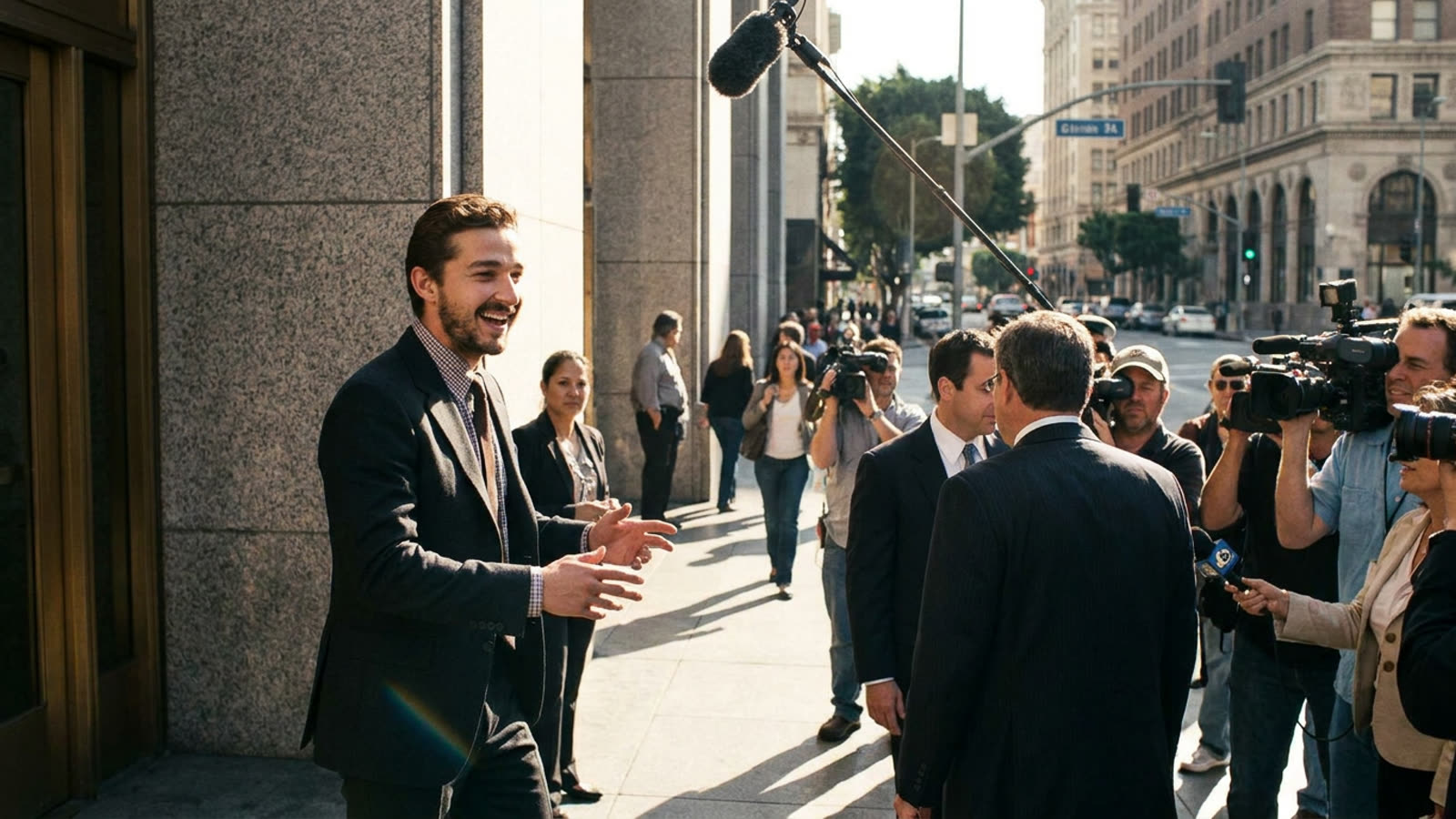
Shia LaBeouf turned 40 this week with a quiet stroll alongside his girlfriend, a tableau of domestic normalcy that belies one of the most turbulent careers in modern entertainment. The actor recently avoided jail time in his latest legal entanglement, adding another chapter to a biography that reads less like a Hollywood story than a clinical case study in self-sabotage and survival.
The birthday images — casual, sunlit, unremarkable — carry weight precisely because of their ordinariness. For an actor whose public appearances have historically involved police reports, viral meltdowns, and performance-art provocations, a simple walk represents something approaching revolution.
The pattern that refuses to break
LaBeouf's trajectory from child star to prestige actor to cautionary tale has been documented exhaustively, yet the repetition itself has become the story. Since his Disney Channel days through his Transformers blockbuster era and into his indie-darling reinvention, the cycle has remained consistent: acclaimed work, public crisis, apparent redemption, then collapse. His 2020 accusations of abuse from former partner FKA twigs seemed to mark a definitive end, yet here he stands, still working, still walking free, still somehow maintaining a career.
The entertainment industry's relationship with LaBeouf reflects broader questions about accountability, rehabilitation, and the peculiar amnesia that attends genuine talent. His performance in last year's Padre Pio earned genuine critical respect, suggesting that whatever personal demons persist, the craft remains intact.
The girlfriend question
His current relationship has drawn scrutiny partly because stability itself seems foreign to the LaBeouf narrative. The actor has been linked to various partners through his years of chaos, each relationship eventually subsumed by whatever crisis came next. Whether this one represents genuine change or merely the calm before another storm remains the question that hangs over every paparazzi shot.
Hollywood has historically rewarded comeback narratives, but LaBeouf's version lacks the clean arc the industry prefers. There has been no single moment of reckoning, no definitive bottoming-out followed by triumphant return. Instead, there is this strange persistence — legal troubles that never quite result in consequences, controversies that fade without resolution, talent that refuses to be extinguished by the person wielding it.
Our take
At 40, LaBeouf has outlasted predictions of his demise so many times that the predictions themselves have grown tired. The birthday stroll photographs will circulate, inspire brief commentary, and disappear into the endless churn. What they represent is harder to name: not redemption exactly, nor defiance, but something more unsettling — the demonstration that in Hollywood, certain talents operate under different gravitational laws. Whether that reflects the industry's capacity for forgiveness or its moral bankruptcy depends entirely on which part of his story you choose to remember.