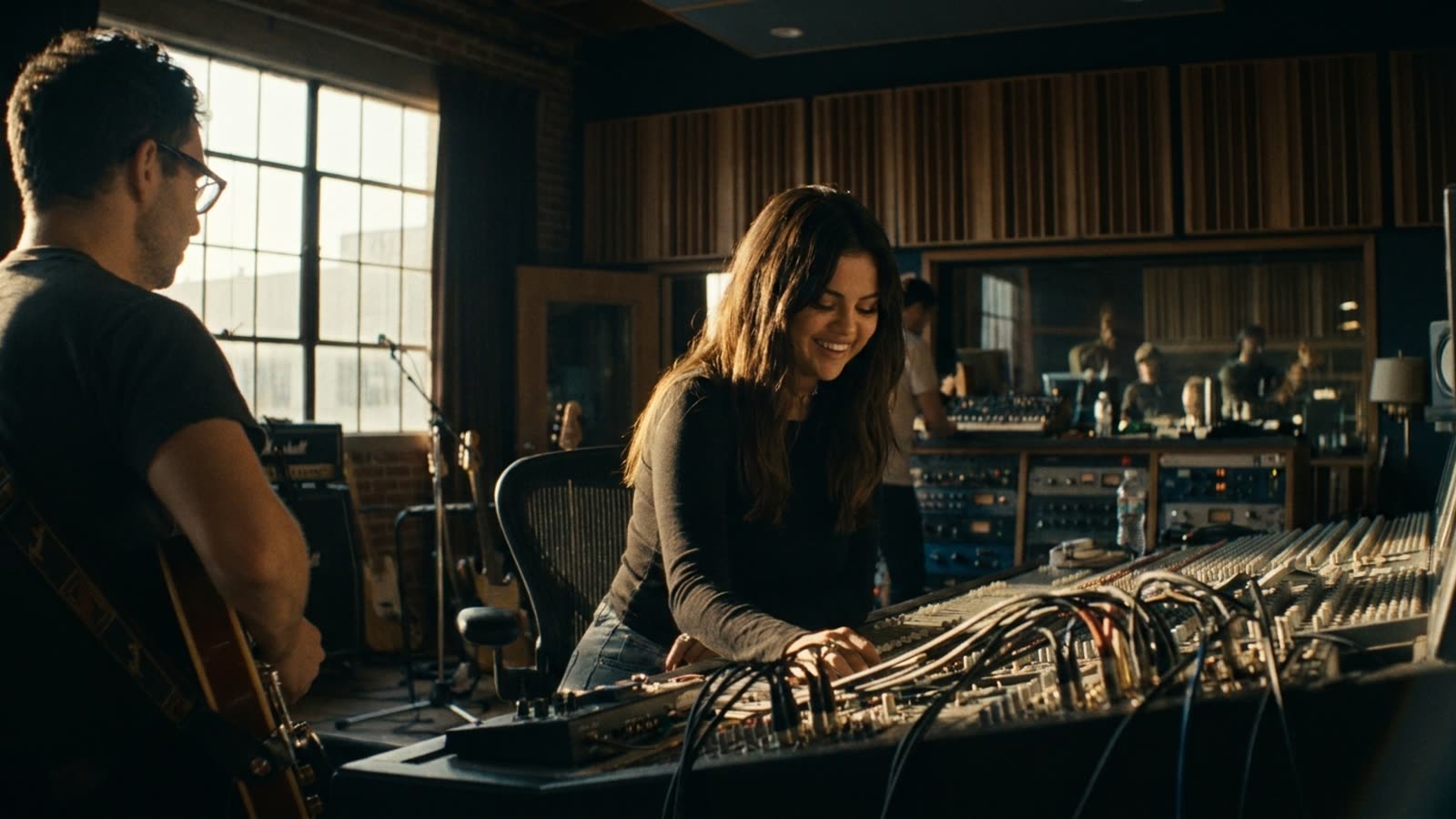
The most consequential collaborations in pop music rarely announce themselves with fanfare. They emerge from studio sessions that run long, from creative chemistry that neither party fully anticipated, and from the kind of mutual artistic respect that publicists cannot manufacture. Selena Gomez and Jack Antonoff appear to be building exactly this kind of partnership — and the implications for both careers are more significant than the celebrity press has acknowledged.
Antonoff, the producer-songwriter who has shaped the sound of the 2020s as definitively as anyone, has spent the past decade becoming pop's most sought-after collaborator. His work with Lorde, Lana Del Rey, and most famously Taylor Swift has established a sonic vocabulary — layered synthesizers, emotional crescendos, production that sounds simultaneously intimate and arena-ready — that has become the dominant aesthetic of prestige pop.
The strategic logic
For Gomez, the partnership represents something more than another A-list collaboration. Her musical career has always existed in productive tension with her acting work and her Rare Beauty empire, which reportedly reached a $2 billion valuation. Unlike peers who have committed fully to the album cycle treadmill, Gomez has released music sporadically, prioritizing quality over quantity in a streaming era that rewards the opposite.
Antonoff offers her something specific: credibility with the critical establishment that has sometimes dismissed her as a celebrity who happens to sing. His production has a way of elevating artists in the eyes of music publications that would otherwise ignore them. For an artist whose acting in Emilia Pérez earned her a Cannes Best Actress honor, the musical gap in her critical reception must feel increasingly anomalous.
What this means for the sound
Antonoff's recent work has grown more experimental — the Bleachers albums have become increasingly personal, his production for other artists more willing to sit in discomfort rather than resolve immediately into hooks. If Gomez is indeed working with him on new material, we should expect something that sounds less like Rare and more like the moody, textured work he has done with Del Rey.
The timing matters too. Gomez has been remarkably candid about her mental health journey, and Antonoff has proven adept at translating that kind of vulnerability into songs that feel confessional without becoming maudlin. His best work turns private pain into something that sounds like a shared experience.
Our take
Hollywood friendships and professional partnerships blur constantly, and most of them produce nothing worth remembering. But Antonoff has an almost uncanny ability to identify artists at inflection points in their careers and help them become more fully themselves on record. Gomez, at 33, with a cosmetics empire and an acting career that has finally earned the respect it deserves, seems ready to make music that matches her ambitions elsewhere. If Antonoff is the one helping her get there, her next album might be the one that finally silences the skeptics who never quite took her seriously as a musician. The pop landscape could use exactly that kind of surprise.