Marc Benioff's company wants to be the operating system for American defense, and it is buying its way there one startup at a time.
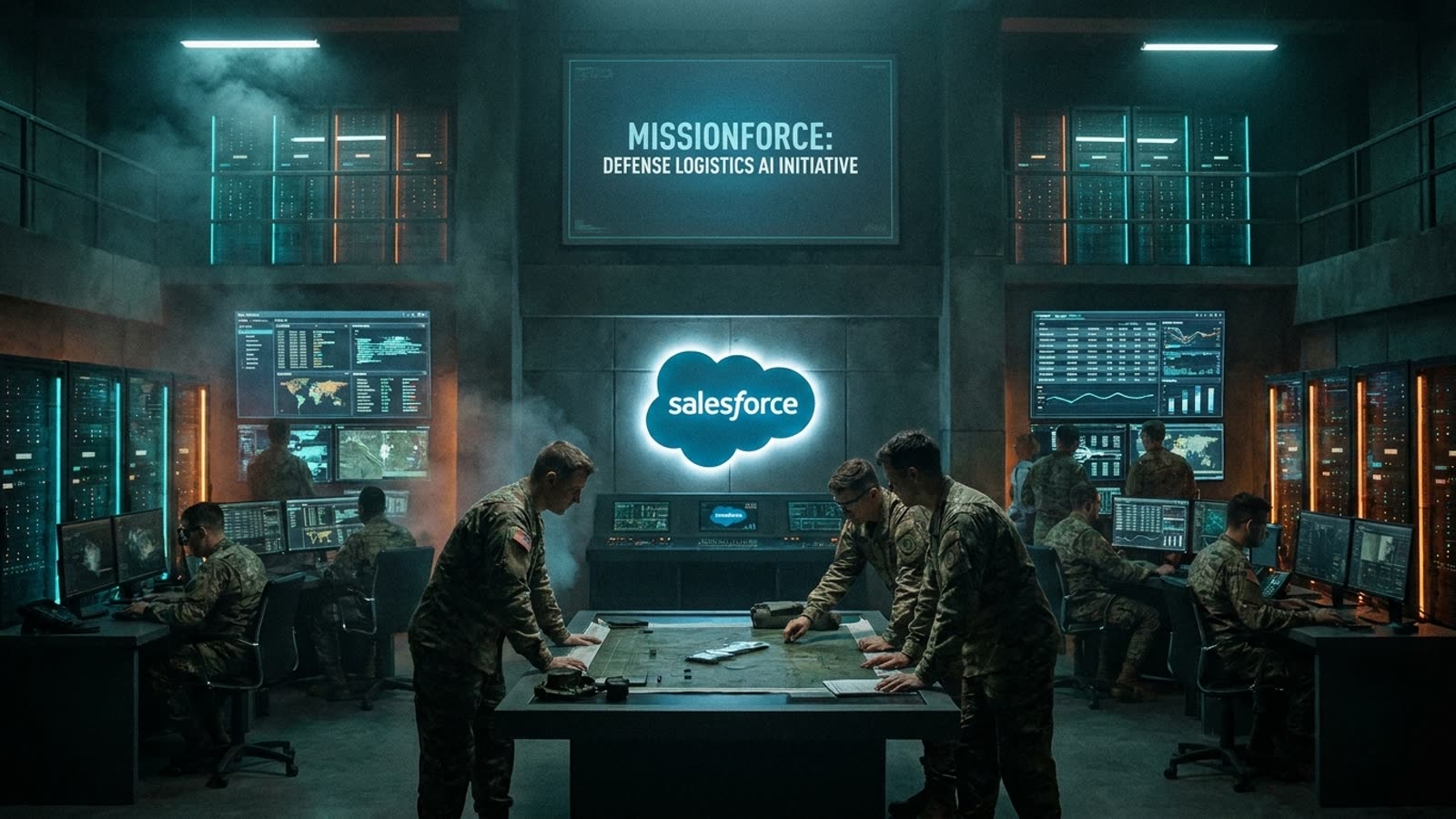
Salesforce's reported $375 million acquisition of Rune, a defense-focused AI logistics startup, represents the latest brick in an edifice the San Francisco software giant has been constructing with increasing urgency. Rune's technology—AI systems that optimize military supply chains, predict equipment failures, and coordinate troop movements—will be folded into Missionforce, Salesforce's platform for government and defense clients that has grown from afterthought to strategic priority.
The defense pivot accelerates
Salesforce spent decades as the friendly face of enterprise software, selling customer relationship management tools to sales teams who wanted better spreadsheets. The defense push marks a harder edge. Missionforce, launched in 2024, was initially positioned as a modest government vertical. Two years and several acquisitions later, it has become something more ambitious: a unified platform that promises to bring Salesforce's cloud infrastructure, AI capabilities, and data management to military operations.
Rune is the third defense-adjacent acquisition Salesforce has made this year, following deals for satellite imagery analytics and secure communications firms. The pattern suggests Benioff sees an opportunity in the Pentagon's scramble to modernize its technology stack—and in the billions of dollars Congress has allocated for defense AI initiatives.
The competition problem
Salesforce is not alone in this hunt. Palantir has spent two decades building relationships with intelligence agencies. Anduril is the defense darling of Silicon Valley venture capital. Microsoft and Amazon both have substantial government cloud businesses. What Salesforce brings is something different: an installed base of millions of users already fluent in its interface, and a reputation for making enterprise software that people actually use without wanting to defenestrate their laptops.
The bet is that military logistics officers and procurement specialists will find Salesforce's familiar dashboards more intuitive than purpose-built defense systems designed by contractors who have never had to compete for users. It is a reasonable theory, though one that assumes the Pentagon's procurement apparatus can move at anything resembling commercial speed.
Our take
There is something faintly surreal about the company that pioneered the friendly cartoon mascot in B2B software now positioning itself as a defense contractor. But Benioff has always been a pragmatist beneath the Hawaiian shirts and meditation retreats. Defense spending is countercyclical, margins are excellent, and the AI infrastructure Salesforce has built for selling widgets transfers surprisingly well to coordinating military operations. The question is whether Salesforce can navigate the security clearances, congressional oversight, and cultural friction that have humbled other tech companies' defense ambitions. Rune is a small bet in the scheme of Salesforce's balance sheet. The strategic intent behind it is anything but.