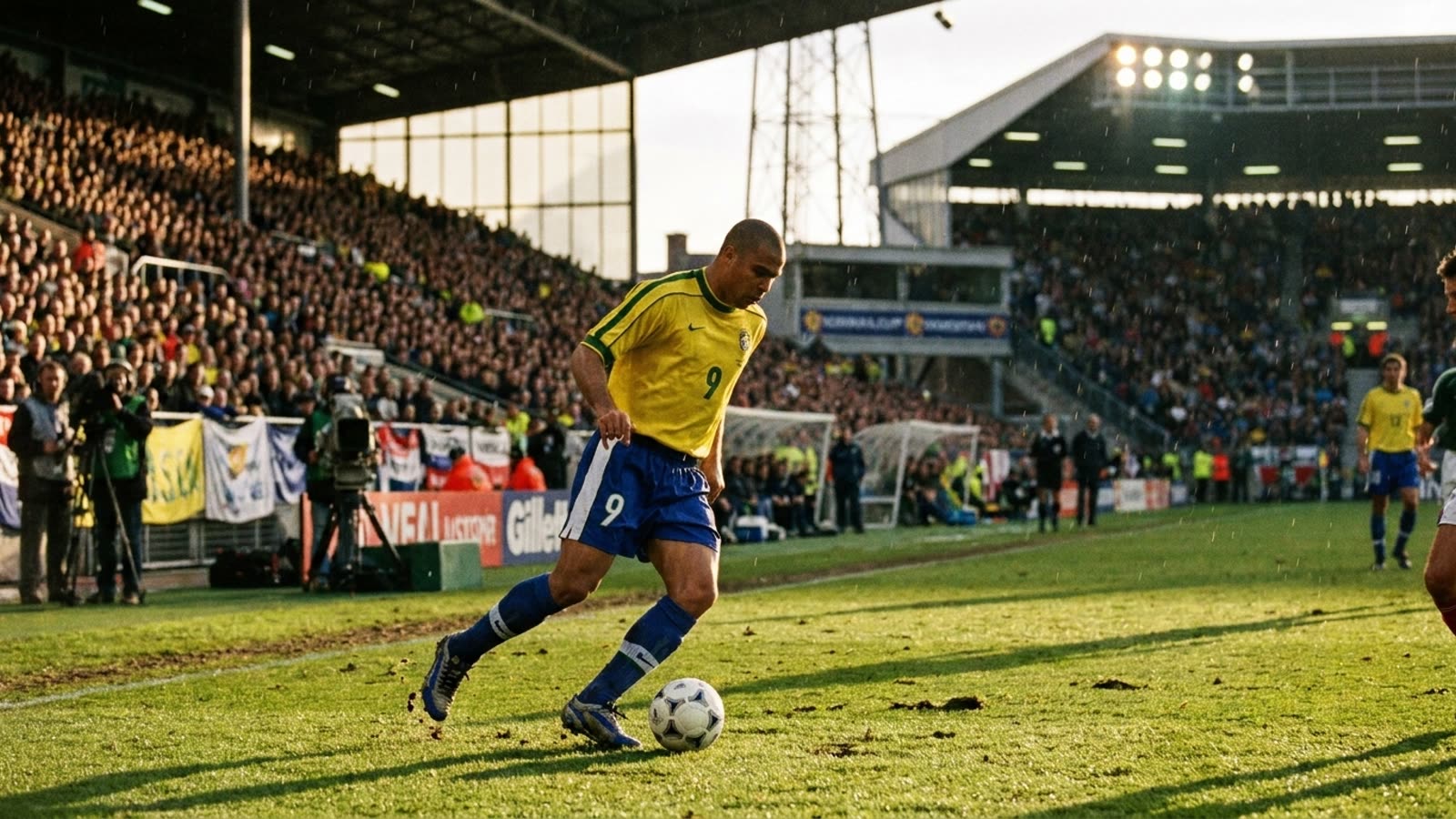
There is a particular kind of football brilliance that announces itself immediately, that requires no context or replay or tactical explanation. You see it and you know. Ronaldo Luís Nazário de Lima had this quality in such abundance that by the time he was twenty, the only debate was whether he might be the greatest player who ever lived.
The debate never got a fair hearing. Injuries intervened with such cruelty and frequency that Ronaldo's career became a meditation on what might have been rather than what was. And yet what was—even the truncated, patched-together version—remains staggering.
The impossible combination
What made Ronaldo singular was not any one attribute but the combination. He was devastatingly fast, but so was Thierry Henry. He was technically immaculate, but so was Dennis Bergkamp. He was physically imposing, but so was Didier Drogba. He possessed extraordinary close control at speed, but so did Lionel Messi. The difference was that Ronaldo had all of these qualities simultaneously, packaged in a frame that seemed purpose-built for destruction.
Watch footage of his goals and you notice something peculiar: defenders often appear to be moving in slow motion. This is not an artifact of camera work. Ronaldo processed the game faster than those around him, and his body could execute what his mind conceived without the usual lag that afflicts even elite players. The ball seemed welded to his foot even as he accelerated past challenges. Goalkeepers committed too early because his body shape gave no reliable tells.
His 1996-97 season at Barcelona, scored at age twenty, remains one of the great individual campaigns in club football history. Thirty-four league goals. The run against Compostela, where he collected the ball inside his own half and simply ran through an entire team, is not a highlight—it is a thesis statement.
The cruelty of cartilage
The first major knee injury came in November 1999, a ruptured tendon that cost him most of two seasons. He returned, improbably, to lead Brazil to the 2002 World Cup with eight goals, including both in the final against Germany. It was a triumph of will as much as talent, achieved on knees that would never fully recover.
The second rupture, in February 2000, was worse. The third, in 2008, ended everything. Between these catastrophes, Ronaldo won two Ballon d'Or awards, two World Cups, and scoring titles in three different leagues. He did this while never again possessing the explosive acceleration that had defined his early years, learning instead to become a different kind of striker—still lethal, but now through positioning and finishing rather than pure physical domination.
What the injuries took was not just speed but the sense of limitless possibility. The young Ronaldo at PSV, Barcelona, and early Inter seemed capable of anything at any moment. The later Ronaldo at Real Madrid was merely one of the best strikers in the world, which felt like a diminishment only because of what had come before.
Our take
Football has produced players with longer careers, more trophies, and more consistent excellence. What it has not produced, before or since, is anyone who combined Ronaldo's particular gifts in quite the same way. Messi and Cristiano Ronaldo have dominated the sport for nearly two decades, but neither has ever possessed the same terrifying directness—the sense that the shortest path between ball and goal ran directly through any obstacle. O Fenômeno earned his nickname honestly. That his body betrayed his talent is football's great tragedy. That he achieved what he did despite those betrayals is its great wonder.