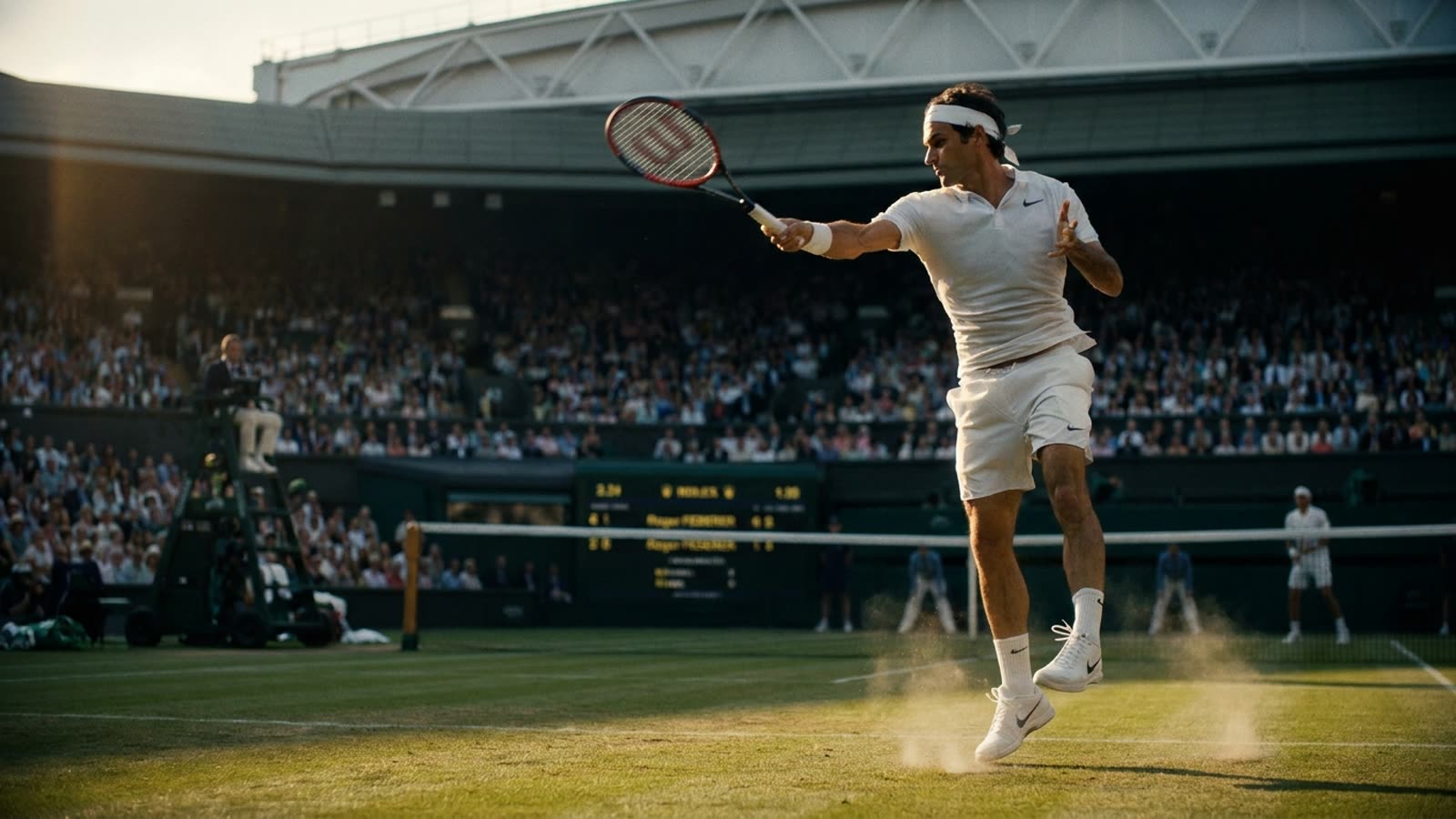
The most radical thing Roger Federer ever did was make it seem like he wasn't trying. In an era of grunting baseline grinders, of athletes who wore their exertion like medals, the Swiss played tennis as if it were a pleasant afternoon activity that happened to take place in front of millions. This was, of course, an elaborate illusion — and perhaps the most technically demanding deception in modern sports.
Federer's footwork alone required thousands of hours of refinement. Watch any slow-motion replay of his movement and you'll notice something peculiar: he seemed to float between positions, arriving at the ball with time to spare while opponents lunged and scrambled. This wasn't natural talent alone. It was the product of obsessive preparation disguised as nonchalance, a magic trick performed in plain sight.
The architecture of ease
What separated Federer from his great rivals wasn't raw power or defensive tenacity — Rafael Nadal and Novak Djokovic arguably surpassed him in those departments. It was his commitment to aesthetic efficiency. Every stroke in his repertoire served multiple purposes: the inside-out forehand that could be a winner or a wrong-footing setup, the slice backhand that bought time while appearing aggressive, the serve that looked languid until it painted the corner at 125 miles per hour.
This economy of motion had practical benefits. Federer's body endured remarkably well into his late thirties precisely because he never fought the ball. Where others muscled through shots, he redirected pace. Where others planted and loaded, he took the ball on the rise and moved through it. The elegance wasn't vanity; it was engineering.
The burden of beauty
Yet there was something almost unfair about Federer's style. It set expectations he couldn't always meet. When he lost — particularly to Nadal in those bruising early finals — the defeats seemed more crushing because the aesthetic contract had been broken. We expected the beautiful game to win, and when it didn't, we felt vaguely betrayed.
Federer himself seemed to understand this burden. In interviews, he rarely discussed the work behind the elegance, as if acknowledging it would spoil the illusion. He spoke instead of instinct, of feeling, of the joy of competition. Whether this was genuine mysticism or careful brand management remains unclear. Probably both.
Our take
Federer's legacy transcends his trophy count, impressive as it is. He proved that excellence and grace need not be adversaries, that the highest levels of competition can accommodate beauty without sacrificing effectiveness. In a sporting culture that often celebrates suffering — the grimace, the scream, the visible toll — he offered an alternative vision: mastery as serenity, dominance as dance. Future champions will win more titles. None will make it look quite so effortless.