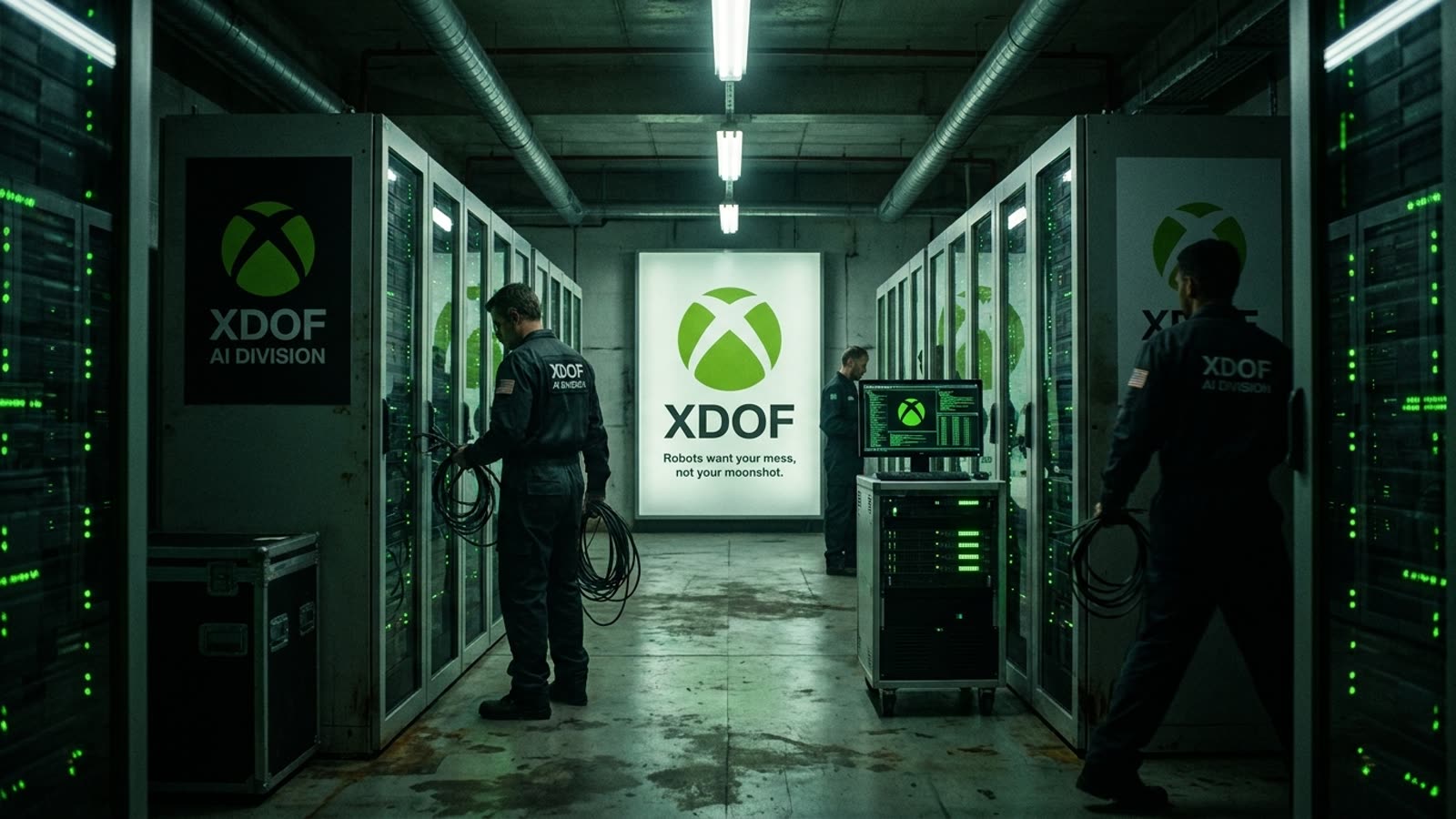
The glamorous story of AI is measured in flops and flashy demos; the real story of embodied AI is measured in zip ties, tape marks on factory floors, and the patience to reset a bin of screws a hundred times. As labs race to teach robots dexterous, general-purpose skills, the constraint isn’t just compute. It’s data—specifically, gritty, hands-on demonstrations that anchor learning in the stubborn physics of the real world. That is the market niche a little-known operator, XDOF, is carving out: getting paid by AI labs to collect the training data nobody wants to admit is indispensable.
Why the best robot data is inconvenient
Large language models gorge on text people already produced. Robots have no such buffet. They need demonstrations: teleoperated maneuvers, kinesthetic teaching, multi-camera captures, and endless environment resets. Synthetic and simulated data help, but the sim-to-real gap remains brutal for contact-rich tasks. Real-world sequences—grasping a slippery bottle, opening a misaligned drawer, clearing a cluttered counter—encode failure modes and friction that perfect physics engines politely ignore. The result is a new cost curve: tokens are pennies; minutes of teleoperation are dollars, plus ergonomic strain, liability, and downtime. Firms like XDOF are productizing that pain, offering repeatable pipelines for messy, high-signal data that models can actually use.
The labor behind the learning
This is data work with splinters. It blends the invisible labor of data labeling with the physical risks of light industrial temping. Who owns a demonstration recorded in a private warehouse? How are workers protected when a six-degree-of-freedom arm misbehaves? What does “quality control” mean when a small bias in wrist angle quietly cascades into brittle policies? If this sector scales, expect familiar platform dynamics: pay-per-demo piecework, pressure to hit throughput targets, and a race to standardize capture rigs to squeeze variance out of the pipeline. The ethical bar can’t be an afterthought; it’s the substrate the models learn from.
Strategy: data gravity, not just GPU gravity
Compute is commoditizing at the margin; good robot data is not. The teams that assemble large, diverse, high-fidelity corpora of physical interactions will possess the leverage to tune frontier policies, benchmark credibly, and iterate faster. That favors operators who can deliver breadth—surfaces, lighting, clutter, human co-presence—at industrial scale, with meticulous metadata and repeatability. It also reorders moats: less about owning a proprietary gripper, more about owning the million nuanced attempts that taught it what not to do. If standardized capture kits and QA emerge, we may see an “AWS for robot data,” and the API will be a signed stream of mistakes.
Our take
Embodied AI’s inflection won’t arrive on a keynote slide; it will arrive in pallets, carts, and careful protocols. Paying specialists to harvest high-quality, physical demonstrations is not a detour—it’s the on-ramp. The winners will treat this as infrastructure, not a gig. If the industry invests in safety, consent, and standards now, the reward is compounding data that models can truly learn from. If it doesn’t, the robots will faithfully reproduce our shortcuts—and our blind spots.