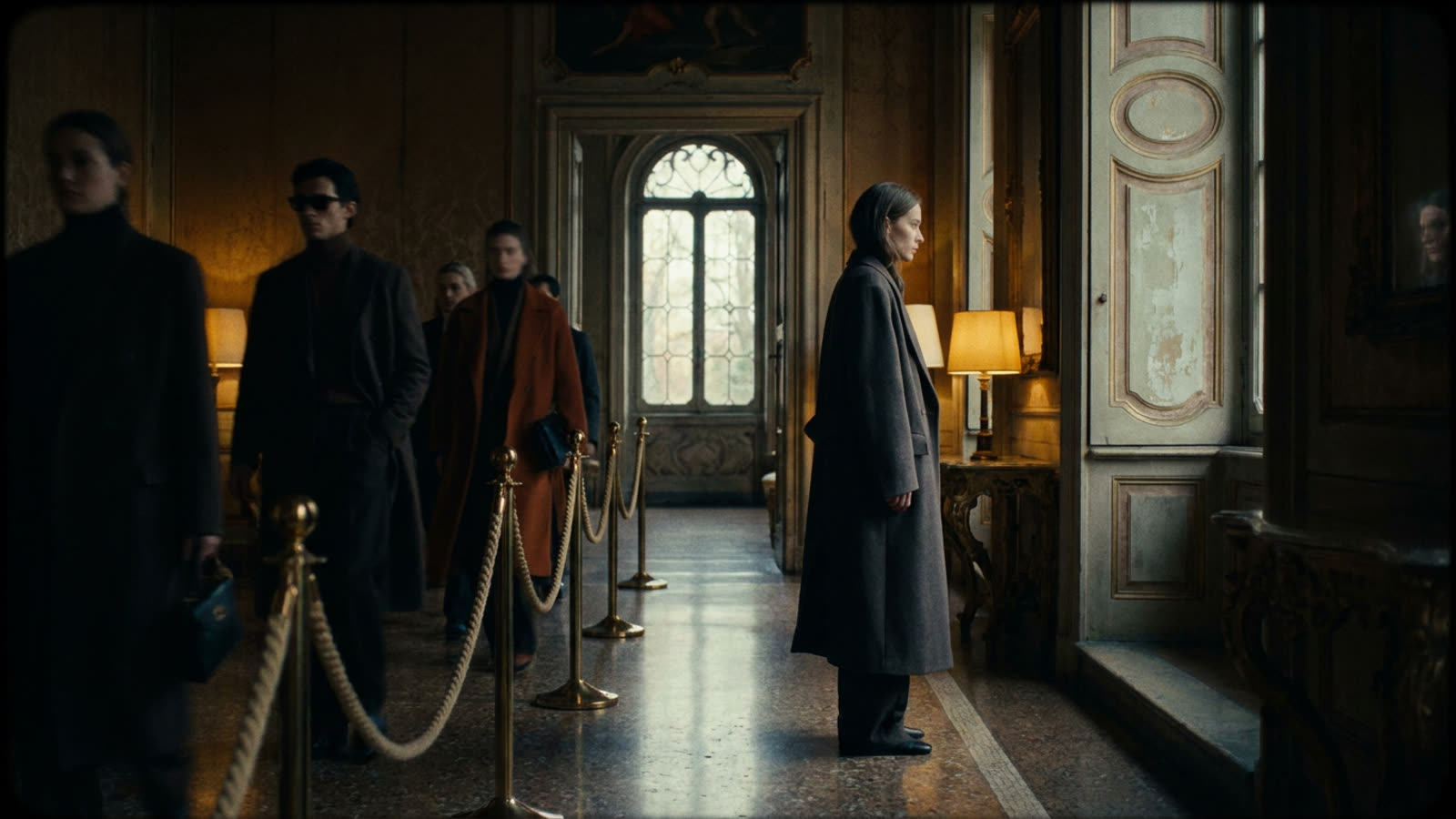
The most expensive outfit in any room is now the one you cannot identify. This is the central paradox of quiet luxury, the aesthetic movement that promised to liberate the wealthy from the vulgarity of visible branding only to create an entirely new hierarchy of coded signals that the initiated read as fluently as their predecessors once read Gucci's interlocking Gs.
The term itself emerged from fashion commentary in the early 2020s, though the sensibility it describes is far older. Old money has always dressed to be recognized by other old money and ignored by everyone else. What changed was the democratization of this aspiration, driven partly by the HBO series Succession and its parade of billionaires in unmarked navy sweaters, and partly by a broader cultural exhaustion with the Instagram era's performative consumption.
The Brunello Cucinelli problem
The Italian house Brunello Cucinelli became the unlikely avatar of this movement, its dove-gray cashmeres and oatmeal linens serving as the uniform of a new discretion. The brand's revenues have grown substantially over the past several years, proving that there is enormous money in selling the appearance of not caring about money. Loro Piana, owned by LVMH, occupies similar territory, as does The Row, the label founded by Mary-Kate and Ashley Olsen that charges several thousand dollars for a white T-shirt whose only distinguishing feature is that it has no distinguishing features.
The irony is obvious but worth stating plainly: quiet luxury is now extremely loud. The aesthetic has been codified, dissected, and replicated at every price point. Zara and Mango sell "quiet luxury" capsule collections. TikTok creators post tutorials on achieving the look affordably. What was once a refusal to participate in fashion's signaling games has become the most legible signal of all.
The next move
The truly wealthy have already begun their retreat. Some have embraced what might be called "loud quiet luxury," wearing pieces so aggressively plain that their expense becomes a kind of taunt. Others have moved toward deliberate eccentricity, the logic being that only someone with genuine security would wear something so unflattering. Still others have abandoned the game entirely, dressing with such complete indifference that no algorithm can categorize them.
The deeper shift may be away from clothing as the primary vehicle of status signaling altogether. Real estate, experiences, access, health—these are the new luxury goods, and they have the advantage of being genuinely difficult to replicate at lower price points. You can buy a convincing quiet-luxury sweater for under two hundred dollars. You cannot buy a convincing house in Portofino.
Our take
Quiet luxury was always a fantasy, the idea that wealth could be enjoyed without the moral complications of display. Its rapid absorption into the mainstream proves that fashion cannot escape its fundamental nature as a system of distinction. The rich will always find new ways to signal to each other, and the rest of us will always eventually decode those signals and replicate them. The only winning move, as the old money always knew, is not to care whether you win.