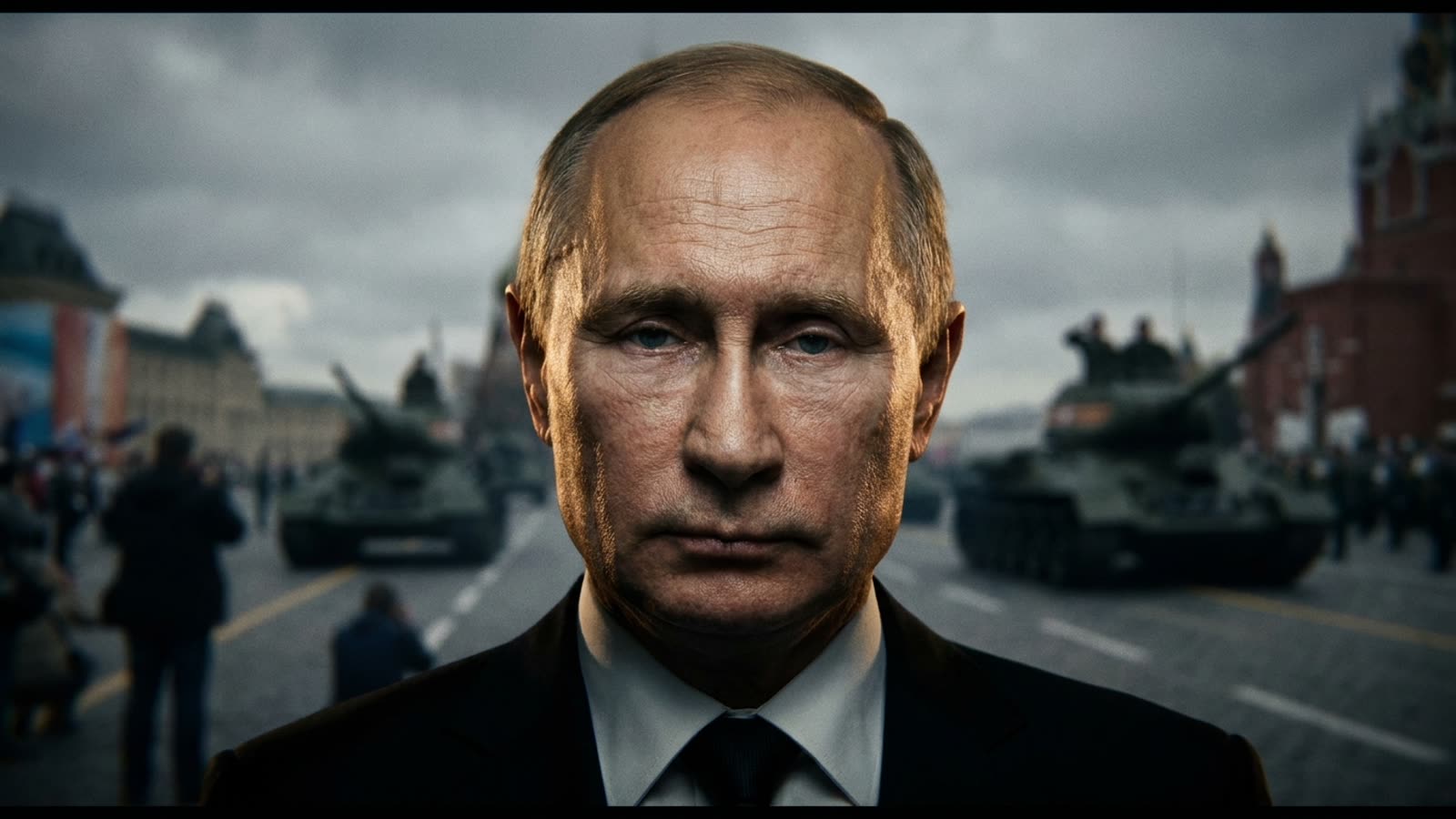
For three decades, Victory Day has been Vladimir Putin's liturgy of power—columns of tanks rolling through Red Square, nuclear-capable missiles glinting in the May sun, the implicit message that Russia remains undefeatable. This year the choreography cracked. Citing security concerns, the Kremlin staged a truncated parade, with fewer troops, shorter routes, and a palpable nervousness that no amount of martial music could drown out.
The official explanation—unspecified threats—is itself the story. Moscow has endured Ukrainian drone strikes with increasing frequency; air-defense systems now dot the capital's rooftops. Scaling back the one event designed to project invincibility is an admission that the war Putin launched in February 2022 has migrated home in ways the regime never advertised to its citizens.
The symbolism Russia cannot spin
Victory Day commemorates the Soviet defeat of Nazi Germany, and Putin has spent years inflating its significance to justify his own military adventures. The parade is not merely a parade; it is the visual proof that the state can mobilize, coordinate, and intimidate. A diminished version tells domestic audiences—and foreign capitals—that resources are stretched, that the threat environment has changed, and that the Kremlin's information managers are running out of ways to frame sacrifice as triumph.
What the West should read into the optics
Western analysts have long debated whether Putin faces meaningful internal pressure. A scaled-back parade is not a coup, but it is a data point. The Russian president built his legitimacy on stability and strength; both are now visibly contested. European and American policymakers watching the footage will note that sanctions, military aid to Ukraine, and Kyiv's own drone campaigns are producing cumulative effects that even state television cannot fully obscure.
The home-front calculus
Ordinary Russians have been told the "special military operation" is proceeding according to plan. A truncated parade, combined with sporadic evacuations and air-raid alerts in border regions, complicates that narrative. The Kremlin still controls most information flows, but cognitive dissonance has a half-life. Each visible concession to reality—fewer tanks, shorter marches, tighter security—chips away at the fiction of a contained, victorious campaign.
Our take
Putin has always understood spectacle as statecraft. That he could not, or would not, deliver the full pageant this year matters more than any single battlefield dispatch. Wars are won and lost in morale as much as in territory, and the Russian president just told his own people, however obliquely, that the capital is no longer a sanctuary. The West should take note—and keep the pressure on.