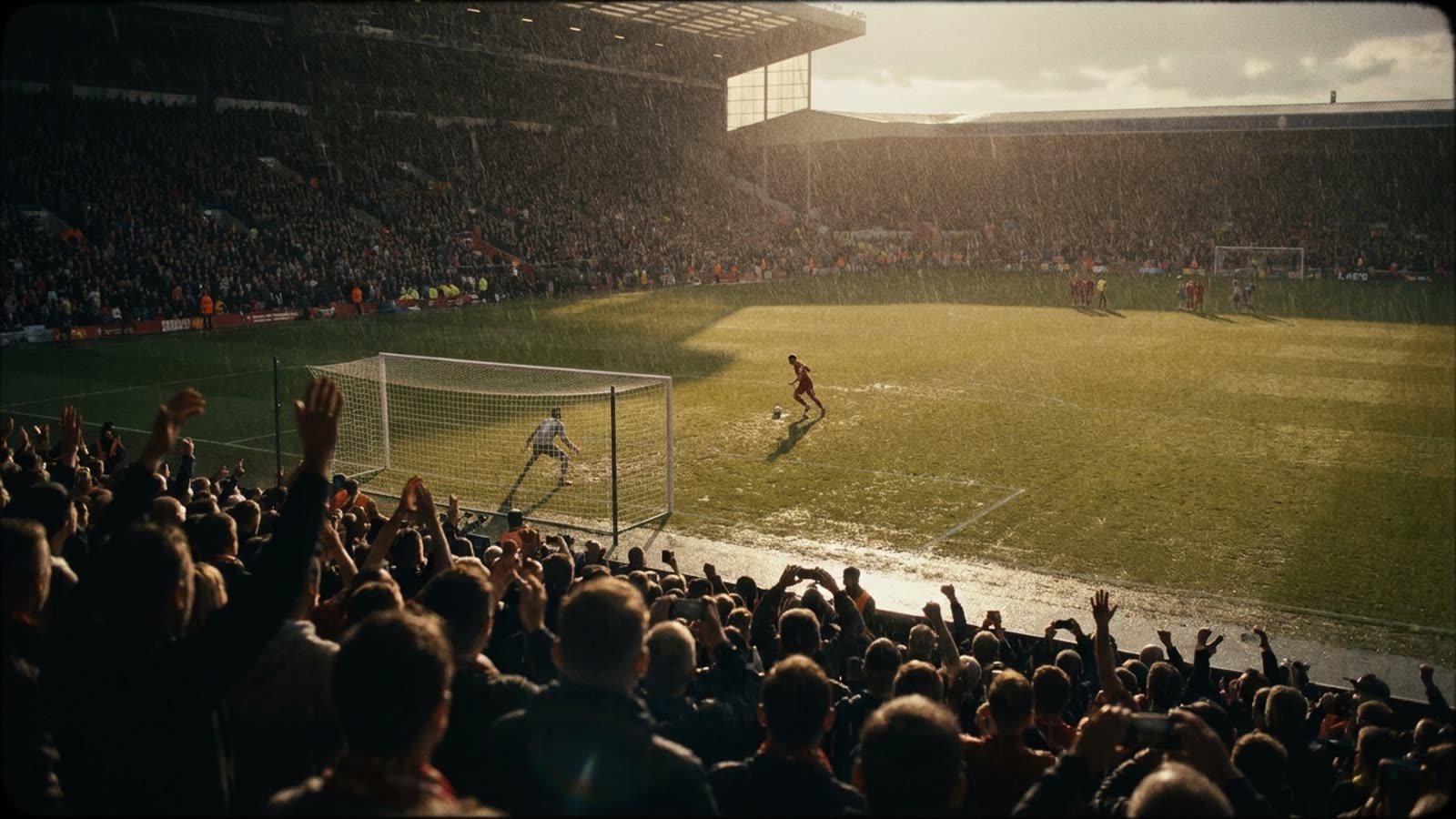
The walk from the center circle to the penalty spot takes roughly fifteen seconds, but it contains multitudes. In that brief transit, a footballer transforms from a component of an eleven-person tactical system into something far more exposed: a solitary figure whose next action will be replayed, analyzed, and remembered for decades. The penalty shootout is football's most psychologically naked moment, and its persistence at the summit of the sport's biggest competitions tells us something important about what we actually want from athletic spectacle.
The shootout's critics have always been vocal. It reduces the beautiful game to a coin flip, they argue, a lottery unworthy of deciding championships. The statistics partially support this: conversion rates hover around 75 percent, meaning roughly one in four kicks fails regardless of the taker's quality. But this criticism misses what makes the shootout genuinely compelling. It is not a test of footballing skill in the conventional sense. It is a test of something rarer and more difficult to cultivate: the capacity to perform a simple task under unbearable pressure.
The geometry of inevitability
A regulation goal measures eight feet high and twenty-four feet wide. A goalkeeper, arms extended, covers perhaps a third of that space. A well-struck penalty, traveling at typical speeds, reaches the goal line in roughly 0.4 seconds—less time than the human reaction process requires to identify direction and initiate movement. The mathematics should favor the kicker overwhelmingly. That they do not reveals how profoundly pressure distorts execution.
Goalkeepers have learned to exploit this asymmetry. Modern penalty preparation involves exhaustive video analysis of opponents' tendencies, but the deeper skill is performative: the ability to project presence, to make the goal seem smaller through sheer psychological occupation. The best penalty-saving keepers understand they are engaged in theater as much as athletics.
Memory's long shadow
World Cup shootout misses become biographical facts in ways that regular-play misses never do. The player who skies a penalty in a semifinal carries that moment permanently, referenced in every subsequent profile, every career retrospective. This disproportionate weight creates a curious selection pressure: some technically excellent players develop reputations for avoiding shootout responsibility entirely, while others—often not the most gifted—volunteer repeatedly, their willingness itself a form of competitive advantage.
National footballing cultures have developed distinct relationships with the shootout. Some countries carry the accumulated weight of historical failures, each new tournament bringing fresh opportunities to either exorcise or reinforce collective trauma. Others approach the format with apparent equanimity, suggesting that penalty psychology operates at cultural as well as individual levels.
Our take
The shootout's detractors want football decided by football—by the accumulated weight of tactical preparation, physical conditioning, and technical mastery expressed over ninety or more minutes. This is a reasonable position, but it underestimates what the shootout actually tests. The capacity to execute under existential pressure is not a lesser skill than the capacity to execute in flow; it is a different and arguably rarer one. The twelve-yard walk remains sport's purest examination of what happens when everything extraneous falls away and a person must simply perform.