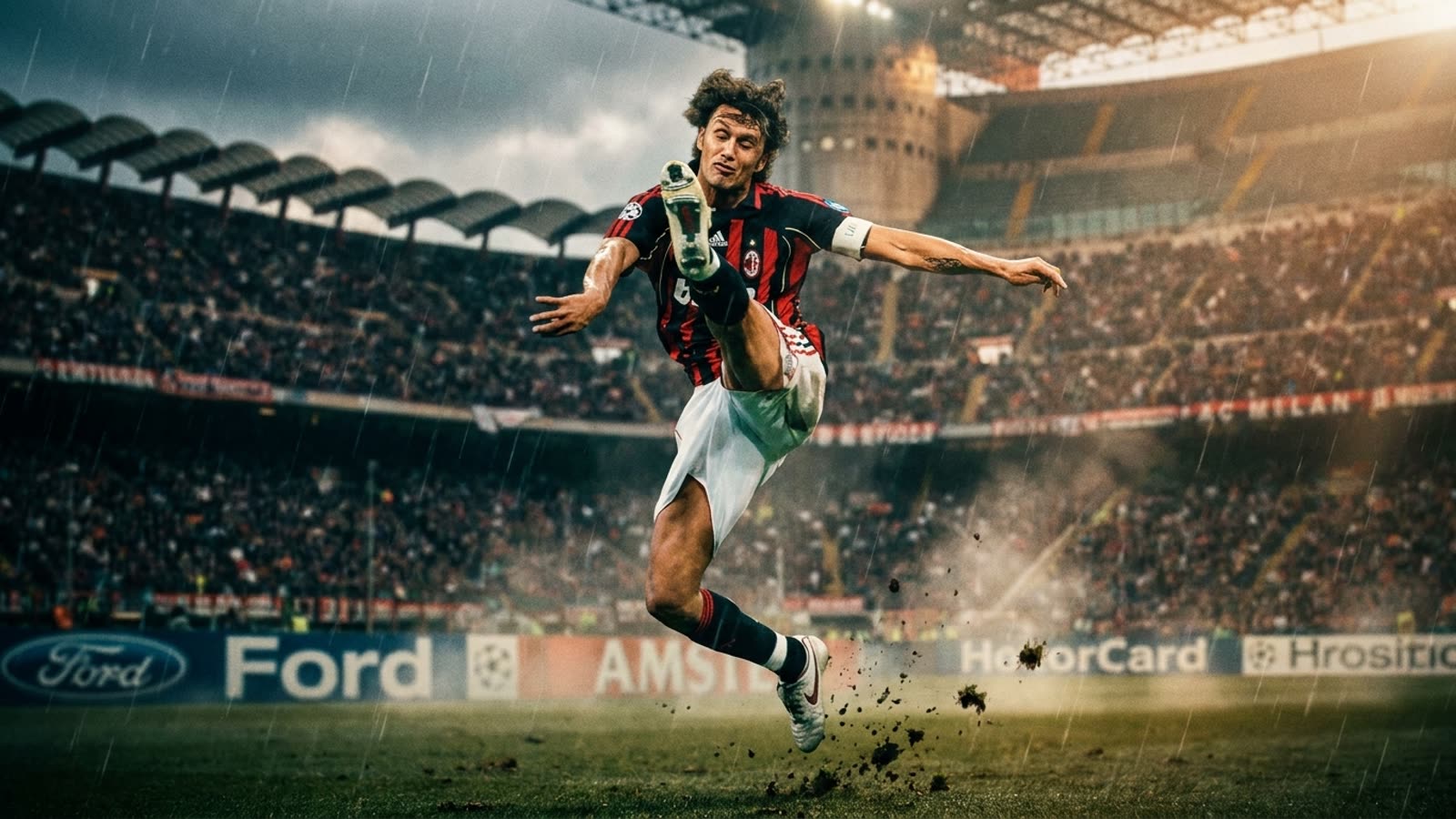
The greatest compliment ever paid to Paolo Maldini came not from a coach or a trophy committee but from the attackers who spent careers trying to get past him. They described the experience as uniquely demoralizing — not because Maldini was brutal or intimidating, but because he made them feel slow-witted. He was already where they wanted to go, positioned with such anticipatory precision that their best moves felt telegraphed.
Maldini's genius resided in economy. In an era when defenders earned reputations through crunching tackles and theatrical clearances, the Italian built his legend on interventions so subtle they barely registered on highlight reels. He claimed to have made perhaps ten sliding tackles in his entire career — an exaggeration, certainly, but one that captured something true. A sliding tackle, in Maldini's philosophy, represented a failure of positioning, a desperate correction for being caught out of place. He preferred never to be caught at all.
The inheritance and the reinvention
Maldini arrived at AC Milan's first team in 1985 carrying a surname that already adorned the San Siro. His father Cesare had captained the club and later managed it. But the younger Maldini quickly established that his presence owed nothing to nepotism. He debuted at sixteen and would not leave for another quarter-century, accumulating more than 900 appearances in Milan's colors — a figure that sounds implausible until you remember he rarely missed matches to injury. His body, like his positioning, seemed engineered for durability.
What distinguished Maldini from other great defenders was his aesthetic completeness. He could mark the world's best attackers into irrelevance, yes, but he could also carry the ball forward with a midfielder's composure, deliver crosses with a winger's accuracy, and read the game with a manager's perspective. Arrigo Sacchi's revolutionary Milan teams of the late 1980s required defenders who could think three passes ahead; Maldini thought five.
The position's evolution
Modern football has embraced Maldini's template in theory while struggling to produce his equal in practice. Today's elite fullbacks are expected to be auxiliary wingers, bombing forward to provide width and creativity. The defensive arts Maldini perfected — the subtle body positioning, the shepherding of attackers into harmless angles, the interception timed to the millisecond — receive less emphasis in youth academies obsessed with possession metrics.
The result is a generation of technically gifted defenders who can play but cannot always defend. When elite attackers isolate modern fullbacks one-on-one, the outcomes frequently favor the attacker. Maldini made such isolations feel like traps he had set. Attackers would receive the ball thinking they had space, only to discover that Maldini had already closed every viable option. The space was an illusion.
Our take
Maldini's career poses an uncomfortable question for football's analytics revolution: can his kind of excellence be taught, or was it something closer to musical talent — identifiable, admirable, but ultimately mysterious in origin? The sport has decided, perhaps prematurely, that defending is less important than attacking, that fullbacks should be judged by their contributions going forward. Maldini would likely find this amusing. He understood that football, at its highest level, is won by players who prevent goals as much as those who score them. The game keeps searching for his successor. It may be searching for a long time yet.