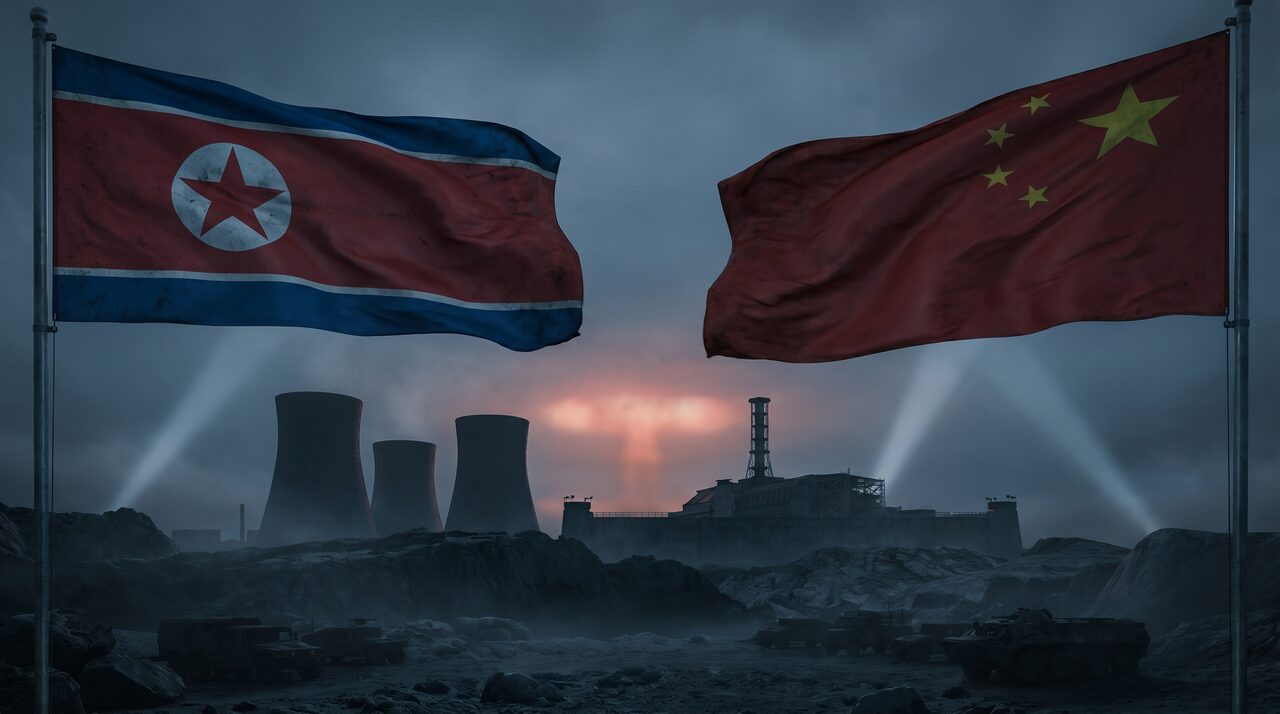
North Korea has thrown down a nuclear gauntlet — and China just signaled it is standing beside Pyongyang.
In a week of dramatic escalation, leader Kim Jong Un unveiled a new plant that produces weapons-grade nuclear material and vowed to expand the country's atomic arsenal "at an exponential rate." Days later, Beijing and Pyongyang jointly announced that Chinese President Xi Jinping will travel to North Korea next week — his first visit since 2019. Together, the two developments mark one of the most significant moments in Northeast Asian security in years.
"Exponential" — Kim's Own Word
Inspecting the new facility, Kim said North Korea has more than doubled its capacity to produce weapons-grade nuclear material in the past five years, and that the new plant will further strengthen its nuclear deterrent, according to state-run KCNA. The language was deliberate and unmistakable: not incremental growth, but exponential.
It is the latest move in a five-year nuclear buildup Kim launched after denuclearization talks with the United States — including three summits with President Donald Trump during his first term — collapsed without a deal.
How Big Is the Arsenal Already?
The numbers are sobering. According to a March Congressional Research Service report, North Korea already possesses enough nuclear material for up to 90 warheads and is believed to have assembled roughly 50.
The International Atomic Energy Agency has identified at least two active enrichment plants — at Yongbyon and Kangson — and has been monitoring construction of a new building at Yongbyon with power and cooling infrastructure resembling an enrichment facility. In April, the head of the U.S. Defense Intelligence Agency told Congress that Pyongyang was "building a probable additional uranium enrichment facility at Yongbyon."
Whether the plant Kim toured is that Yongbyon site or a previously unknown facility remains unclear; KCNA did not disclose the location. It is at least the third time since September 2024 that North Korean state media has shown Kim inspecting a nuclear-material site — a pattern of calculated visibility.
The China Factor: Xi's First Visit Since 2019
The timing of Xi Jinping's announced visit is what elevates this from a North Korean provocation to a regional realignment. A sitting Chinese president traveling to Pyongyang — for the first time in roughly seven years, the day after Kim's nuclear unveiling — is a powerful symbol. Whatever the official agenda, the optics are clear: as Washington pressures adversaries on multiple fronts, Beijing is drawing closer to its most isolated neighbor.
Why It Matters Now
The escalation lands at a fraught moment. Washington is simultaneously trying to broker an end to the months-long U.S.–Israeli conflict with Iran and to stop Tehran from developing nuclear weapons. Kim's "exponential" announcement is a pointed reminder that the country that already crossed the nuclear threshold is not slowing down — it is accelerating, and doing so with apparent confidence that its great-power patron has its back.
For two decades, the international playbook on North Korea has cycled through sanctions, talks, and stalemate. Kim's message this week is that the window for denuclearization — if it ever truly existed — is closing. The arsenal is not a bargaining chip to be traded away. It is, in his framing, a permanent and growing pillar of the state.
The Bottom Line
A new plant. A doubled production capacity. A vow of exponential expansion. And a visit from the Chinese president to underline it all. North Korea is not signaling a willingness to negotiate — it is signaling permanence. And with Xi en route to Pyongyang, the world is being told that Kim does not stand alone.
Reporting based on KCNA statements, IAEA assessments, and U.S. government testimony. Figures on warhead counts are external estimates and cannot be independently verified.