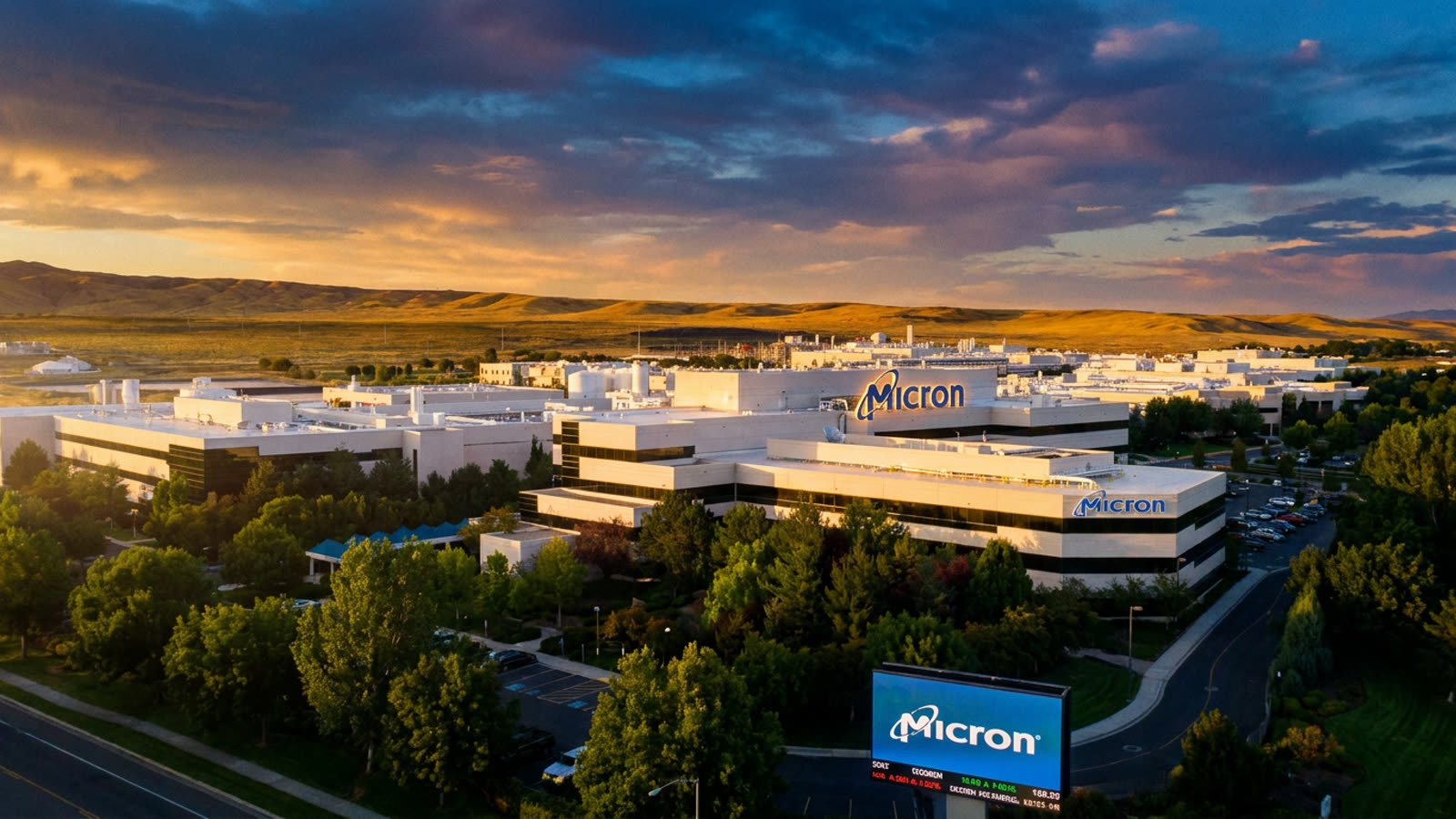
For most of its history, Micron Technology occupied the unglamorous basement of the semiconductor hierarchy: a commodity memory maker grinding through punishing cycles, perpetually one oversupply glut away from margin collapse. That company just crossed $1 trillion in market capitalization, and UBS is telling clients the stock could double again.
The milestone is less about Micron specifically than about a structural repricing of memory's role in the computing stack. High-bandwidth memory (HBM)—the specialized DRAM that sits atop AI accelerators and determines how quickly they can ingest data—has transformed from a niche product into the binding constraint on the entire artificial intelligence buildout. Nvidia cannot ship more GPUs than its memory partners can supply HBM for. That bottleneck has handed Micron, Samsung, and SK Hynix pricing power they have never sustainably possessed.
The math behind the call
UBS's bullish thesis rests on HBM's margin profile. Traditional DRAM sells for roughly $3 per gigabyte in a healthy market; HBM3E commands north of $15. Micron has guided for HBM revenue to exceed $10 billion in fiscal 2026, up from essentially zero three years ago. If AI infrastructure spending continues at anything like current rates—and hyperscalers show no sign of flinching—that figure could triple by decade's end. The analysts argue the market is still valuing Micron as a cyclical commodity play rather than a structural AI beneficiary, leaving substantial upside.
Skeptics note that memory has broken hearts before. Every previous supercycle ended with overcapacity and price collapse. But the HBM market has characteristics that may insulate it: extreme manufacturing complexity (yields remain low even for Samsung), customer qualification cycles measured in years rather than quarters, and a demand curve that tracks AI capex rather than consumer electronics. The competitive moat, in other words, is not just capacity but capability.
What it means for the AI supply chain
Micron's trillion-dollar valuation reshuffles the hierarchy of AI's critical suppliers. The company now trades at a market cap comparable to ASML, the Dutch lithography monopolist, and above TSMC's American depositary valuation. Memory has historically been the semiconductor industry's least defensible segment; it is now being priced as infrastructure.
For hyperscalers, the implication is that memory costs will remain elevated. Unlike logic chips, where TSMC's scale drives relentless cost declines, HBM's supply base is an oligopoly with little incentive to sacrifice margin for volume. AI training runs are already constrained by GPU availability; memory pricing ensures they will also be constrained by economics.
Our take
The trillion-dollar milestone is a useful reminder that AI's winners extend far beyond the obvious names. Micron spent decades as the industry's whipping boy, a company that could never escape the commodity trap. HBM has sprung that trap, at least for now. Whether the stock doubles from here depends on whether AI capex sustains its current trajectory—a bet on continued corporate faith that intelligence scales with compute. That faith shows no sign of wavering, which is why UBS's call, aggressive as it sounds, is not crazy. Memory is no longer a commodity. It is a chokepoint.