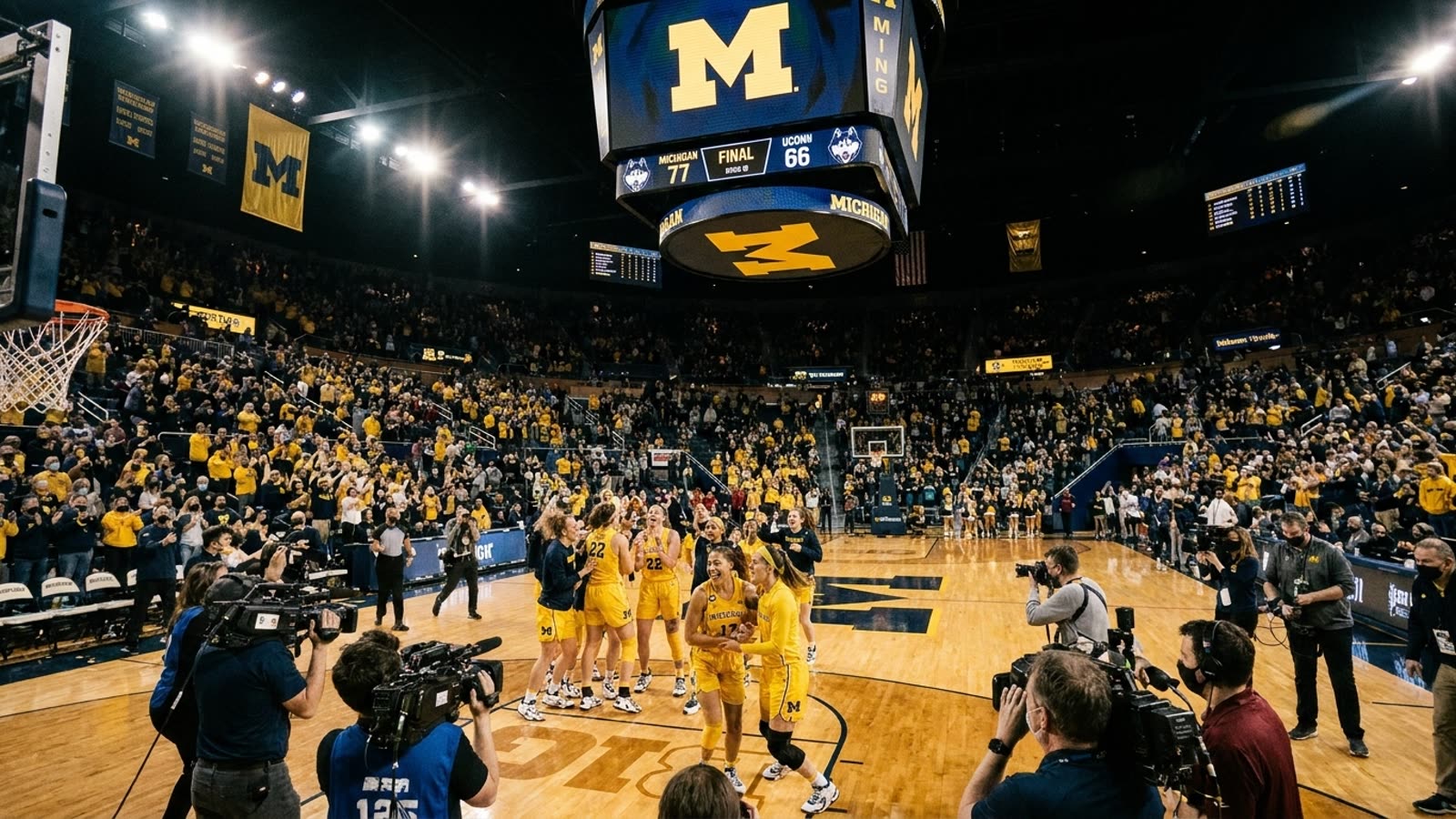
For decades, playing Connecticut in women's college basketball meant accepting a certain fatalism. You could compete, occasionally scare them, but the Huskies always found a way because they were, simply, better. That covenant broke Thursday night in Ann Arbor, where Michigan dismantled the second-ranked team in the country with a poise that suggested this was not an upset at all—just a formal introduction.
The final score, 77-66, undersells the Wolverines' dominance. Michigan controlled tempo, won the rebounding battle, and executed down the stretch when UConn made its inevitable push. This was not a heist; it was a statement of equivalence, delivered in the first top-five matchup ever hosted at Crisler Center.
The Auriemma question
Geno Auriemma has won eleven national championships and built the most successful program in the sport's history. He has also watched the landscape shift beneath him. The transfer portal, NIL money, and improved coaching across the country have eroded the structural advantages that once funneled elite talent to Storrs almost by default. UConn remains a powerhouse, but the margin for error has vanished. Losses like Thursday's—on the road, against a program still building its identity—would have been unthinkable a decade ago. Now they are simply data points in a more competitive ecosystem.
Michigan's arrival
The Wolverines entered the season with expectations but no signature win to validate them. They have one now. Head coach Kim Barnes Arico has steadily elevated the program, recruiting better and developing players into professionals. Thursday's performance was the culmination of that work: a team that believed it belonged against the sport's aristocracy and then proved it. The Big Ten, already the deepest conference in women's basketball, just got more interesting.
What it means for March
A November result does not determine a champion, but it does establish possibility. Michigan now knows it can beat anyone. UConn knows it can lose to anyone playing well. Both pieces of information matter when the bracket is set and the pressure intensifies. The Huskies will almost certainly recover; they have too much talent and too much institutional memory to spiral. But the days when their presence alone intimidated opponents are over.
Our take
This is healthy for the sport. Women's college basketball has suffered from predictability—the same handful of programs cycling through Final Fours while everyone else competed for the honor of losing to them. Michigan's win does not end UConn's relevance, but it does confirm that relevance must now be earned game by game. The Wolverines deserve credit for refusing to be impressed. Auriemma, for his part, will adjust. He always does. But adjusting is different from dominating, and that distinction is the story of this season.