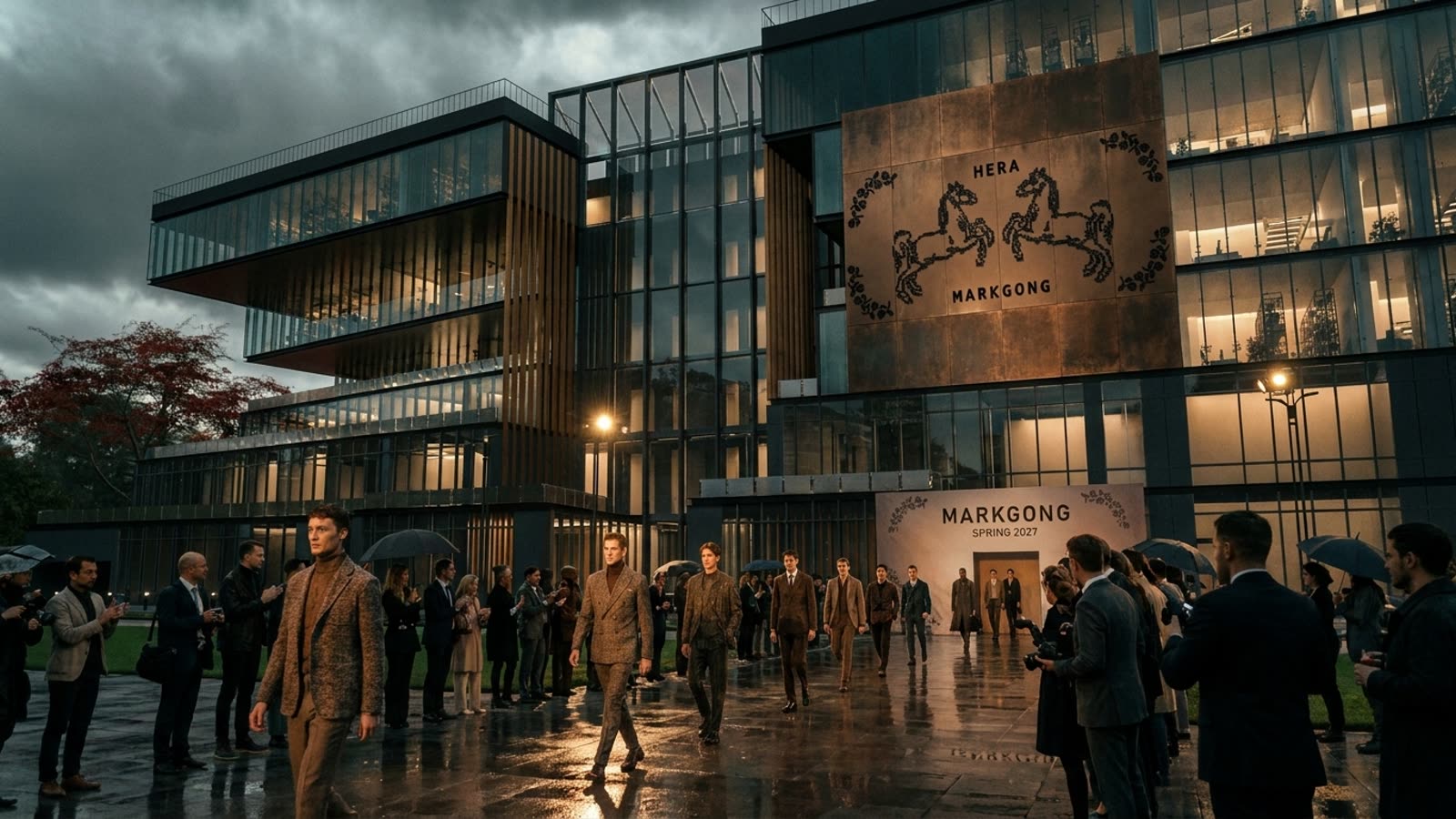
For years, the Western fashion establishment treated Chinese menswear as a contradiction in terms — the country produced fabric, not vision, and its homegrown labels were dismissed as derivative streetwear or ceremonial costume. Markgong's Spring 2027 showing at Shanghai Fashion Week is the latest, and perhaps most persuasive, argument that this condescension has an expiration date.
Designer Mark Gong, who founded the label in 2019 after stints at Central Saint Martins and various European houses, has spent half a decade building a vocabulary that owes nothing to the logomania of Chinese streetwear and little to the stiff tailoring of legacy European menswear. The new collection is his clearest articulation yet: fluid silhouettes, muted earth tones punctuated by unexpected chartreuse, and a material sensibility that treats silk and technical nylon as equals rather than opposites.
The collection's quiet thesis
What distinguished the Spring 2027 outing was its refusal to announce itself. In an era when emerging designers feel compelled to make noise — through collaborations, through controversy, through sheer volume — Gong presented clothes that demanded attention through proportion and finish. Oversized blazers fell just so; trousers pooled at the ankle without looking sloppy; a series of translucent layering pieces suggested humidity and movement without resorting to obvious references to traditional Chinese dress. The restraint was the point.
Shanghai's growing confidence
The collection also reflects a broader shift in Shanghai Fashion Week itself. Once treated as a regional curiosity by international press, the event has grown increasingly confident in presenting designers who are not auditioning for Western approval. Markgong's placement in the schedule — a prime evening slot — signals that local organizers recognize his work as a flagship rather than an experiment. The audience, too, has evolved: fewer influencers performing enthusiasm, more buyers taking notes.
The commercial question
Whether Gong can translate critical respect into commercial scale remains uncertain. Chinese menswear consumers have historically gravitated toward established European houses or domestic giants like Bosideng; the market for mid-priced designer menswear is underdeveloped. But Gong's pricing — accessible by Western designer standards, aspirational by Chinese high-street standards — suggests he is betting on a generation of male consumers who want something between fast fashion and Zegna.
Our take
Markgong will not be the label that makes Chinese fashion a household phrase in the West — that will require a celebrity co-sign or a conglomerate acquisition that Gong seems uninterested in pursuing. But his Spring 2027 collection is proof that the talent pipeline is real and that Shanghai is no longer waiting for Paris to validate its designers. The question is whether the rest of the industry will notice before the moment passes.