The most revealing thing about MARA Holdings isn't in its upcoming earnings report—it's in what investors have decided to ignore. The company, formerly Marathon Digital and one of the largest publicly traded Bitcoin miners in the world, is expected to post losses for the first quarter of 2026. Yet the stock has held relatively steady, buoyed by something that would have seemed heretical in the crypto maximalist circles of a few years ago: a pivot toward AI data center revenue.
This is not a story about one company's quarterly numbers. It is a story about the quiet capitulation of an industry that spent years insisting it needed nothing from the traditional economy, only to discover that its most valuable asset—cheap access to massive amounts of electricity and cooling infrastructure—might be worth more to OpenAI than to the Bitcoin network.
The economics of empty racks
Bitcoin mining has always been an arbitrage on energy costs. Miners seek out the cheapest electricity on earth, build warehouses full of specialized chips, and race to solve cryptographic puzzles before their competitors. When Bitcoin prices are high, this is extraordinarily profitable. When prices fall, or when the network's difficulty adjusts upward, margins evaporate. MARA has lived this cycle repeatedly.
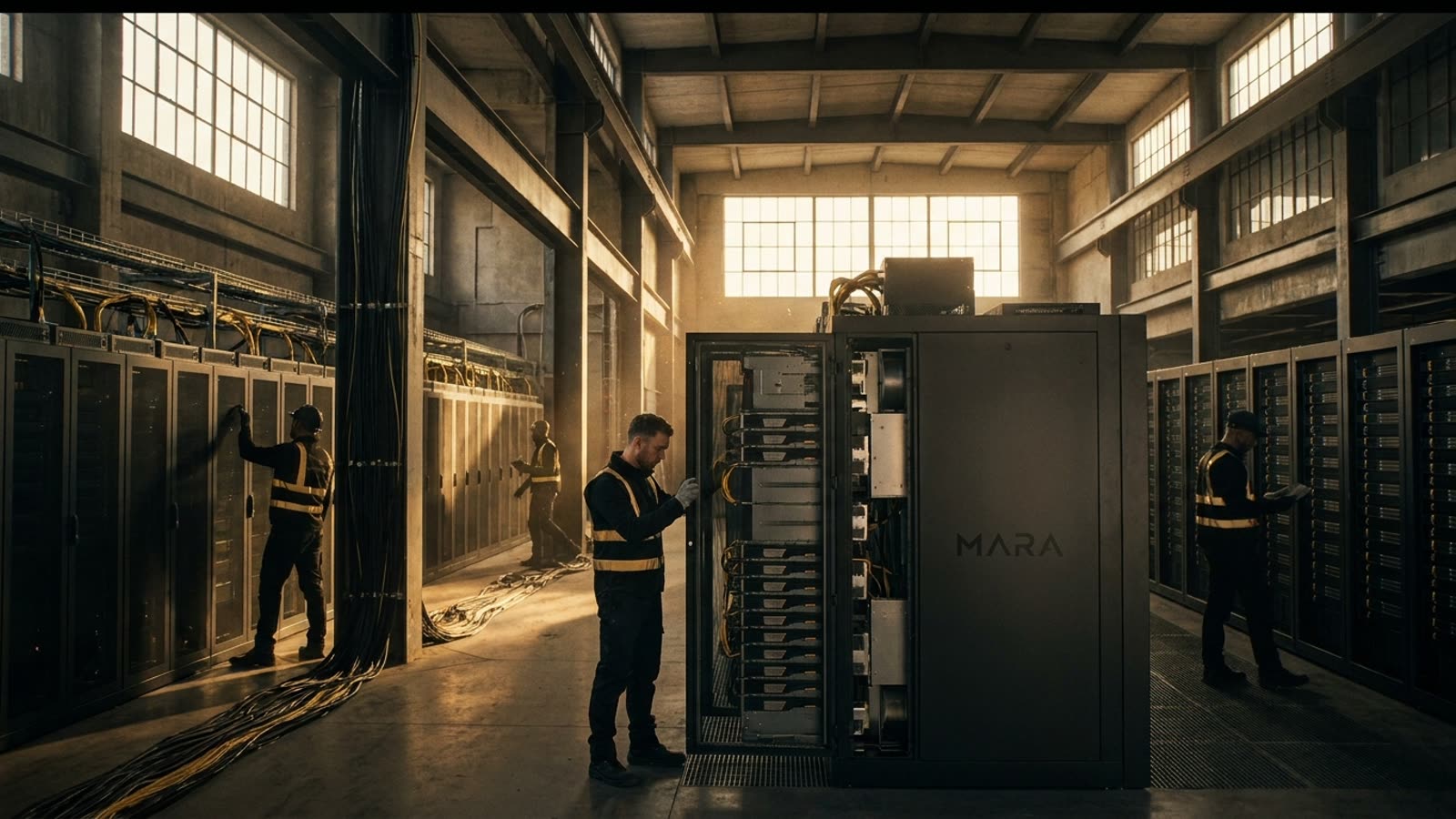
What has changed is the emergence of a buyer willing to pay handsomely for exactly what miners have built: facilities with enormous power capacity, robust cooling systems, and locations chosen for cheap energy rather than proximity to population centers. AI model training and inference require precisely these conditions. Nvidia's latest chips generate so much heat that data center design has become as much a thermodynamics problem as a computing one. Bitcoin miners, it turns out, have been solving that problem for years.
The identity question
For MARA's investors, the AI pivot is a hedge—a way to generate steadier cash flows that don't depend on Bitcoin's famously volatile price. For the broader crypto industry, it raises uncomfortable questions about what mining companies actually are. If MARA's most valuable long-term asset is its real estate and power contracts rather than its ability to secure the Bitcoin network, then the company starts to look less like a crypto native and more like a specialized REIT with a sideline in digital assets.
This is not necessarily a bad outcome for shareholders. Diversification is sensible. But it does puncture a certain narrative—that Bitcoin mining was a revolutionary new industry operating outside the logic of traditional capital markets. In practice, the industry's survivors are the ones who figured out how to sell their infrastructure to whoever will pay the most for it.
Our take
MARA's AI pivot is pragmatic, probably smart, and deeply ironic. The company built its brand on Bitcoin maximalism and is now hedging that bet with revenue from the technology most likely to disrupt every industry, crypto included. There is no shame in this; companies adapt or die. But the next time a mining executive talks about being "laser-focused" on Bitcoin, remember that the lasers can be redirected remarkably quickly when the economics demand it.