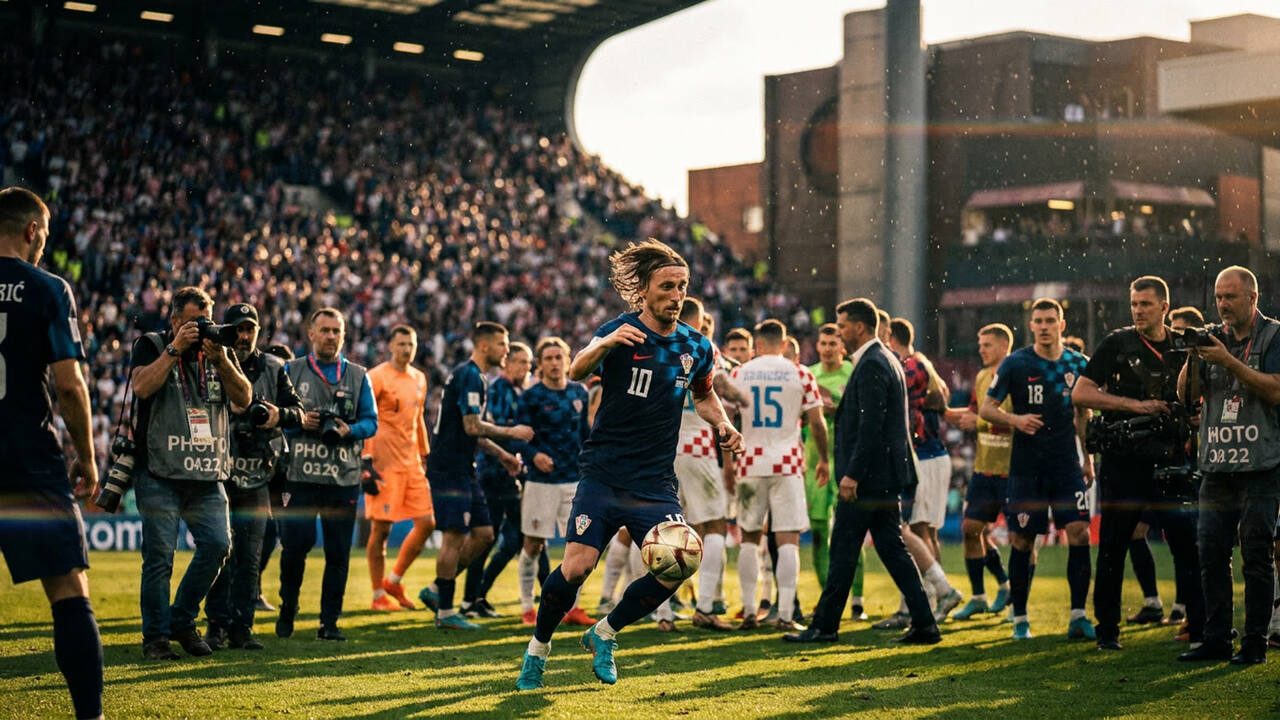
When Luka Modrić collected the Golden Ball at the 2018 World Cup in Russia, he broke a duopoly that had seemed eternal. For a decade, Lionel Messi and Cristiano Ronaldo had divided football's individual honours between themselves like feuding monarchs. That a slight, soft-spoken Croatian should interrupt their reign—and do so at the tournament where neither had ever truly shone—felt less like an upset than a correction.
Modrić did not win the World Cup. Croatia fell to France in a final they probably deserved to lose. But the award recognised something the statistics alone could not capture: that this 32-year-old had dragged a nation of four million people to the brink of football immortality through the sheer force of his footballing intelligence.
The education of a refugee
Modrić was six when the Croatian War of Independence forced his family to flee their village near Zadar. His grandfather was killed by Serbian forces. The family spent years in a hotel for displaced persons in the coastal town. The boy played football in the hotel parking lot, small even by the standards of children his age, and coaches repeatedly dismissed him as too fragile for the professional game.
Dinamo Zagreb eventually took a chance. So did Tottenham Hotspur, and then Real Madrid, where Modrić arrived in 2012 to a reception so hostile that Spanish media voted him the worst signing of the season. He responded by becoming indispensable to a club that would win five Champions League titles during his tenure.
The geometry of control
What makes Modrić singular is not pace, power, or even technique in the conventional sense. It is his relationship with time. He receives the ball in congested spaces and somehow creates an extra half-second that lesser players cannot find. His first touch moves the ball into positions that make the next pass obvious, and the pass after that inevitable. Opponents find themselves chasing not the man but the geometry he has already constructed.
At the World Cup in Russia, this quality proved decisive. Against Denmark and then Russia in the knockout rounds, Croatia needed penalty shootouts to advance. Modrić converted both of his attempts with the composure of someone paying a utility bill. In the semi-final against England, he controlled a midfield that included younger, faster, theoretically superior athletes, and Croatia won in extra time.
A nation's proxy
Croatia's run to that final remains one of the great underdog stories in World Cup history, and Modrić was its author. He played every minute of every match, covered more ground than any other outfield player in the tournament, and did so while serving as his country's emotional lodestar. When he finally lifted the Golden Ball, tears streaming down his face, he was crying for more than himself.
The achievement reframed what small nations could aspire to. Iceland had charmed the world at Euro 2016; Croatia showed that charm could translate into genuine contention. The template required no secret: find your best player, build around him, and trust that collective belief can compensate for individual deficits.
Our take
Modrić's career is an argument against the tyranny of the measurable. In an era obsessed with sprint speeds and expected goals, he has demonstrated that football's most valuable currency remains the ability to think faster than everyone else on the pitch. His World Cup campaign was not a fluke but a thesis statement—one that every undersized midfielder with a good first touch should study until they have memorised its every chapter.