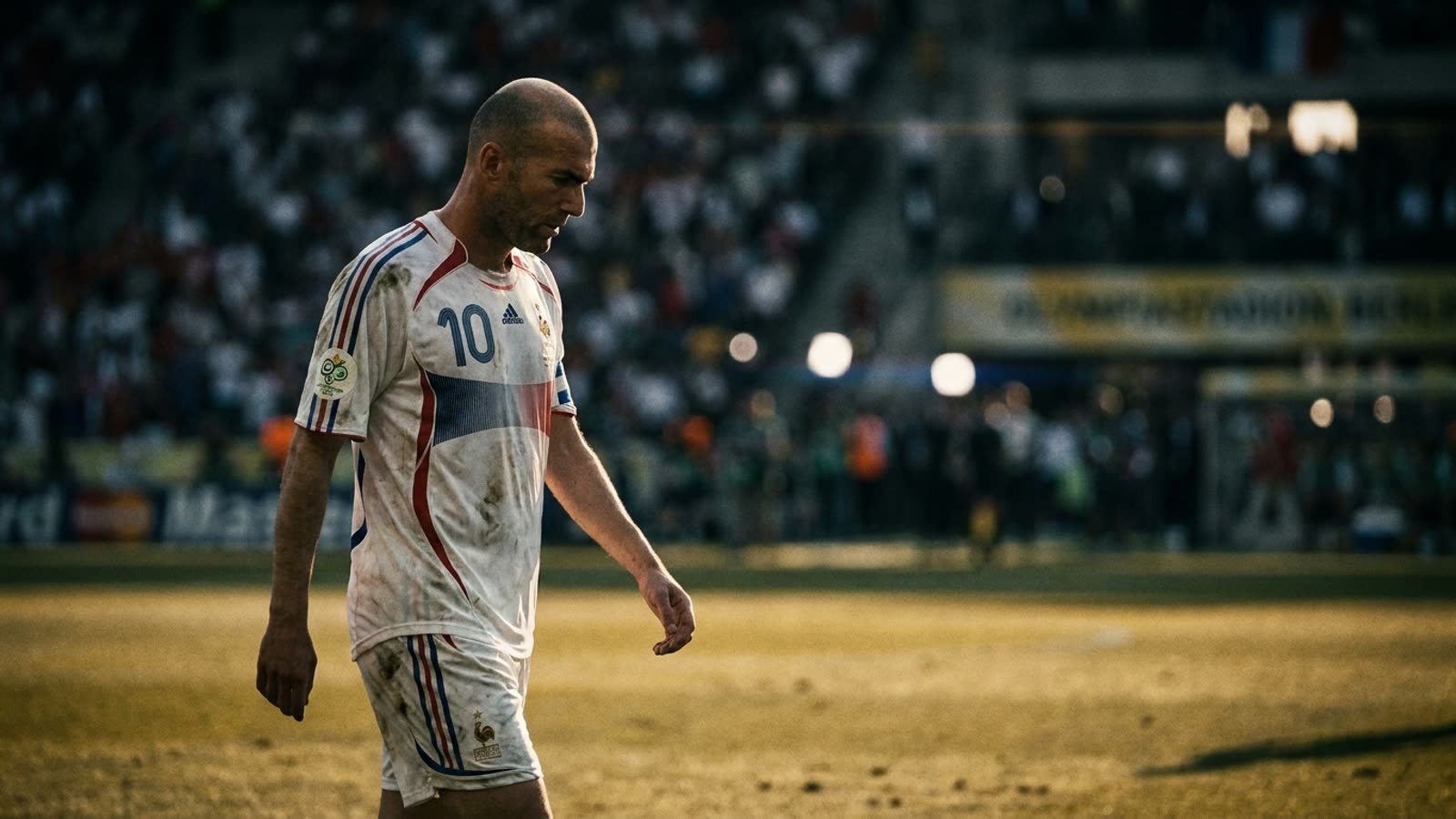
No athlete has ever chosen a worse moment to become human. Zinedine Zidane spent two decades cultivating an image of serene mastery—the bald head gliding through midfields like a monk through a meditation garden, the ball obeying physics only he seemed to understand. Then, with ten minutes left in the final match of his career, with a World Cup trophy within reach, he lowered that famous head and drove it into Marco Materazzi's chest.
The red card that followed ended more than a match. It ended the most decorated career in French football history in a tableau of confusion: Zidane walking past the trophy he would never touch, his face unreadable, while a billion viewers tried to process what they had witnessed.
The provocation question
Materazzi later admitted to insulting Zidane's sister—though the exact words remain disputed, filtered through lip-readers, denials, and the fog of competitive memory. The Italian defender has never fully disclosed what he said, and Zidane has never demanded he do so. This ambiguity matters. It allows the incident to remain a Rorschach test: was Zidane a noble defender of family honor, goaded beyond endurance? Or did the pressure of the moment expose a volatility that his grace had always concealed?
The truth is probably neither and both. Zidane had been sent off more than a dozen times in his career, a fact often forgotten amid highlight reels of his balletic control. The headbutt was not an aberration but an amplification—the same intensity that made him irreplaceable also made him combustible.
The mythology of the exit
What makes the moment endure is its resistance to narrative closure. Great athletes typically retire in one of two modes: triumphant (Jordan's second three-peat) or diminished (Ali's final fights). Zidane offered neither. He was brilliant that night, converting a nerveless Panenka penalty in the first half, orchestrating France's attack with his usual quiet authority. He was not fading. He was not overwhelmed. He simply chose violence at the worst possible instant, then walked away forever.
This is what unsettles. We want our sporting heroes to be comprehensible, their decisions reducible to strategy or emotion. Zidane's headbutt offers no such comfort. It suggests that even the most controlled among us contain depths we cannot predict—that mastery of a craft does not imply mastery of the self.
The afterlife
Zidane's post-playing career has only deepened the mystique. He became a successful manager at Real Madrid, winning three consecutive Champions League titles with the same inscrutable calm he brought to midfield. He rarely speaks about the headbutt, and when he does, he refuses to apologize for it while acknowledging its cost. This is not defiance; it is something stranger—an acceptance that the act was both wrong and inevitable, a collision he could not have avoided because it came from somewhere inside him he does not fully control.
France lost that final on penalties. Materazzi scored the decisive kick. The trophy went to Italy. But nobody remembers the shootout. They remember the headbutt, frozen in time, inexplicable and eternal.
Our take
The 2006 final is football's most literary moment precisely because it refuses to teach a lesson. Zidane did not fall from grace through hubris or age or corruption—he simply revealed, in one explosive second, that even transcendent talent cannot insulate us from our own worst impulses. It is uncomfortable to watch and impossible to forget, which is perhaps the only honest way for a career of that magnitude to end.