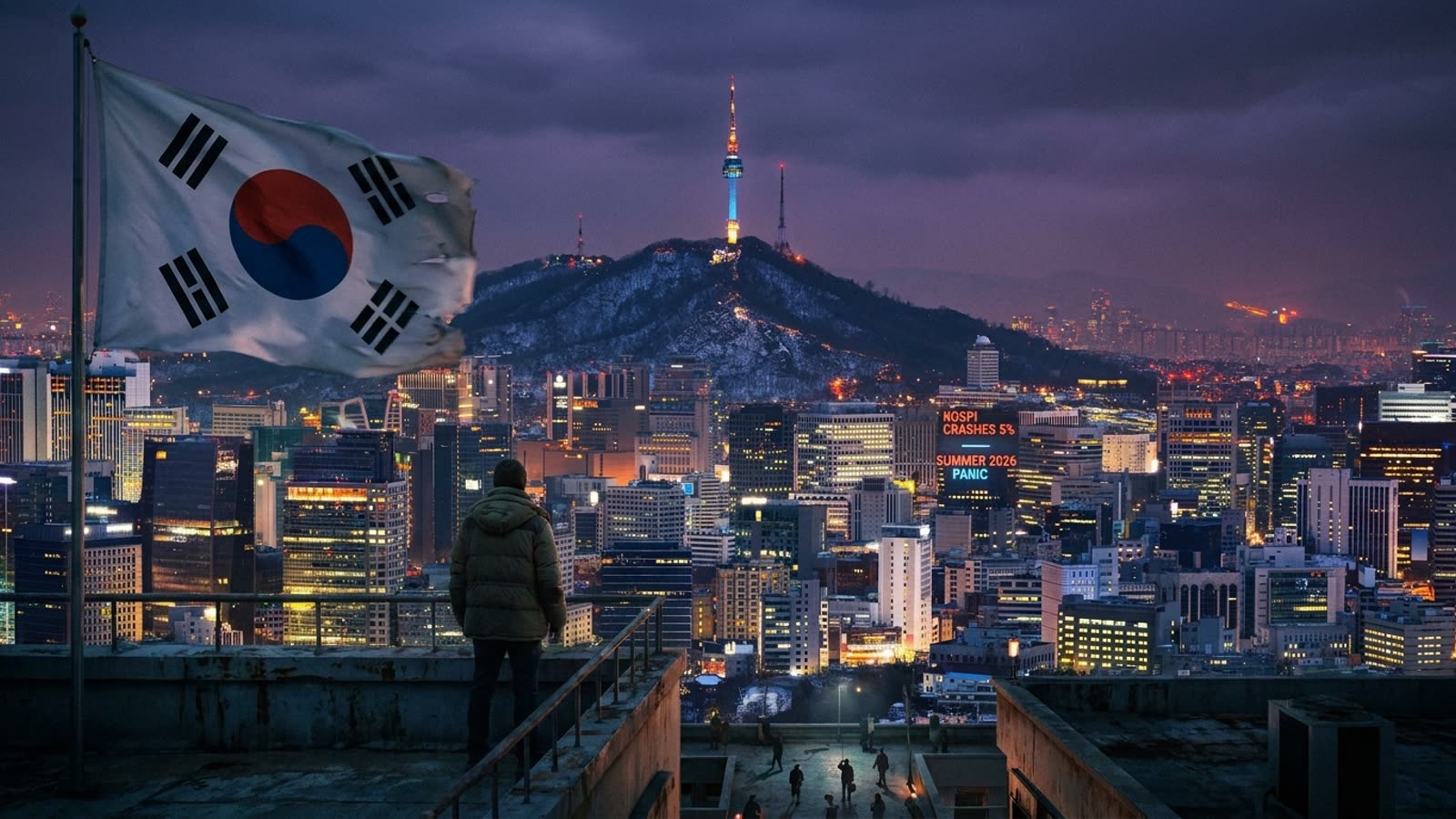
The contagion playbook remains unchanged: a tremor in one corner of the global financial system, a brief moment of denial, then the dominoes. South Korea's benchmark KOSPI index collapsed nearly 10%, triggering a market-wide circuit breaker, on Tuesday in its steepest single-session decline since the pandemic panic of March 2020, and by the time New York opened for business, the Nasdaq was already down 2% with no floor in sight.
This is not, strictly speaking, a Korean crisis. Seoul's plunge was triggered by a combination of factors that have been building for months: semiconductor inventory concerns, a weakening won, and mounting evidence that the global AI spending boom may be entering a more selective phase. But Korea, as the world's memory-chip factory and a bellwether for tech supply chains, has an outsized ability to transmit anxiety across borders.
The semiconductor transmission mechanism
Samsung Electronics and SK Hynix together control roughly 60% of the global DRAM market and a dominant share of high-bandwidth memory chips that power AI servers. When Korean chipmakers sneeze, Nvidia catches a cold. The logic is straightforward: if memory demand is softening, perhaps the hyperscalers are not as committed to their datacenter buildouts as their earnings calls suggest.
This fear has been circulating since the Federal Reserve's June meeting, where officials signaled rates would remain elevated through year-end. Higher-for-longer rates make growth stocks mathematically less attractive and raise the discount rate on future AI profits that may or may not materialize. Korea's crash gave traders permission to act on doubts they had been suppressing.
The Fed's uncomfortable position
Jerome Powell now faces a familiar dilemma with an unfamiliar backdrop. Inflation remains sticky at 3.2%, well above the 2% target, which argues for keeping rates restrictive. But a global equity selloff, if it deepens, could tighten financial conditions more aggressively than the Fed intends, potentially triggering the recession it has spent three years trying to avoid.
The central bank's June dot plot suggested one rate cut by December—a hawkish stance that disappointed markets hoping for summer relief. With Korea's crash now reverberating through global portfolios, some traders are betting the Fed will be forced to pivot earlier. Fed funds futures are pricing in a modest increase in the probability of a September cut, though conviction remains low.
Why this time might be different (or not)
The optimistic case is that Korea's selloff is a healthy correction in an overheated semiconductor trade. Valuations had become stretched; a reset was overdue. The AI buildout is real, even if the timeline is longer than bulls assumed. This reading suggests buying the dip.
The pessimistic case is that Korea is the canary. If memory demand is genuinely softening, it implies that the AI infrastructure boom is hitting a plateau earlier than expected. That would ripple through everything from Nvidia's multiple to the commercial real estate bets on datacenter construction. This reading suggests the summer of 2026 has only begun to get uncomfortable.
Our take
Markets have spent the past eighteen months pricing in an AI future that requires flawless execution across supply chains, regulatory environments, and monetary policy. Korea's crash is a reminder that execution is never flawless. The selloff may prove to be a buying opportunity or the opening act of something uglier—but either way, it has punctured the complacency that had settled over global equities. That, at least, is healthy.