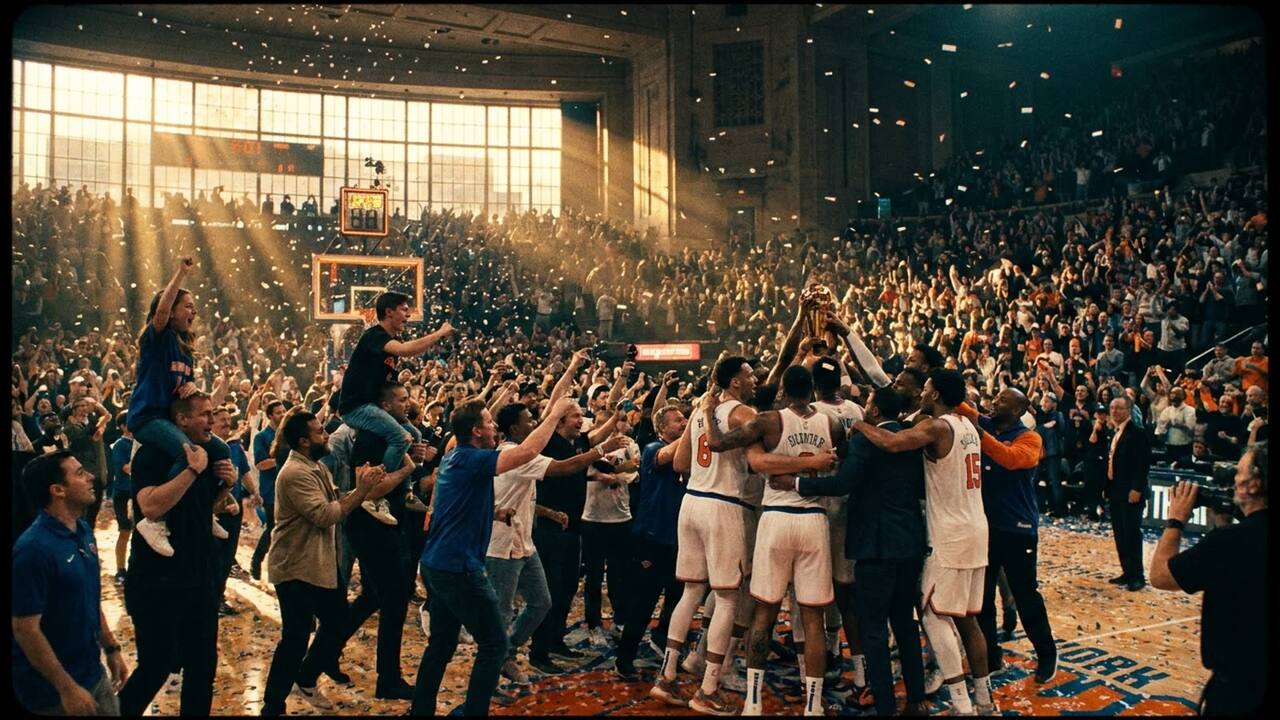
The New York Knicks are NBA champions for the first time since 1973, ending the longest active title drought in the league and one of the most agonizing waits in American professional sports.
Fifty-three years. That's how long New York waited — through the Ewing era's near-misses, the Isiah Thomas catastrophe, the Carmelo trade that never quite worked, and countless seasons that ended in lottery balls rather than champagne. On Saturday night at Madison Square Garden, the drought ended with a Game 5 victory that sent the world's most famous arena into delirium.
The weight of history
To understand what this means, consider the timeline. When the Knicks last won a championship, Richard Nixon was president, the World Trade Center was under construction, and the internet was a Pentagon research project. The franchise's 19,392-day wait between titles is not merely a statistical curiosity — it represents generations of fans who were born, grew up, and in some cases died without seeing their team win it all.
The Knicks became professional sports' most expensive cautionary tale, a franchise that proved even unlimited resources in the world's largest market couldn't guarantee success. Madison Square Garden remained "the Mecca of basketball" in name while functioning as a museum of disappointment in practice. Season-ticket holders paid premium prices for the privilege of watching mediocrity, sustained only by memories of Reed, Frazier, and DeBusschere.
A city transformed
New York is not a sentimental sports town. It is demanding, impatient, and quick to turn on underperforming stars. But the relationship between the city and the Knicks has always been different — more codependent than transactional. The team's suffering became woven into the city's identity, a shared trauma that bonded strangers on subway platforms and in corner bodegas.
The scenes across the five boroughs Saturday night reflected something beyond typical championship celebration. This was catharsis on a municipal scale. In a city that prides itself on having seen everything, grown adults wept openly on Seventh Avenue. The honking horns in Manhattan weren't angry for once.
What comes next
The immediate question is whether this championship opens a window or closes a chapter. The roster construction that delivered this title was years in the making, built through patient drafting, shrewd trades, and the kind of front-office discipline that had eluded the franchise for decades. The core is young enough to suggest this could be the beginning of something sustained rather than a one-off.
But dynasties are not guaranteed, and the NBA's competitive landscape shifts rapidly. What matters now is that the Knicks have proven they can win again — that the franchise's futility was not some cosmic curse but rather the result of fixable organizational dysfunction.
Our take
Some championships matter more than others, and this one matters enormously. Not because the Knicks are a more deserving franchise than any other, but because their return to relevance is good for basketball. The NBA is better when Madison Square Garden is rocking in June rather than hosting concerts because the home team was eliminated in April. New York's wait is over, and the sport's biggest stage finally has a champion worthy of it.