Before Johan Cruyff, football had geography. Defenders defended. Midfielders patrolled the middle. Strikers waited near the goal like hunters at a watering hole. Cruyff looked at this arrangement and saw something absurd — why should a player's position on the pitch determine what he was allowed to do with his mind?
The answer, of course, was that it shouldn't. And from that insight emerged Total Football, the tactical philosophy that Cruyff first embodied as a player with Ajax and the Netherlands in the early 1970s, then codified as a manager at Barcelona in the late 1980s and early 1990s. The system demanded that every outfield player be capable of playing every outfield position, that the team move as a single organism expanding and contracting across the grass, that possession itself become a form of defense. It was less a formation than a state of mind.
The turn that became a signature
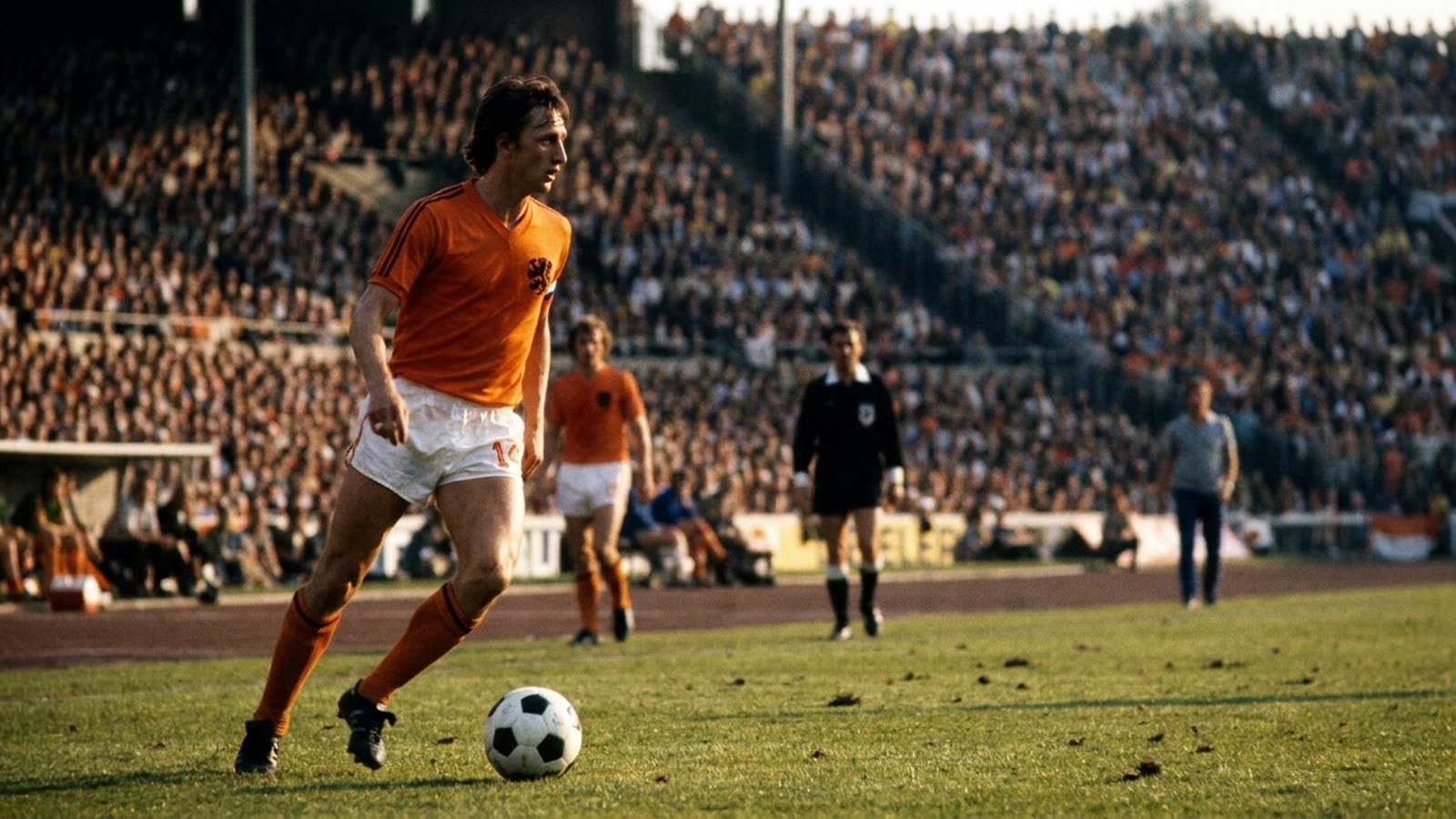
Cruyff's playing career produced one of football's most iconic individual moments: the "Cruyff Turn," executed against Sweden at the 1974 World Cup, in which he appeared to be passing the ball forward only to drag it behind his standing leg and accelerate in the opposite direction. The Swedish defender, Jan Olsson, was left grasping at philosophy. The move has been replicated millions of times since, but what made it revolutionary was not its mechanics — it was its premise. Cruyff believed that deception and intelligence should triumph over mere athleticism, that football was ultimately a cognitive sport dressed in athletic clothing.
That Netherlands team reached the 1974 World Cup final, losing to West Germany, and the 1978 final without Cruyff, losing to Argentina. The Dutch never won, which somehow enhanced the mythology. Total Football became associated with beautiful failure, with idealism punished by pragmatism. Cruyff himself seemed unbothered by this narrative. Winning without style, he suggested, was a kind of losing.
Barcelona as laboratory
When Cruyff took over Barcelona in 1988, he inherited a club that had won a single league title in over a decade. He left behind a dynasty. His "Dream Team" won four consecutive La Liga championships and the club's first European Cup in 1992. More importantly, he established La Masia, Barcelona's youth academy, as a factory for technically gifted players who understood football as a spatial puzzle rather than a physical contest.
The production line was extraordinary. Pep Guardiola learned under Cruyff as a player, then implemented an even more extreme version of his philosophy as Barcelona's manager, winning everything with a team built around Lionel Messi, Xavi, and Andrés Iniesta — all La Masia graduates. Guardiola's subsequent work at Bayern Munich and Manchester City extended the Cruyff lineage further, making possession-based, high-pressing football the dominant aesthetic of the modern elite game.
Our take
Cruyff, who died in 2016, would likely find today's tactical debates amusing. The arguments about whether possession football has been "solved" or whether counter-attacking systems have evolved to neutralize it would strike him as missing the point. His philosophy was never really about keeping the ball — it was about players who could think faster than their opponents, who understood that space is created by movement and that movement is created by imagination. Every manager who asks a center-back to play like a midfielder, every academy that prioritizes technical education over physical development, every analyst who maps passing networks instead of counting tackles — they are all, whether they know it or not, working inside the house that Cruyff built.