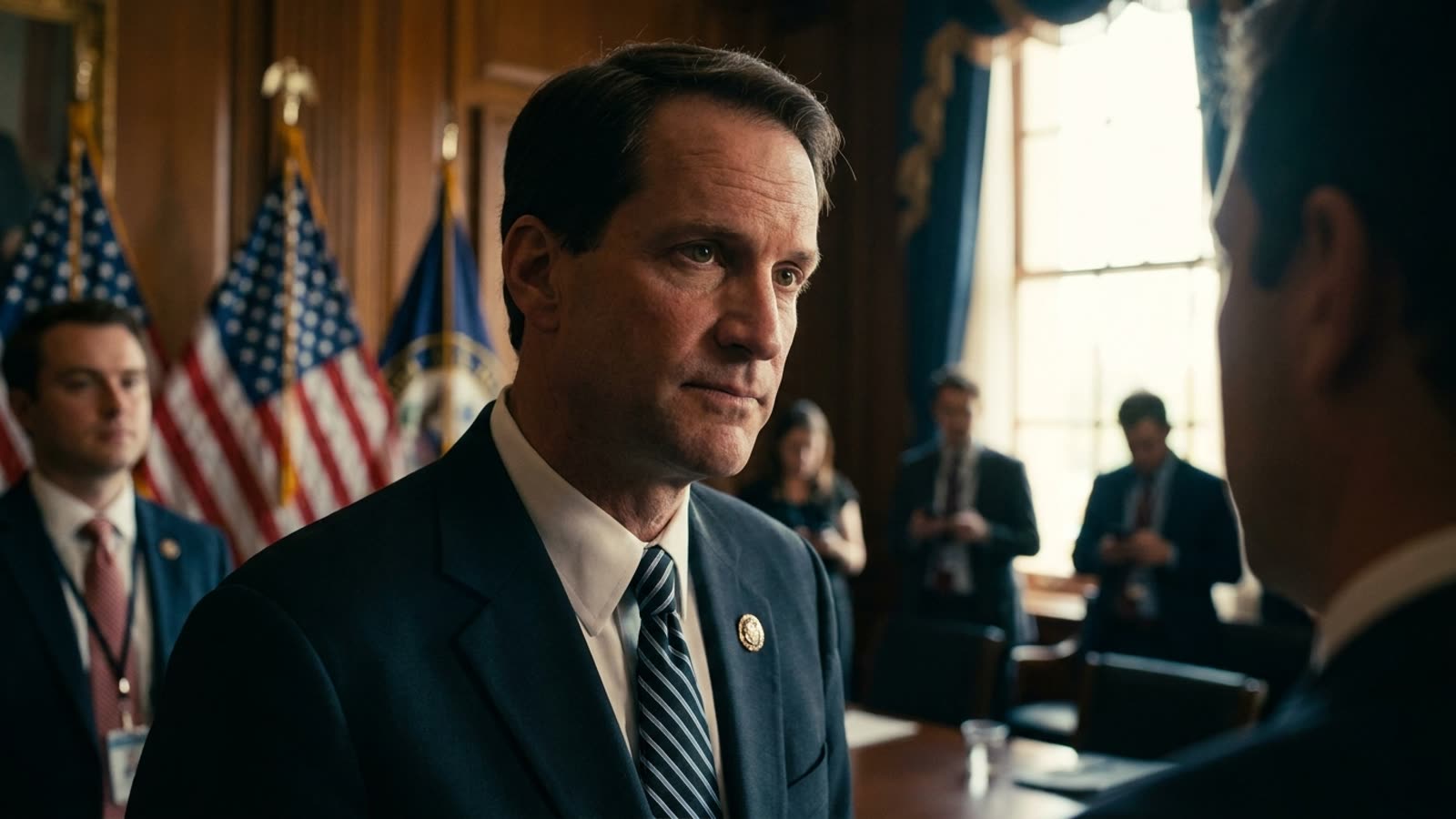
Three months into a conflict that was supposed to demonstrate American resolve, the most telling critique of President Trump's Iran policy came not from Tehran but from a Connecticut congressman with a reputation for measured analysis. Representative Jim Himes, the ranking Democrat on the House Intelligence Committee, described the administration's abrupt pivot toward a peace agreement as a "surrender" driven by "political toxicity" — a phrase that cuts closer to the truth than the White House would prefer.
Himes's assessment, delivered with the weary precision of someone who has sat through countless classified briefings, strips away the triumphalist rhetoric that has accompanied every administration announcement about Iran. The war, he suggested, has become politically untenable not because of battlefield losses but because of the cumulative weight of economic disruption, casualty reports, and the dawning realization among American voters that "maximum pressure" campaigns have a way of becoming maximum quagmires.
The intelligence committee's view
What makes Himes's critique notable is its source. As ranking member of the Intelligence Committee, he has access to assessments that most critics lack. His willingness to publicly characterize the administration's diplomatic scramble as capitulation suggests that the classified picture may be even less flattering than the public one. The congressman stopped short of revealing specifics, but his tone conveyed what briefing documents apparently confirm: the military campaign has not achieved its stated objectives, and continuing it carries risks the administration is no longer willing to accept.
The White House has framed its diplomatic outreach as negotiating from strength, pointing to damaged Iranian infrastructure and disrupted supply lines. Himes's counter-narrative — that Trump is seeking an off-ramp because the political costs have become unbearable — represents the Democratic talking point heading into what promises to be a brutal midterm environment.
The toxicity calculation
Himes's use of "political toxicity" deserves unpacking. Wars become toxic when their costs exceed their perceived benefits in the minds of voters, a threshold that varies based on the clarity of objectives and the visibility of progress. The Iran conflict has suffered from both ambiguities. The administration never articulated what victory would look like beyond vague references to "ending the threat," and the absence of measurable milestones has left the public with little beyond casualty counts and gas prices to evaluate success.
The congressman's framing also implicitly acknowledges something Democrats have been reluctant to say plainly: the American public's appetite for Middle Eastern military engagements, already diminished after two decades in Afghanistan and Iraq, has reached a historic low. Trump, whatever his other political instincts, has always possessed an acute sensitivity to where his base draws lines.
Our take
Himes is playing politics, obviously — that's his job. But the accusation lands because it contains an irreducible kernel of truth. The administration's sudden enthusiasm for diplomacy does not reflect a strategic breakthrough; it reflects a recognition that the war's trajectory was becoming incompatible with political survival. Whether that constitutes "surrender" depends on what one believes the war was supposed to achieve in the first place. If the goal was regime change, then yes, accepting anything less is capitulation. If the goal was always a negotiated settlement that Trump could brand as a win, then the congressman's critique misses the mark. The uncomfortable reality is that the administration has never been clear about which objective it was pursuing — and that ambiguity may be the most damning indictment of all.