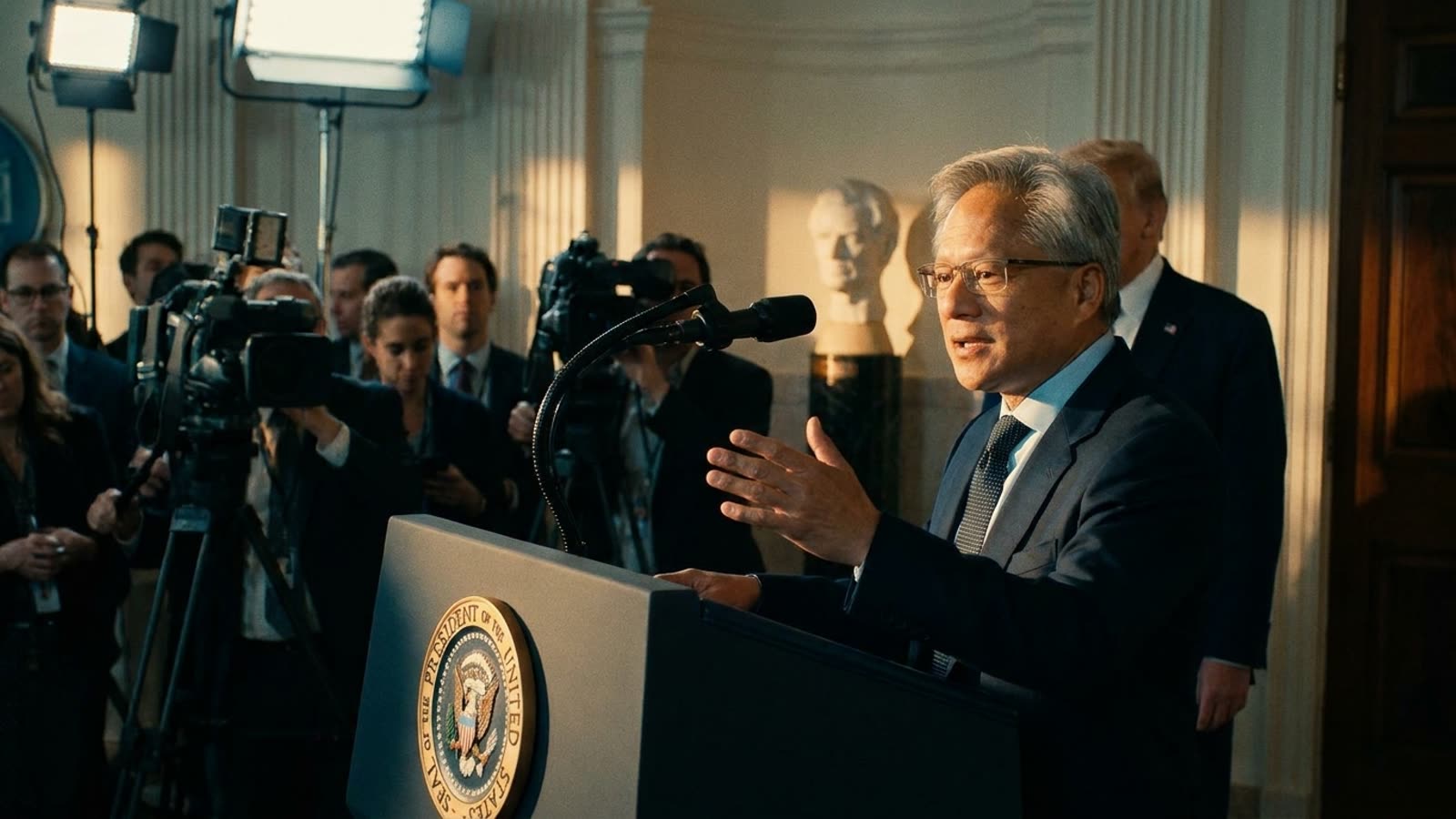
The revelation that Nvidia CEO Jensen Huang may have been the target of a Chinese government spy operation—and that President Trump reportedly chose not to respond—crystallizes everything contradictory about this administration's approach to technology and national security.
Huang is not merely a prominent tech executive. He is the architect of the infrastructure powering the global AI revolution, the man whose company's market capitalization has at times exceeded $3 trillion, and the figure most responsible for America's current dominance in the chips that make artificial intelligence possible. If Beijing wanted to compromise anyone in Silicon Valley, Huang would be the obvious choice.
The strategic calculus
The decision to take no action defies the administration's own stated priorities. This is the same White House that has expanded export controls on advanced semiconductors to China, citing national security. The same administration that has pressured allies to restrict chip equipment sales to Chinese firms. The same president who has repeatedly characterized the US-China technology competition as existential.
Yet when presented with intelligence suggesting China was actively targeting the single most important figure in American AI hardware, the response was apparently silence. The disconnect suggests either that the intelligence was deemed insufficiently actionable, that other considerations—perhaps commercial, perhaps diplomatic—took precedence, or that the administration's China hawkishness is more performative than operational.
What Nvidia represents
Nvidia's position in the AI stack is difficult to overstate. The company's GPUs train virtually every frontier AI model. Its CUDA software ecosystem has created a moat that competitors have struggled for years to breach. Control over Nvidia—or access to its roadmap, its research, its strategic thinking—would give any adversary an extraordinary window into America's AI future.
Huang, a Taiwanese-American immigrant who founded the company in 1993, has become a geopolitical figure whether he sought that role or not. His travel to Taiwan, his comments on cross-strait relations, his company's delicate dance with Chinese customers under tightening export rules—all carry weight far beyond typical corporate concerns.
Our take
The story here is not that China would target Huang—of course they would. The story is the reported non-response. An administration that has made countering Chinese technological ambitions a centerpiece of its foreign policy apparently encountered evidence of those ambitions in their most direct form and shrugged. Either the intelligence community's assessment was weaker than the headline suggests, or the White House has decided that some targets are too commercially sensitive to defend. Neither explanation is particularly reassuring for anyone who believed the semiconductor export controls reflected genuine strategic conviction rather than political theater.