The kissaten is not a café. This distinction matters more than it might seem. While Starbucks counts success in throughput and specialty coffee shops compete on single-origin provenance, Japan's traditional coffee houses measure their worth in something harder to quantify: the quality of time suspended.
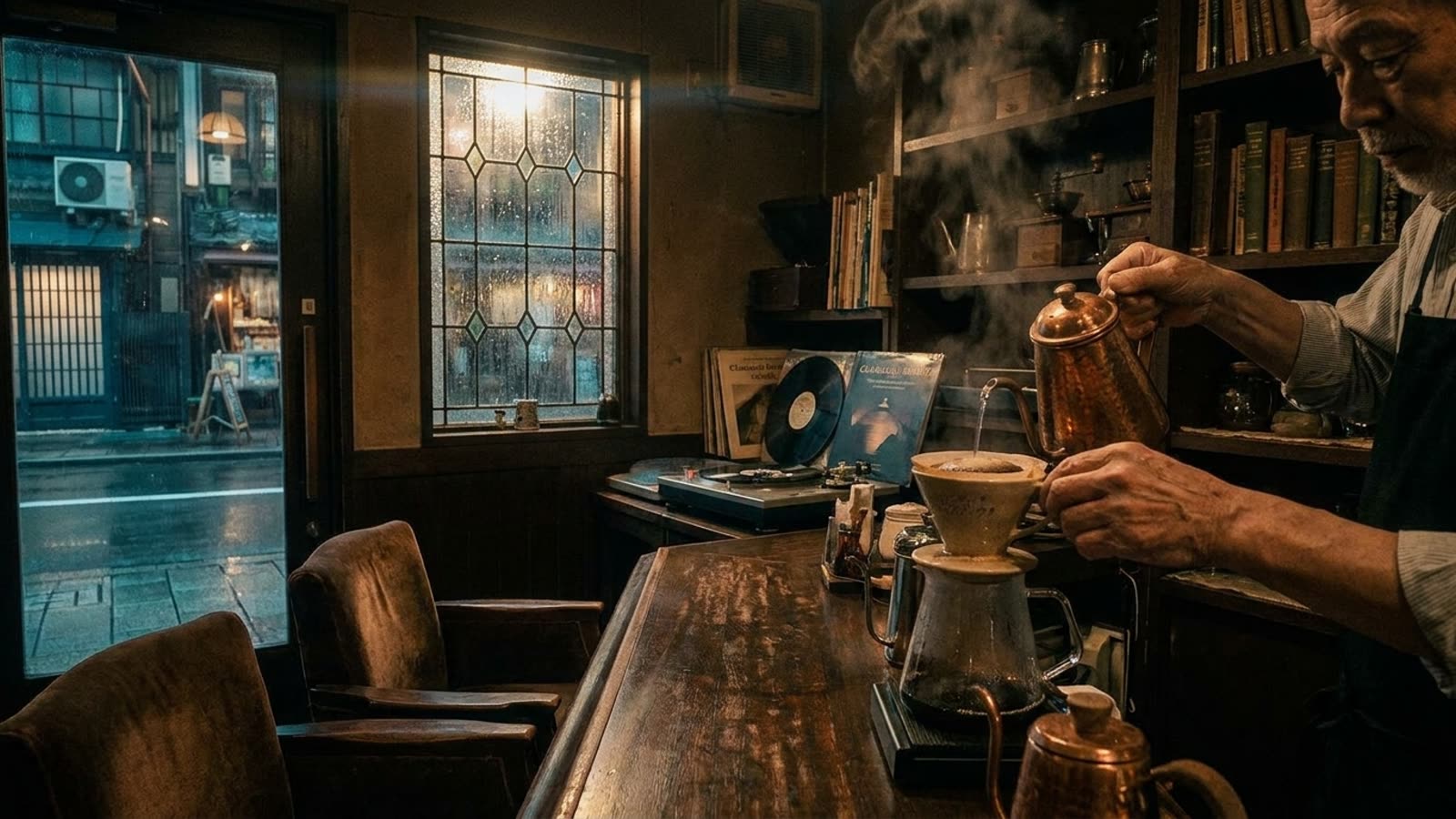
Walk into a kissaten in Tokyo's Jinbocho district or Osaka's Nakazakicho neighborhood and you enter a temporal anomaly. The lighting is amber, deliberately insufficient for productivity. The seats are worn velvet, shaped by decades of customers who came not to work but to exist. The coffee arrives in porcelain cups, hand-dripped by someone who has performed this ritual thousands of times. The bill might be twice what you would pay at a chain. The experience is worth considerably more.
The architecture of slowness
Kissaten emerged in Japan's Meiji era, when coffee was still exotic and Western culture carried aspirational weight. By the mid-twentieth century, they had evolved into something distinctly Japanese: spaces where salarymen could escape the relentless expectations of corporate life, where jazz enthusiasts could listen to rare pressings on equipment they could never afford at home, where solitude was not loneliness but a cultivated pleasure.
The physical design enforces this ethos. Counter seating faces the master, not a laptop screen. Tables are spaced for privacy. Many kissaten prohibit phone calls. Some still ban photography. The menu is deliberately limited—coffee, perhaps a sandwich, maybe a slice of cake—because abundance would imply choice, and choice would imply hurry.
Survival against the odds
The kissaten should be extinct. Japan's convenience culture, its vending machines dispensing hot canned coffee on every corner, its konbini offering decent drip brew for pocket change, should have rendered these establishments obsolete. The number of kissaten has declined precipitously since their peak, with thousands closing as their aging proprietors retired without successors.
Yet something curious has happened. A younger generation of Japanese entrepreneurs, along with a devoted cohort of international admirers, has begun opening new kissaten or reviving dormant ones. They are not motivated by nostalgia alone. They have recognized that the kissaten offers something the modern economy has otherwise eliminated: permission to be unproductive.
In a culture that invented the concept of karoshi—death by overwork—the kissaten functions as a quiet resistance. You cannot optimize the experience. You cannot multitask your way through it. The hand-drip method takes precisely as long as it takes. The master will not rush.
The exportable philosophy
Western cities have begun developing their own interpretations. In London, Brooklyn, and Melbourne, a new category of café has emerged that borrows the kissaten's rejection of efficiency without always understanding its depth. They get the slow pour-over right, the moody lighting, the prohibition on laptops. What they sometimes miss is the kissaten's fundamental premise: that the customer is not buying coffee but renting a particular quality of attention.
The best kissaten masters know their regulars not by their orders but by their silences. They understand when to speak and when to let the only sound be the whisper of water through grounds. This is hospitality as meditation, service as art.
Our take
The kissaten's persistence is not merely charming; it is instructive. We have built an economy that treats friction as failure and optimization as virtue. The kissaten suggests an alternative: that some experiences should resist efficiency, that slowness can be a feature rather than a bug. In an age when every moment is meant to be monetized or measured, the radical act is to sit with a cup of coffee that took four minutes to prepare, in a chair that has held thousands before you, and want nothing more than exactly this.