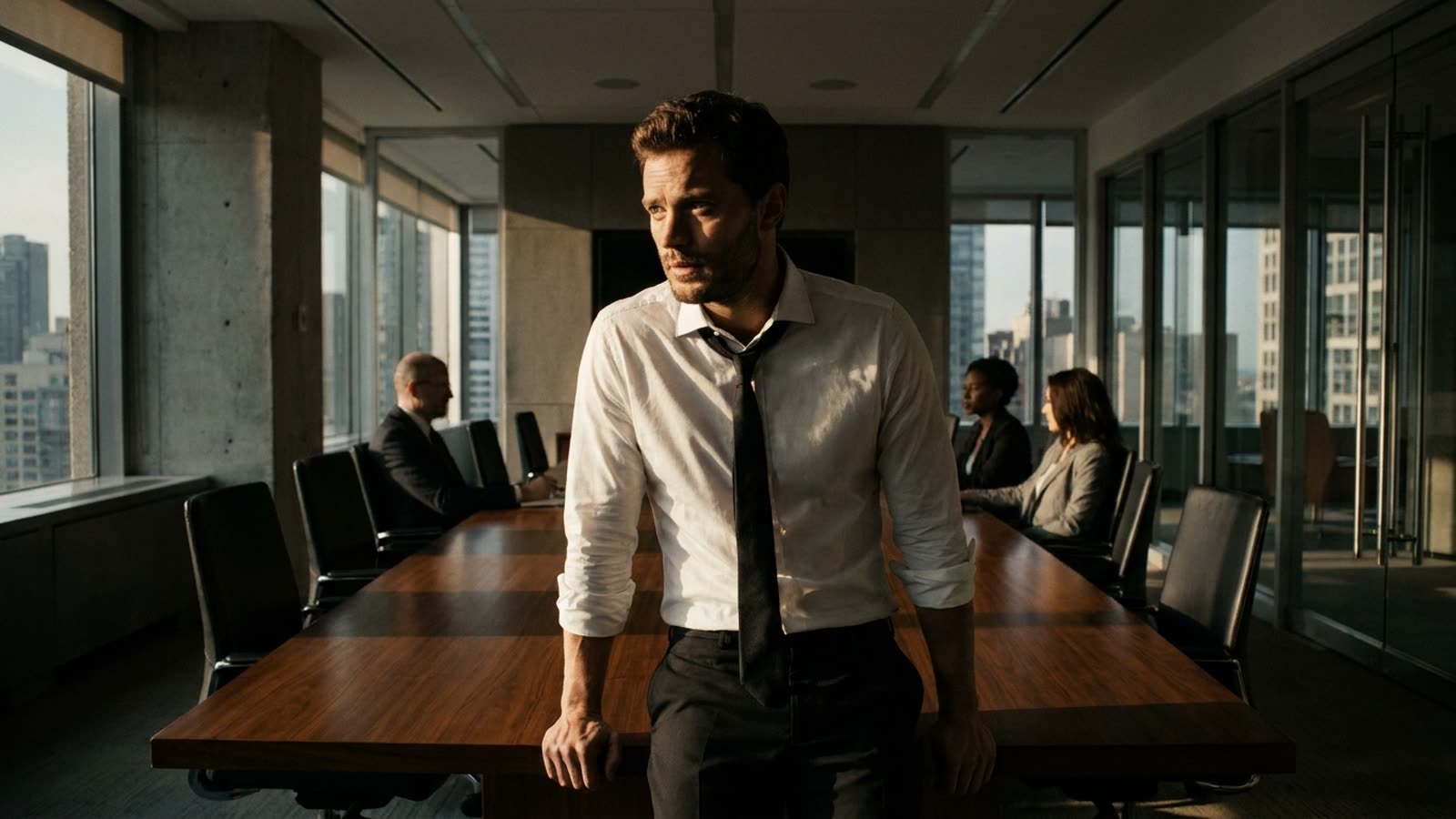
Jamie Dornan has spent the better part of a decade trying to outrun Christian Grey. With his new executive-producer role on Nostalgie, a feature expansion of Kathryn Ferguson's IFTA-winning short, he may finally have found the exit.
The film stars Aidan Gillen as a one-hit-wonder pop star confronting irrelevance in middle age, with original music by Bastille's Dan Smith and cinematography from two-time Oscar nominee Robbie Ryan. It is a small, melancholy Irish production — precisely the kind of project that announces an actor's intentions louder than any press release.
The post-franchise playbook
Dornan's trajectory mirrors a now-familiar pattern among actors who struck gold in franchise IP and then spent years seeking critical rehabilitation. Robert Pattinson did it with Good Time and The Lighthouse. Kristen Stewart did it with Personal Shopper and Spencer. The playbook is clear: attach yourself to auteurs, accept lower fees, and hope the festival circuit notices.
What distinguishes Dornan's move is the executive-producer credit. Rather than simply appearing in prestige fare, he is now actively packaging it — a signal that he wants to shape the kinds of films that get made, not just audition for them. For an actor whose most famous role required him to be, essentially, a very expensive prop, the shift is pointed.
Why Gillen, why now
Casting Aidan Gillen as a faded pop star is inspired. Gillen has spent his career playing men who believe they are smarter than everyone else — Littlefinger, Tommy Carcetti, Stuart Alan Jones — and the prospect of watching him embody delusion of a different, sadder variety is genuinely intriguing.
The project also benefits from Ferguson's eye. Her short-form work has demonstrated a facility for capturing masculine vulnerability without sentimentality, and Ryan's involvement suggests the feature will have visual ambitions beyond its modest budget. These are not the ingredients of a streaming algorithm play; they are the ingredients of a film that wants to exist at Sundance or Venice.
The Irish independent moment
Ireland is having a quiet renaissance in prestige film. The Banshees of Inisherin reminded the world that Irish stories could compete at the highest levels, and the subsequent wave of production incentives has drawn talent back to Dublin and beyond. Nostalgie slots neatly into this moment, offering a specifically Irish meditation on fame and failure that nonetheless speaks to universal anxieties about relevance and time.
For Dornan, who was born in Belfast and has spoken often about wanting to work more in Ireland, the project is also a homecoming of sorts — a chance to use whatever leverage Fifty Shades bought him in service of something closer to home.
Our take
Executive-producer credits can mean anything from genuine creative involvement to a glorified cameo fee. But the specificity of Nostalgie — its subject matter, its collaborators, its scale — suggests Dornan is not simply lending his name. He is making a statement about the kind of actor he wants to be, and more importantly, the kind of films he wants to exist. Whether audiences follow him there is another question. But the attempt itself is worth watching.