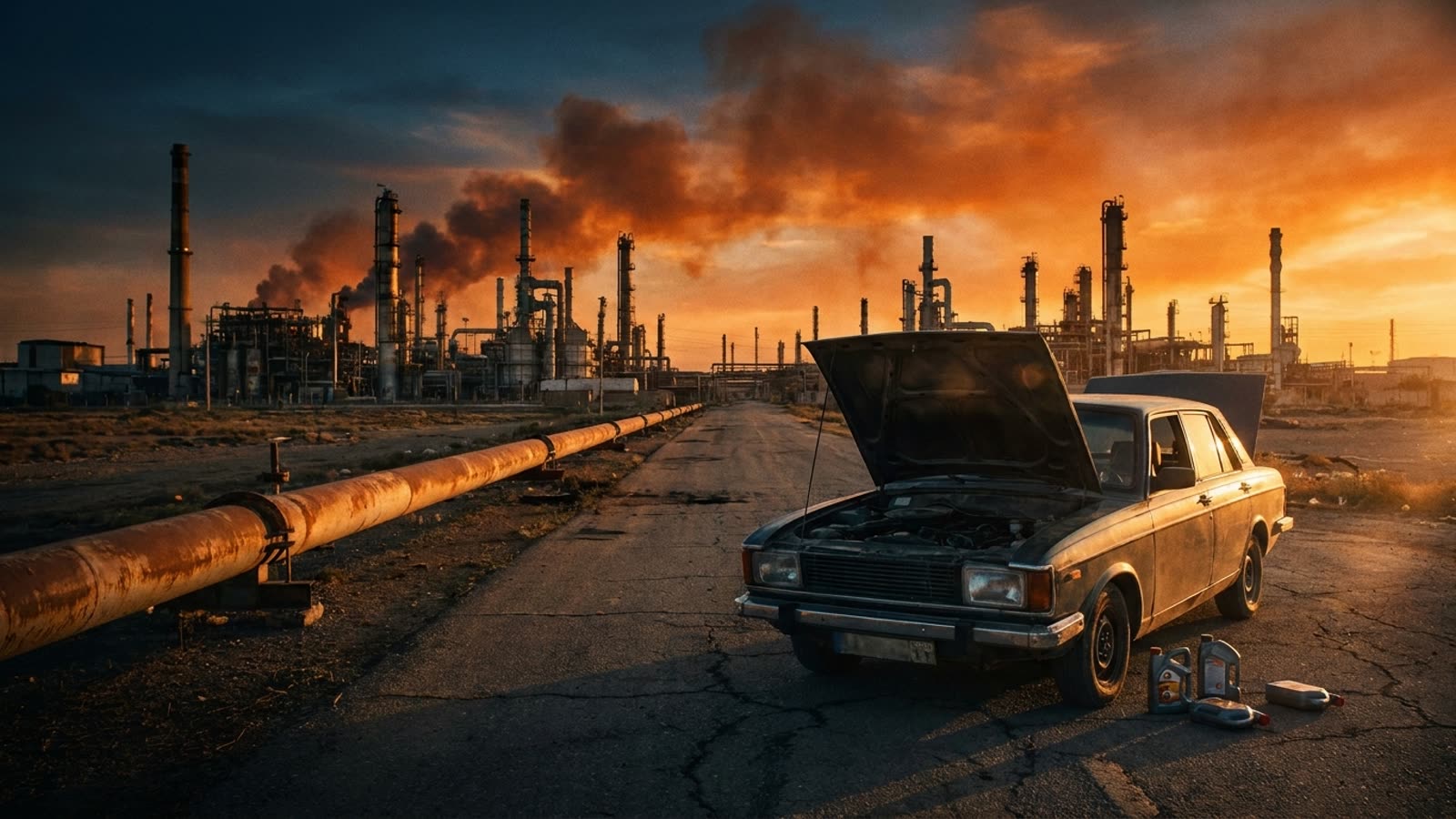
The Iran war has produced no shortage of dramatic headlines—missile strikes, carrier deployments, diplomatic ruptures—but its most consequential economic impact may be unfolding in the unglamorous aisles of auto-parts stores. Motor oil, that prosaic fluid most drivers think about twice a year, is becoming genuinely scarce, and the ripple effects promise to touch nearly every corner of the consumer economy.
The supply crunch stems from the obvious: base oil production depends heavily on refinery capacity in the Gulf region, and refineries don't operate smoothly when they're dodging cruise missiles. But the problem is compounded by less obvious factors. Additive packages—the chemical cocktails that make modern synthetic oils perform—rely on specialty chemical plants concentrated in a handful of Asian facilities, several of which have curtailed output amid shipping-insurance chaos in the Strait of Hormuz.
The logistics cascade
Motor oil isn't just for passenger vehicles. It's the lifeblood of the trucking fleet that moves 72% of American freight by tonnage. When trucking companies face rationing—or simply higher costs—those expenses propagate instantly to grocery shelves, construction sites, and Amazon delivery windows. Fleet operators are already reporting spot prices for commercial-grade lubricants up 40% since March, with allocation limits becoming common. Some regional carriers have begun parking trucks rather than paying the premium.
The agricultural sector faces particular exposure. Planting season equipment runs on diesel and hydraulic fluid, both of which share feedstock with motor oil. Farmers in the Midwest are describing a grim calculus: pay inflated prices now or risk equipment failures mid-harvest. Neither option is cheap.
Why reserves won't save us
The United States maintains a Strategic Petroleum Reserve for crude oil emergencies, but no equivalent stockpile exists for refined lubricants. The assumption has always been that refining capacity could ramp quickly enough to meet demand shocks. That assumption looks naive in retrospect. Domestic refineries are running near capacity already, and retooling for lubricant-heavy output takes months, not weeks.
Some analysts point to synthetic alternatives produced from natural gas feedstocks, but those facilities are similarly constrained. The Permian Basin produces abundant gas, yet the specialty chemical infrastructure to convert it into high-grade lubricants simply doesn't exist at scale. Building it would take years and billions in capital expenditure—investment that oil majors have been reluctant to make amid the broader energy-transition uncertainty.
Our take
This is the kind of slow-motion crisis that rewards early attention and punishes complacency. Motor oil shortages won't produce the telegenic drama of gas lines, but they'll impose a steady, grinding tax on economic activity that compounds over months. The smart money is betting that inflation metrics will reflect this by midsummer, long after the conflict's architects have moved on to other concerns. For consumers, the lesson is familiar: wars are expensive, and the bill always arrives in unexpected forms.