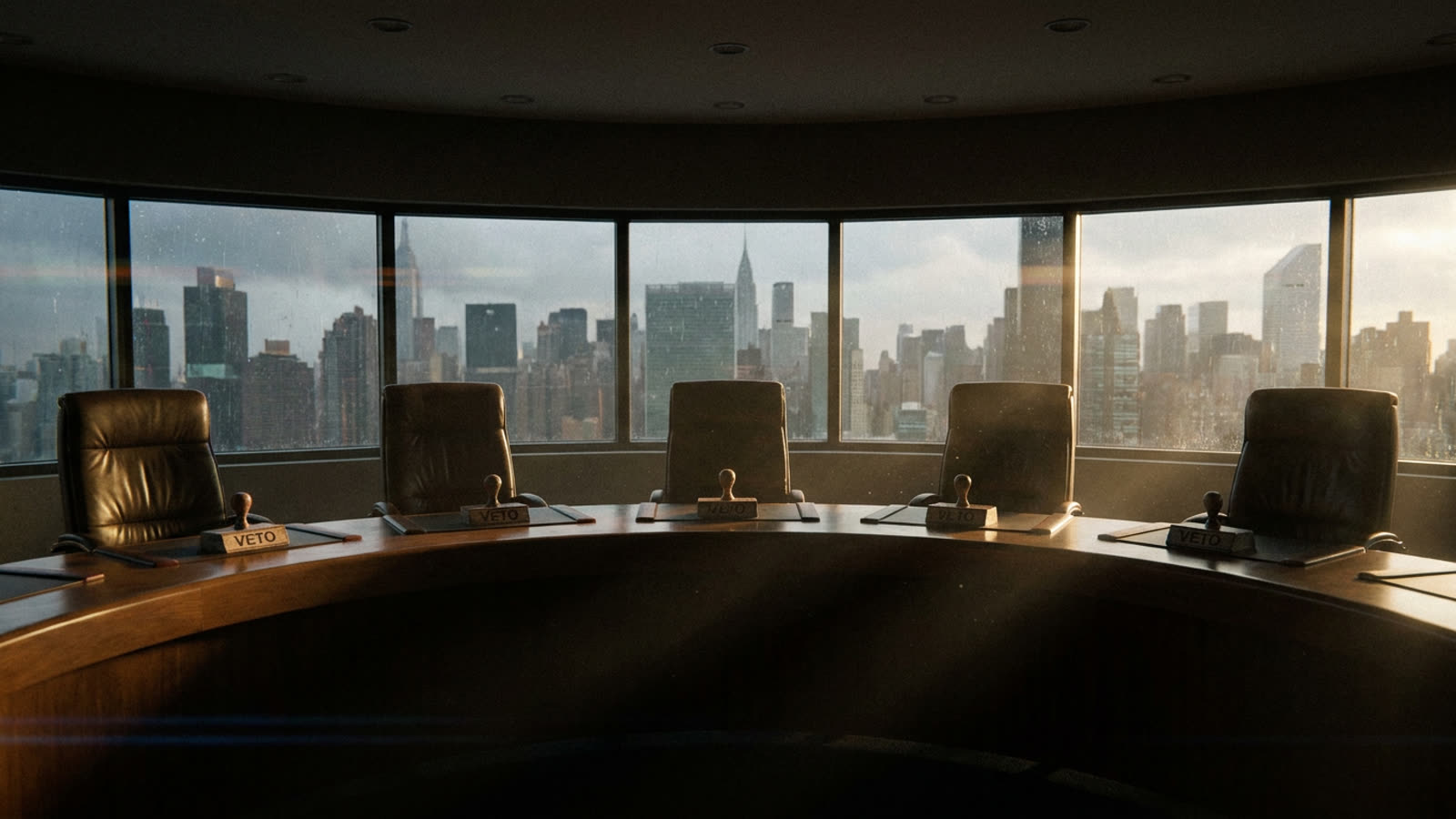
The United Nations Security Council meets in a chamber designed to project gravitas, but its most consequential moments are often the quietest: a single raised hand, a murmured objection, and months of diplomatic effort evaporate. The veto power held by the five permanent members—the United States, Russia, China, France, and the United Kingdom—is the least democratic feature of the international order, and also the most durable.
Understanding how the veto actually functions requires abandoning the notion that the Security Council exists to solve problems. It exists to manage great-power competition without direct military confrontation. Every other function is secondary.
The architecture of paralysis
The veto emerged from the wreckage of the League of Nations, which failed in part because it required unanimity among all members while lacking any mechanism to compel compliance. The architects of the UN Charter—primarily American, British, and Soviet diplomats meeting between 1944 and 1945—concluded that any effective security body needed the major powers inside the tent, even if that meant granting them extraordinary privileges.
Article 27 of the Charter requires nine affirmative votes for any substantive resolution, with no negative vote from any permanent member. The language is deliberately oblique: the Charter never uses the word "veto." But the effect is absolute. A single permanent member can block any resolution on matters of international peace and security, regardless of how the other fourteen Council members vote.
The practical result is that the Security Council can act decisively only when the permanent five agree, or when none of them cares enough to object. This explains the Council's peculiar pattern of intervention: robust action in places like Kuwait in 1990 or Libya in 2011, paralysis over Syria, Gaza, or Ukraine.
The shadow veto
The formal veto—a negative vote cast in public session—is actually the least common form of obstruction. Far more resolutions die in what diplomats call "informal consultations," the closed-door meetings where the real negotiations occur. A permanent member need only signal that it will veto a draft for that draft to be withdrawn or watered down beyond recognition.
This shadow veto is impossible to quantify but vastly more consequential than the public record suggests. Resolutions that might embarrass a permanent member or its allies rarely reach the formal voting stage. The threat alone reshapes what is politically conceivable.
The numbers that do exist are revealing. Russia has cast more vetoes than any other permanent member since the Cold War ended, frequently to shield the Assad regime in Syria or to block criticism of its own military actions. The United States has used its veto most often to protect Israel from censure. China, historically the most veto-averse permanent member, has grown more willing to deploy the power in recent years, often in tandem with Russia.
Reform is a fantasy, but not because of inertia
Every few years, proposals circulate to reform or abolish the veto. Brazil, Germany, India, and Japan have lobbied for permanent seats. Various academics have suggested requiring two vetoes to block a resolution, or limiting veto use in cases of mass atrocity. None of these proposals has any realistic prospect of adoption.
The reason is structural, not political. Amending the UN Charter requires ratification by two-thirds of member states, including all five permanent members. No permanent member will voluntarily surrender or dilute its veto power. The system is designed to be unchangeable by the very actors who would need to change it.
Our take
The veto is not a bug in the international system; it is the system. It reflects an honest assessment that great powers will not submit to rules they cannot control, and that the alternative to managed hypocrisy is unmanaged conflict. Critics who demand its abolition are really demanding a different world order, one in which sovereignty is conditional and enforcement is genuine. That world may be more just, but it is not the one we inhabit, and pretending otherwise is its own form of evasion.