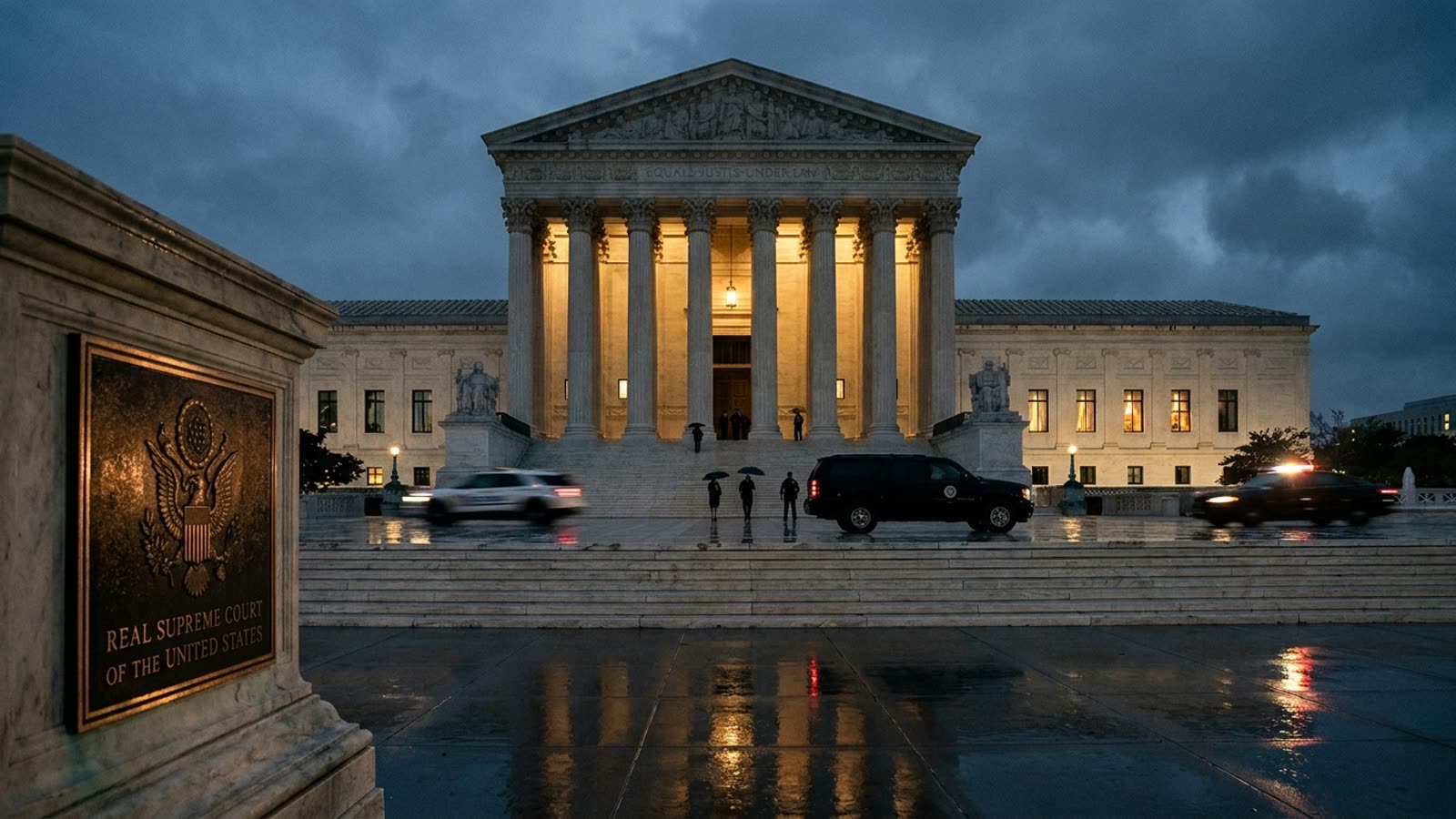
For most of its history, the Supreme Court operated on a stately rhythm: cases arrived, lawyers filed briefs, justices heard arguments, and months later, lengthy opinions explained the reasoning behind each decision. That process still exists. But increasingly, the Court's most consequential interventions happen through a parallel system that skips nearly all of it—a procedural backdoor that legal scholars have come to call the shadow docket.
The term encompasses the thousands of orders the Court issues each year outside its regular merits docket: emergency applications, stays of execution, injunctions blocking or allowing laws to take effect. These decisions often arrive in the middle of the night, with no oral argument, limited briefing, and frequently no written explanation beyond a single sentence. A law that took years to pass can be frozen—or unfrozen—in hours.
The mechanics of emergency power
The shadow docket is not new. The Court has always handled emergency matters. What has changed is the frequency and stakes of its use. Applications for emergency relief that once numbered in the dozens annually now arrive in the hundreds. More critically, the Court has increasingly used these expedited procedures not merely to preserve the status quo while litigation proceeds, but to effectively decide the merits of cases before they are fully heard.
The process typically begins when a party asks a single justice—usually the one assigned to oversee a particular federal circuit—to intervene urgently. That justice can act alone or refer the matter to the full Court. Responses are due in days, sometimes hours. There is no oral argument. The justices vote, and an order issues. Often, the only public record is a brief notation: "Application granted" or "Application denied." Sometimes a justice will write a dissent or concurrence, offering a glimpse into the reasoning. But the majority rarely explains itself.
Why it matters beyond legal circles
The shadow docket's expansion has real consequences for ordinary citizens. Major policies on immigration enforcement, pandemic-era eviction moratoriums, and religious exemptions from public health orders have all been shaped by emergency orders rather than fully reasoned opinions. In several instances, the Court has effectively allowed laws to take effect—or blocked them—without ever ruling on their constitutionality in a traditional sense.
This matters because the legitimacy of judicial review rests partly on transparency. When the Court issues a fifty-page opinion, observers can scrutinize the logic, identify inconsistencies, and hold the institution accountable. When it issues a one-sentence order at midnight, that scrutiny becomes impossible. Lower courts, tasked with applying the decision, are left to guess at the reasoning. Lawyers struggle to advise clients. The law becomes less predictable.
Our take
The shadow docket is not inherently illegitimate—emergencies do require emergency procedures. But the Court's increasing willingness to use these tools for matters of profound national importance, without explanation, represents a quiet erosion of judicial accountability. Transparency is not a luxury in a democracy; it is the mechanism by which citizens evaluate whether power is being exercised fairly. The justices may prefer the efficiency of unexplained orders. The rest of us should be asking what is lost when the nation's highest court decides its most contentious questions in the dark.