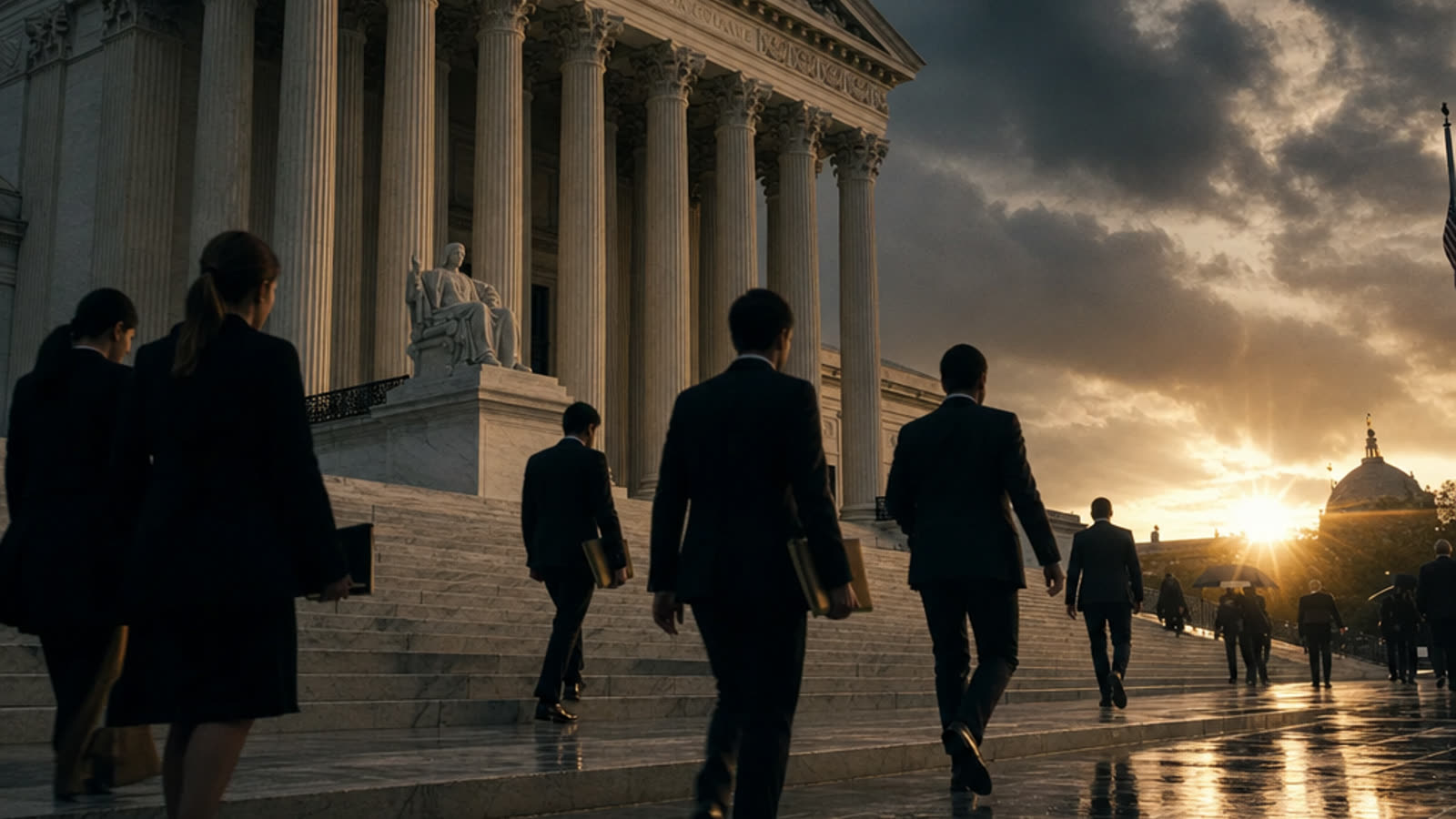
The nine justices of the United States Supreme Court decide roughly sixty to seventy cases per term. But they receive more than seven thousand petitions annually, meaning someone must sort the consequential from the frivolous. That someone is not a justice. It is a twenty-six-year-old with a prestigious law degree, working hundred-hour weeks in a cramped office, earning a government salary that will soon be dwarfed by a signing bonus from a corporate law firm. The Supreme Court clerkship is the legal profession's most coveted credential, and its occupants exercise a form of power that sits awkwardly in a democracy: unelected, unconfirmed, and largely invisible.
The modern clerkship system dates to the late nineteenth century, when Justice Horace Gray began hiring Harvard Law graduates to assist with research. What started as administrative support evolved into something more substantive. Today, each justice typically employs four clerks per term, selected through an opaque process that privileges graduates of a handful of elite law schools—Harvard, Yale, Stanford, and Chicago dominate the rolls—and prior clerkships with influential appellate judges. The pipeline is narrow and self-reinforcing.
The cert pool and its gatekeepers
The clerks' most consequential task may be the least visible. Eight of the nine justices participate in what is called the "cert pool," a system where clerks divide the thousands of petitions for certiorari among themselves and write memoranda recommending whether the Court should hear each case. A single clerk's assessment can determine whether a constitutional question reaches the justices' conference or dies in obscurity. The pool was created in the early 1970s as a labor-saving measure, but critics argue it concentrates too much discretion in too few hands. Justice Samuel Alito, before his retirement announcement, was the lone holdout from the pool, preferring his own clerks review every petition—a choice that speaks to the system's contested legitimacy.
Opinion drafting and ideological formation
Once a case is decided, clerks typically produce the first draft of the majority, concurring, or dissenting opinions. Justices revise to varying degrees—some are hands-on editors, others delegate extensively—but the initial framing often survives. This means a clerk's interpretive instincts can shape how a constitutional principle is articulated for generations. The relationship is symbiotic: justices select clerks whose judicial philosophies align with their own, and clerks emerge from the experience with their ideological commitments sharpened. The Federalist Society and American Constitution Society have become informal sorting mechanisms, ensuring that clerks arrive pre-vetted for compatibility.
The golden ticket and its rewards
A Supreme Court clerkship functions as a credentialing superweapon. Major law firms routinely offer signing bonuses exceeding four hundred thousand dollars to former clerks. Academic positions, government appointments, and partnerships follow with unusual ease. The alumni network is dense and powerful: Chief Justice John Roberts clerked for Chief Justice William Rehnquist; Justice Elena Kagan clerked for Justice Thurgood Marshall. The institution reproduces itself through these lineages, creating a legal aristocracy that shapes doctrine, trains future judges, and populates the upper echelons of the bar.
Our take
The clerkship system is brilliant and troubling in equal measure. It channels extraordinary talent toward public service, at least temporarily, and exposes young lawyers to the craft of judging at its highest level. But it also concentrates power in a remarkably homogeneous group, selected through processes that favor pedigree over diversity of experience. The Court's legitimacy depends partly on the perception that its decisions emerge from the justices themselves, not from a rotating cast of elite graduates. Greater transparency about clerks' roles—and broader recruitment beyond the usual feeder schools—would not diminish the institution. It might strengthen it.