Every four years, Americans participate in what they believe is a direct election for president. They are mistaken. The presidency is decided by 538 electors whose existence most voters barely register, whose names appear on no ballot in most states, and whose collective arithmetic has overridden the national popular vote twice in the past quarter-century. The Electoral College is not an anachronism waiting to be reformed; it is the active operating system of American presidential politics, and its logic dictates everything from campaign spending to policy promises.
The system's influence begins long before Election Day. Because nearly every state awards all its electoral votes to whichever candidate wins the state's popular vote—the winner-take-all method—campaigns rationally concentrate resources on the handful of states where outcomes are uncertain. A Republican vote in California or a Democratic vote in Oklahoma is, for practical purposes, irrelevant to the final count. This is not a bug in the system; it is the system.
The arithmetic of attention
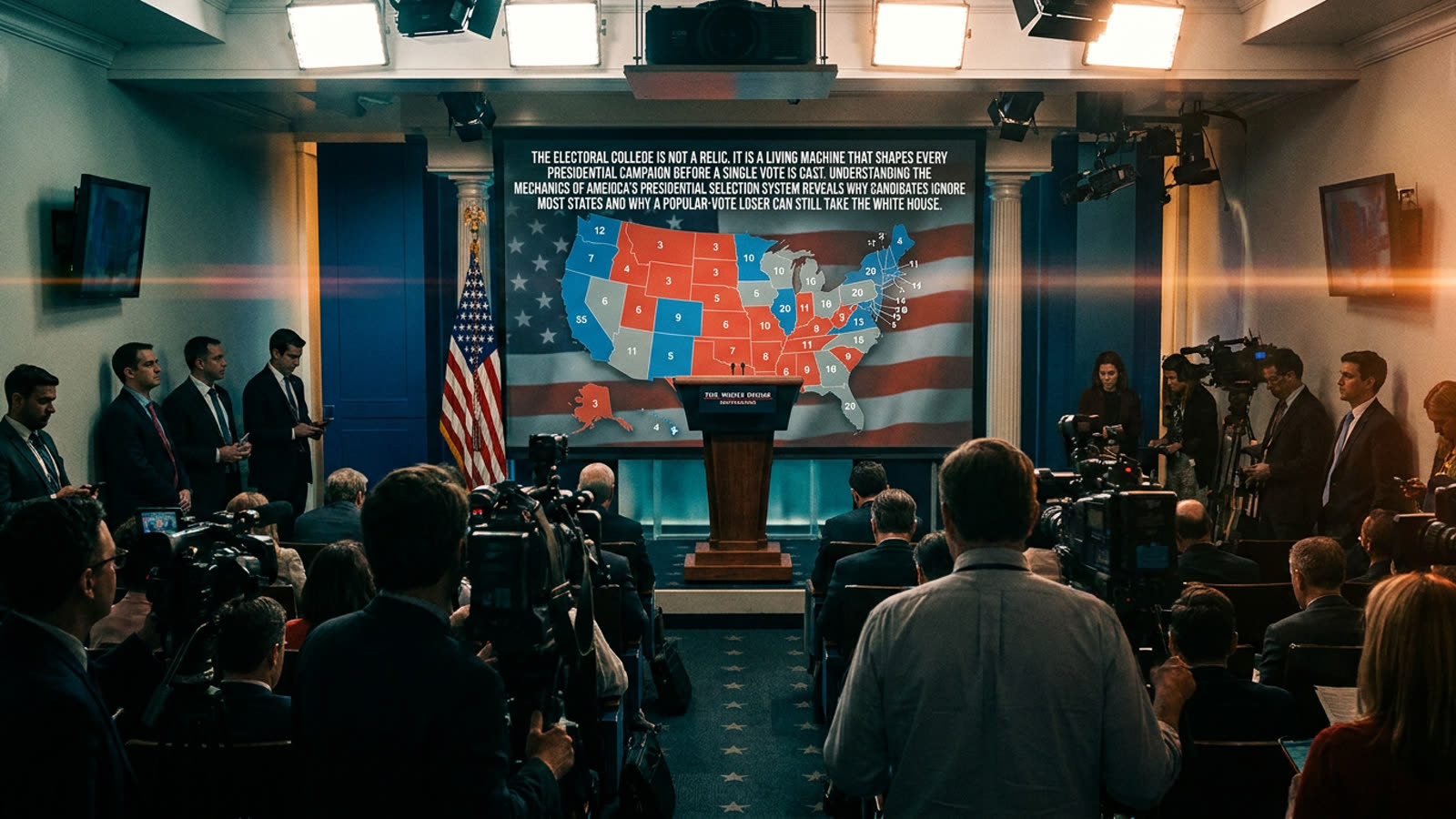
The magic number is 270—a bare majority of the 538 total electors. Each state's electoral count equals its congressional delegation: two senators plus its House representatives, which are apportioned by population. This formula gives small states disproportionate weight per capita. Wyoming, with fewer than 600,000 residents, commands three electoral votes, or roughly one per 190,000 people. California's 54 electoral votes represent one per 730,000 residents. The Senate bonus baked into the formula ensures that rural, less populous states punch above their demographic weight.
The winner-take-all allocation—used by 48 states and the District of Columbia—amplifies this distortion. A candidate who wins Florida by a single vote claims all 30 of its electoral votes, the same haul as if they had won by two million. Nebraska and Maine split their votes by congressional district, a quirk that occasionally delivers a stray elector to the losing statewide candidate but rarely alters the national outcome.
When the math breaks
The system's most controversial feature is its capacity to elect a president who lost the popular vote. This occurred in 2000 and again in 2016, producing presidencies that a plurality of voters opposed. Critics call this a democratic failure; defenders argue the framers never intended a national plebiscite. The Constitution's architects feared both direct democracy and congressional selection, settling on an intermediary body of notionally independent electors. That independence has eroded—most states now bind electors to vote as pledged—but the structural logic remains: the presidency is won state by state, not citizen by citizen.
The contingency procedures are even stranger. If no candidate reaches 270, the House of Representatives selects the president, with each state delegation casting a single vote regardless of population. This has happened twice, in 1800 and 1824, and the prospect of a deadlocked Electoral College periodically haunts close races.
Our take
The Electoral College is neither sacred nor accidental. It is a deliberate eighteenth-century compromise that continues to shape twenty-first-century politics in ways most voters never examine. Whether one views it as a federalist safeguard or a democratic defect, understanding its mechanics is prerequisite to understanding American presidential campaigns. Candidates do not chase voters; they chase electors. Until that changes—and constitutional amendments are notoriously difficult—the map, not the majority, will keep choosing presidents.