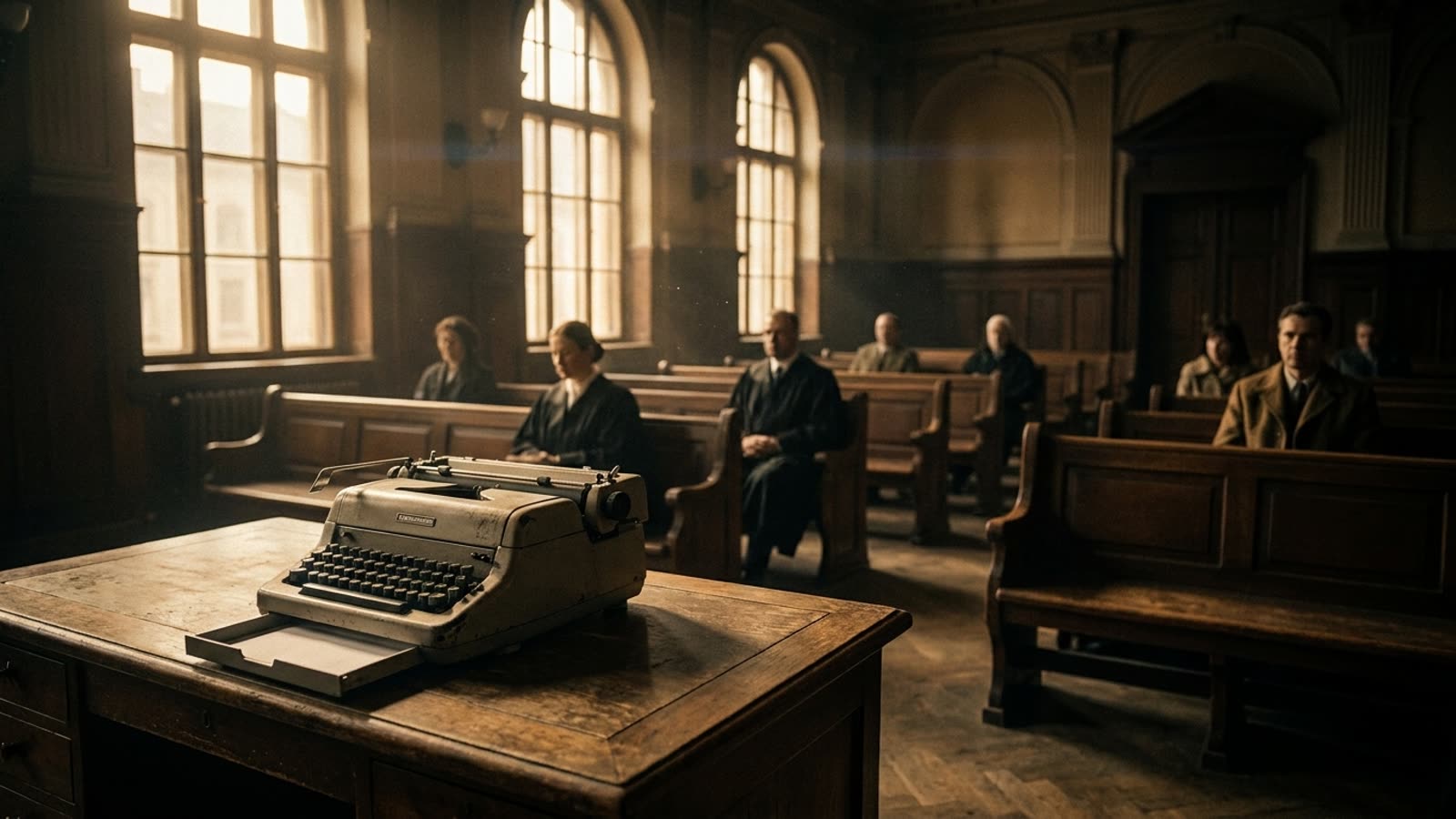
For more than a century, the court reporter has been the invisible guarantor of legal truth. Sitting below the judge's bench, fingers dancing across a stenotype machine at speeds exceeding 200 words per minute, these professionals have produced the official record upon which appeals are won, precedents are set, and justice is theoretically served. Now, that role is being quietly dismantled by software that costs a fraction of a human salary and never asks for a bathroom break.
The transition has been gradual but accelerating. Jurisdictions facing chronic shortages of certified court reporters—a problem decades in the making as training programs shuttered and young people declined to spend years mastering an arcane skill—have turned to automated transcription as a practical necessity rather than an ideological choice. The technology has improved dramatically; modern systems can handle multiple speakers, filter ambient noise, and produce rough transcripts in real time. For routine proceedings, the output is often serviceable.
The accuracy question nobody wants to answer
Serviceable, however, is not the standard the legal system claims to uphold. Court reporters routinely achieve accuracy rates above 99 percent, a threshold that remains elusive for automated systems in adversarial environments where speakers interrupt each other, use technical jargon, speak with regional accents, or simply mumble. More critically, human reporters can stop proceedings to request clarification—a function no algorithm performs. When a witness's crucial admission is garbled into nonsense, the software simply moves on.
The error rate matters less in a traffic court than in a capital murder trial, but the same technology is being deployed across both. Budget-strapped court systems rarely implement the kind of tiered approach that would reserve human reporters for high-stakes proceedings. The logic of cost savings, once embraced, tends to be applied universally.
What gets lost in translation
Beyond accuracy lies a subtler concern. Experienced court reporters develop an institutional memory that no transcript captures. They know when a witness is being evasive, when an attorney's question is improper, when the judge's patience is fraying. They serve as informal archivists of courtroom culture, sometimes catching procedural errors before they compound. This tacit knowledge, accumulated over careers spanning decades, cannot be uploaded to a cloud server.
The profession itself is aging out. The average court reporter is well into middle age, and accredited training programs have dwindled from dozens to a handful. Young people who might once have pursued the career now see a field under technological siege and choose differently. This creates a self-fulfilling prophecy: the shortage that justified automation becomes permanent because automation eliminated the incentive to train replacements.
Our take
The replacement of court reporters by AI is being framed as an inevitability, but inevitabilities are often choices dressed in the language of fate. The legal system's legitimacy rests on the premise that what happens in courtrooms is recorded with meticulous care, that the official record is worthy of the name. Automated transcription may be adequate for many purposes, but adequacy is a curious aspiration for institutions that exist to adjudicate matters of liberty and property. The stenographer's art is dying not because it failed, but because we decided it was too expensive to preserve. That decision will echo through appellate courts for decades.